Industry-Verified Manufacturing Data (2026)

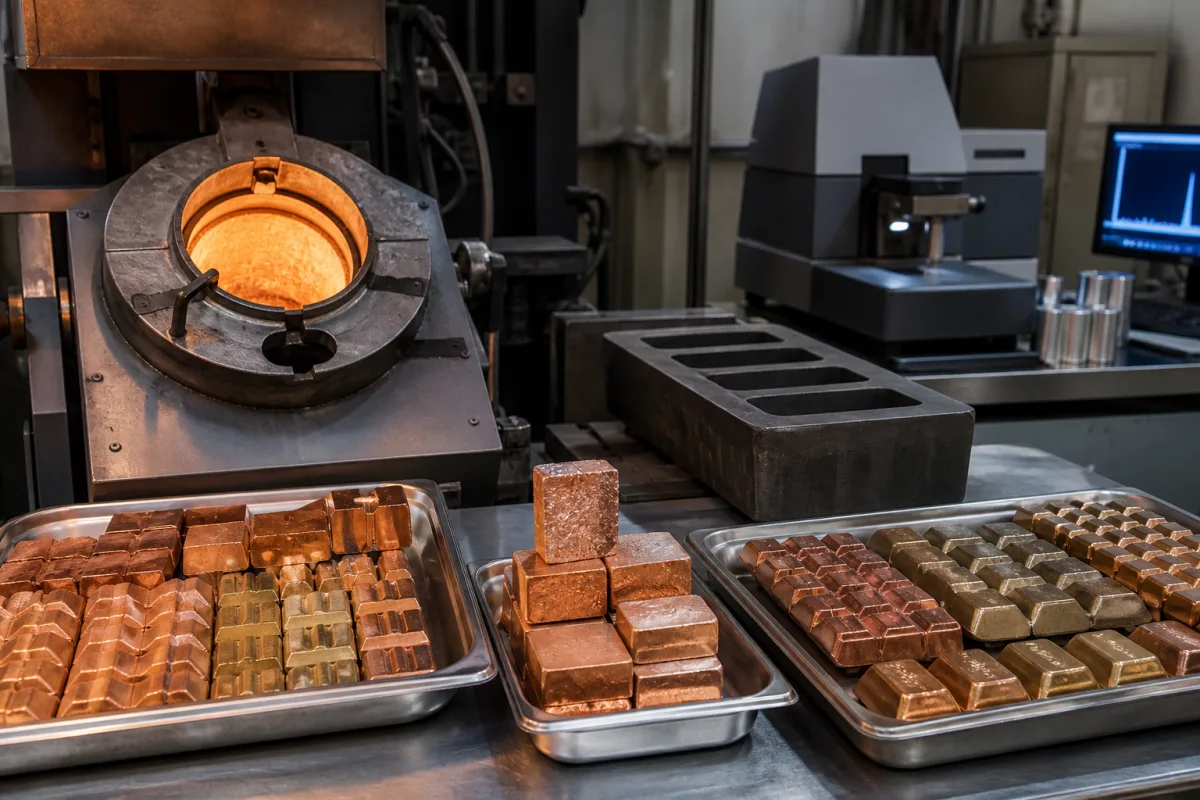
High-Purity Copper Alloy Master Alloy

Based on aggregated insights from multiple verified factory profiles within the CNFX directory, the standard High-Purity Copper Alloy Master Alloy used in the Basic Metal Manufacturing sector typically supports operational capacities ranging from standard industrial configurations to heavy-duty production requirements.

Technical Definition & Core Assembly

A canonical High-Purity Copper Alloy Master Alloy is characterized by the integration of Copper Matrix and Alloying Elements. In industrial production environments, manufacturers listed on CNFX commonly emphasize Electrolytic copper construction to support stable, high-cycle operation across diverse manufacturing scenarios.

Pre-alloyed copper-based material for precise composition control in non-ferrous metal production
Product Specifications

Technical details and manufacturing context for High-Purity Copper Alloy Master Alloy

Definition
High-purity copper alloy master alloy is a pre-melted, homogeneous material containing carefully controlled proportions of alloying elements such as tin, zinc, nickel, or silicon in a copper matrix. It serves as a precise addition agent in secondary smelting and refining processes to achieve exact chemical compositions in final copper alloys. This material eliminates segregation issues and ensures uniform distribution of alloying elements throughout the melt. It significantly reduces melting time and energy consumption compared to adding pure elements separately. Master alloys enable manufacturers to produce consistent, high-quality copper alloys with repeatable mechanical and electrical properties.
Working Principle
The master alloy dissolves uniformly into the molten base metal, releasing alloying elements in controlled proportions to achieve target composition without segregation or oxidation losses.
Common Materials
Electrolytic copper, High-purity alloying elements (Sn, Zn, Ni, Si)
Technical Parameters
  • Minimum copper purity in master alloy (%) Customizable
  • Concentration range of primary alloying element (%) Customizable
Components / BOM
  • Copper Matrix
    Primary metallic base carrying alloying elements
    Material: High-purity electrolytic copper
  • Alloying Elements
    Provide specific mechanical, electrical, or corrosion properties
    Material: Tin, zinc, nickel, silicon, or phosphorus
  • Grain Refiner Optional
    Control microstructure during solidification
    Material: Titanium-boron or zirconium compounds
Engineering Reasoning
Melting temperature: 1083-1200°C, Compositional tolerance: ±0.15 wt% for alloying elements, Density: 8.94-9.05 g/cm³
Segregation coefficient deviation >0.25, Intermetallic phase formation at >1.5 vol%, Oxygen content >50 ppm causing embrittlement
Design Rationale: Gibbs free energy minimization driving phase separation, Constitutional supercooling causing dendritic segregation, Kirkendall effect at diffusion interfaces
Risk Mitigation (FMEA)
Trigger Incomplete dissolution of alloying elements during master alloy production
Mode: Compositional inhomogeneity exceeding ±0.3 wt% in final product
Strategy: Electromagnetic stirring at 50-100 Hz during induction melting, Isothermal holding at 1150°C for 30 minutes minimum
Trigger Oxygen partial pressure >10^-3 atm during processing
Mode: Cu₂O formation at grain boundaries exceeding 0.5 vol%
Strategy: Argon gas shielding with <10 ppm O₂, Phosphorus deoxidation to maintain <20 ppm residual oxygen

Industry Taxonomies & Aliases

Commonly used trade names and technical identifiers for High-Purity Copper Alloy Master Alloy.

Industrial Ecosystem & Supply Chain DNA

Complementary Systems
Downstream Applications
Specialized Tooling

Application Fit & Sizing Matrix

Operational Limits
pressure: Atmospheric to 1.5 bar (typical foundry conditions)
temperature: Ambient to 1200°C (melting point dependent on alloy composition)
addition rate: 0.1-5.0% by weight of final melt
slurry concentration: Not applicable (solid master alloy addition)
Media Compatibility
✓ Copper-based alloys (bronze, brass) ✓ Aluminum-copper alloys ✓ Nickel-copper alloys
Unsuitable: Sulfur-containing environments (causes hot shortness)
Sizing Data Required
  • Target final alloy composition (%)
  • Base metal batch size (kg)
  • Required purity level (e.g., 99.99%)

Reliability & Engineering Risk Analysis

Failure Mode & Root Cause
Intergranular corrosion
Cause: Exposure to oxidizing acids or high-temperature oxidizing atmospheres, leading to preferential attack along grain boundaries due to microstructural segregation of alloying elements.
Stress corrosion cracking
Cause: Combined action of tensile stress (residual or applied) and corrosive environments containing ammonia, sulfur compounds, or moisture, particularly in high-purity alloys with specific metallurgical conditions.
Maintenance Indicators
  • Greenish-blue corrosion products (verdigris) forming on surfaces exposed to moisture or chemical environments
  • Audible cracking or popping sounds during thermal cycling or mechanical loading indicating crack propagation
Engineering Tips
  • Implement strict environmental control to prevent exposure to ammonia, sulfur compounds, and acidic contaminants, particularly in processing and storage areas.
  • Apply controlled annealing treatments to relieve residual stresses and optimize grain structure, followed by proper handling to prevent reintroduction of stress during installation.

Compliance & Manufacturing Standards

Reference Standards
ASTM B224-21: Standard Classification of Coppers ISO 1190-1:2012: Copper and copper alloys - Designation system DIN 17660-1:1991: Copper alloys; master alloys; chemical composition
Manufacturing Precision
  • Chemical composition: +/- 0.5% for alloying elements
  • Particle size distribution: 90% within 0.5-3.0mm range
Quality Inspection
  • Optical Emission Spectrometry (OES) for chemical composition verification
  • Microstructure analysis for homogeneity and inclusion assessment

Factories Producing High-Purity Copper Alloy Master Alloy

Verified manufacturers with capability to produce this product in China

✓ 98% Supplier Capability Match Found

T Technical Director from Singapore Jan 31, 2026
★★★★★
"Reliable performance in harsh Basic Metal Manufacturing environments. No issues with the High-Purity Copper Alloy Master Alloy so far."
Technical Specifications Verified
P Project Engineer from Germany Jan 28, 2026
★★★★☆
"Testing the High-Purity Copper Alloy Master Alloy now; the Copper Purity (%) results are within 1% of the laboratory datasheet. (Delivery took slightly longer than expected, but technical support was excellent.)"
Technical Specifications Verified
S Sourcing Manager from Brazil Jan 25, 2026
★★★★★
"Impressive build quality. Especially the Copper Purity (%) is very stable during long-term operation."
Technical Specifications Verified
Verification Protocol

“Feedback is collected from verified sourcing managers during RFQ (Request for Quote) and factory evaluation processes on CNFX. These reports represent historical performance data and technical audit summaries from our B2B manufacturing network.”

6 sourcing managers are analyzing this specification now. Last inquiry for High-Purity Copper Alloy Master Alloy from USA (1h ago).

Supply Chain Commonly Integrated Components

Infrared Pyrometer

A non-contact temperature measurement device that detects infrared radiation emitted by objects to determine their surface temperature.

Explore Specs →
Signal Processor

Electronic device that conditions, amplifies, filters, and converts raw sensor signals into standardized outputs for temperature measurement systems

Explore Specs →
Purge Air System

A system that provides controlled airflow to clear optical paths and protect sensors in molten metal temperature measurement applications.

Explore Specs →
Degassing Chamber

A specialized vessel within a molten metal degassing system where dissolved gases are removed from molten metal through controlled processes.

Explore Specs →

Frequently Asked Questions

What are the primary applications of high-purity copper alloy master alloys?

High-purity copper alloy master alloys are used in non-ferrous metal production for precise composition control in casting, extrusion, and forging processes, ensuring consistent mechanical properties and reducing defects in final products.

How does the impurity level affect the performance of copper master alloys?

Low impurity levels (measured in ppm) are critical for maintaining electrical conductivity, corrosion resistance, and mechanical strength in final copper alloys, making high-purity master alloys essential for demanding applications like electrical components and marine environments.

What factors determine the melting point of a copper alloy master alloy?

The melting point depends on the primary alloying elements (Sn, Zn, Ni, Si) and their percentages, with copper purity and specific composition ratios creating tailored melting characteristics for different production processes like continuous casting or batch melting.

Can I contact factories directly on CNFX?

CNFX is an open directory, not a transaction platform. Each factory profile provides direct contact information and production details to help you initiate direct inquiries with Chinese suppliers.

Get Quote for High-Purity Copper Alloy Master Alloy

Request technical pricing, lead times, or customized specifications for High-Purity Copper Alloy Master Alloy directly from verified manufacturing units.

Your business information is encrypted and only shared with verified High-Purity Copper Alloy Master Alloy suppliers.

Thank you! Your message has been sent. We'll respond within 1–3 business days.

Need to Manufacture High-Purity Copper Alloy Master Alloy?

Connect with verified factories specializing in this product category

Add Your Factory Contact Us
Previous Product
High-Purity Copper Alloy Continuous Casting Billet
Next Product
High-Purity Copper Cathode