Industry-Verified Manufacturing Data (2026)

High-Purity Copper Rod for Electrical Applications

Based on aggregated insights from multiple verified factory profiles within the CNFX directory, the standard High-Purity Copper Rod for Electrical Applications used in the Basic Metal Manufacturing sector typically supports operational capacities ranging from standard industrial configurations to heavy-duty production requirements.

Technical Definition & Core Assembly

A canonical High-Purity Copper Rod for Electrical Applications is characterized by the integration of Copper Core and Surface Oxide Layer. In industrial production environments, manufacturers listed on CNFX commonly emphasize Electrolytic Copper construction to support stable, high-cycle operation across diverse manufacturing scenarios.

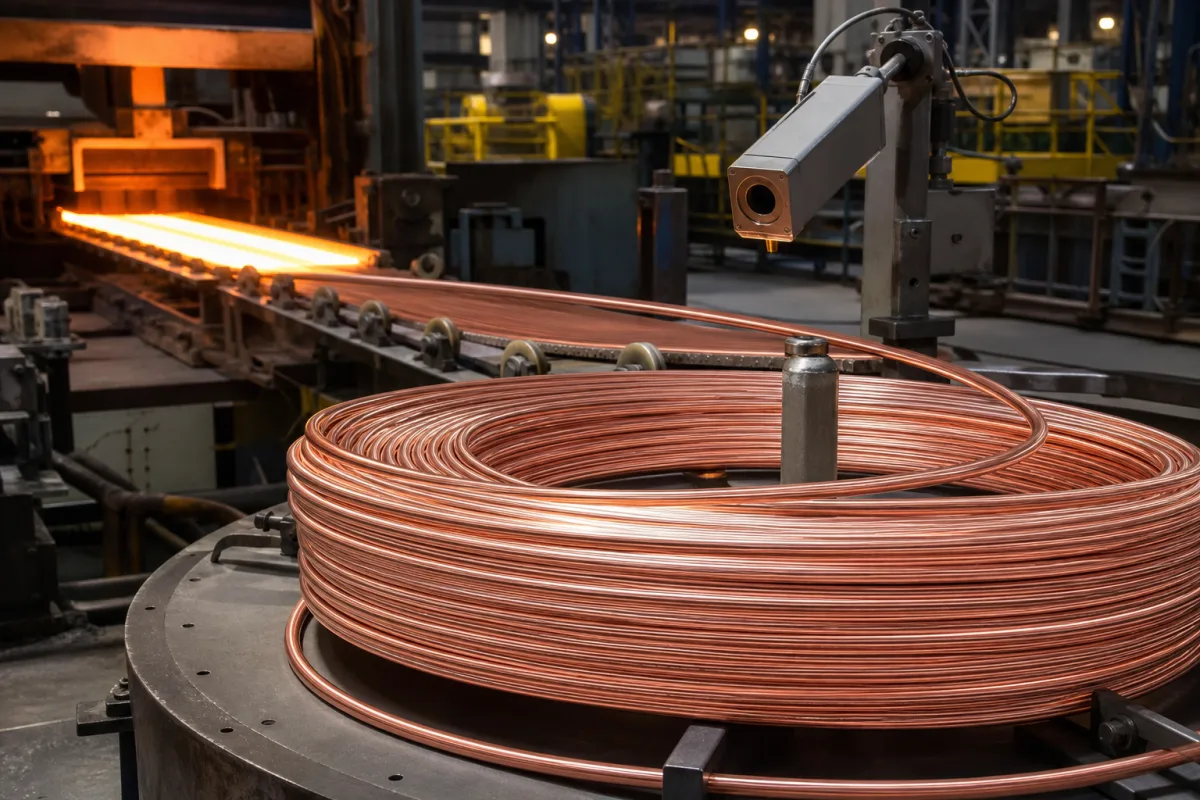
High-conductivity copper rod for electrical wire and cable manufacturing

Product Specifications

Technical details and manufacturing context for High-Purity Copper Rod for Electrical Applications

Definition
High-purity copper rod is a semi-finished industrial material produced through continuous casting and rolling processes. It serves as the primary feedstock for drawing electrical wires, cables, and conductors due to its excellent electrical conductivity and mechanical properties. This material undergoes strict quality control to ensure minimal impurities that could degrade electrical performance. It's essential for power transmission, automotive wiring, and electrical equipment manufacturing industries.
Working Principle
Copper rod functions as a conductive medium by allowing electron flow with minimal resistance, making it ideal for electrical current transmission applications.
Common Materials
Electrolytic Copper, Oxygen-Free Copper
Technical Parameters
  • Rod diameter specification (mm) Per Request
  • Electrical conductivity percentage (IACS %) Per Request
Components / BOM
  • Copper Core
    Primary conductive element providing electrical pathway
    Material: High-purity copper
  • Surface Oxide Layer Optional
    Natural protective coating preventing excessive corrosion
    Material: Copper oxide
Engineering Reasoning
Electrical conductivity: 5.96×10⁷-5.98×10⁷ S/m at 20°C, Temperature: -50°C to 150°C, Current density: 0-3.0×10⁶ A/m²
Annealing temperature: 200°C (permanent conductivity loss), Recrystallization threshold: 150°C (grain structure degradation), Current density: 3.2×10⁶ A/m² (electromigration onset)
Design Rationale: Thermal annealing at 200°C causes irreversible dislocation annihilation and grain growth, reducing electron mean free path from 40 nm to 25 nm, decreasing conductivity by 15%
Risk Mitigation (FMEA)
Trigger Localized Joule heating exceeding 200°C due to contact resistance of 50 μΩ·cm²
Mode: Microstructural recrystallization reducing conductivity from 5.96×10⁷ to 4.8×10⁷ S/m
Strategy: Silver-plated terminations with contact resistance <5 μΩ·cm² and thermal interface material with 8 W/m·K conductivity
Trigger Electromigration at current density >3.2×10⁶ A/m² with activation energy of 1.2 eV
Mode: Void formation at grain boundaries causing 30% cross-sectional area reduction
Strategy: Grain boundary engineering with phosphorus doping at 0.02 wt% and current density derating to 2.5×10⁶ A/m²

Industry Taxonomies & Aliases

Commonly used trade names and technical identifiers for High-Purity Copper Rod for Electrical Applications.

Industrial Ecosystem & Supply Chain DNA

Complementary Systems
Downstream Applications
Specialized Tooling

Application Fit & Sizing Matrix

Operational Limits
pressure: Atmospheric to 1000 psi (depending on insulation/coating)
other spec: Conductivity: ≥100% IACS (International Annealed Copper Standard), Purity: ≥99.9% Cu
temperature: -50°C to 200°C (continuous), up to 300°C (short-term)
Media Compatibility
✓ Dry air/nitrogen environments ✓ Transformer oil insulation systems ✓ PVC/XLPE cable insulation materials
Unsuitable: Ammonia-containing or high-sulfur atmospheres (causes stress corrosion cracking)
Sizing Data Required
  • Required current carrying capacity (Amps)
  • Maximum allowable voltage drop (Volts)
  • Installation environment temperature (Celsius)

Reliability & Engineering Risk Analysis

Failure Mode & Root Cause
Surface oxidation and corrosion
Cause: Exposure to moisture, humidity, or corrosive atmospheres leading to formation of non-conductive oxide layers (e.g., cuprous oxide) and pitting, increasing electrical resistance and reducing conductivity.
Work hardening and microcracking
Cause: Repeated thermal cycling, mechanical stress from bending/vibration, or improper handling during installation/operation causing localized hardening, embrittlement, and crack initiation that can propagate under load.
Maintenance Indicators
  • Visible greenish patina (verdigris) or dark discoloration on rod surface indicating active corrosion
  • Audible buzzing, crackling, or intermittent arcing sounds during electrical operation suggesting poor contact or surface degradation
Engineering Tips
  • Implement regular cleaning with appropriate solvents (e.g., isopropyl alcohol) and apply thin, compatible anti-oxidation coatings (e.g., benzotriazole-based inhibitors) to preserve surface purity
  • Ensure proper support spacing and use flexible couplings at connection points to minimize mechanical stress concentrations, and monitor operating temperatures to stay within copper's recrystallization range (<200°C)

Compliance & Manufacturing Standards

Reference Standards
ASTM B49 - Standard Specification for Copper Rod for Electrical Purposes IEC 60028 - International Standard of Resistance for Copper EN 13601 - Copper and copper alloys - Copper rod, bar and wire for general electrical purposes
Manufacturing Precision
  • Diameter tolerance: +/- 0.05 mm
  • Straightness tolerance: 1 mm per 300 mm length
Quality Inspection
  • Electrical conductivity test (IACS percentage verification)
  • Spectrographic chemical analysis for impurity content

Factories Producing High-Purity Copper Rod for Electrical Applications

Verified manufacturers with capability to produce this product in China

✓ 98% Supplier Capability Match Found

P Project Engineer from Singapore Feb 07, 2026
★★★★★
"Testing the High-Purity Copper Rod for Electrical Applications now; the Copper Purity (%) results are within 1% of the laboratory datasheet."
Technical Specifications Verified
S Sourcing Manager from Germany Feb 04, 2026
★★★★★
"Impressive build quality. Especially the Copper Purity (%) is very stable during long-term operation."
Technical Specifications Verified
P Procurement Specialist from Brazil Feb 01, 2026
★★★★★
"As a professional in the Basic Metal Manufacturing sector, I confirm this High-Purity Copper Rod for Electrical Applications meets all ISO standards."
Technical Specifications Verified
Verification Protocol

“Feedback is collected from verified sourcing managers during RFQ (Request for Quote) and factory evaluation processes on CNFX. These reports represent historical performance data and technical audit summaries from our B2B manufacturing network.”

19 sourcing managers are analyzing this specification now. Last inquiry for High-Purity Copper Rod for Electrical Applications from India (1h ago).

Supply Chain Commonly Integrated Components

Purge Air System

A system that provides controlled airflow to clear optical paths and protect sensors in molten metal temperature measurement applications.

Explore Specs →
Degassing Chamber

A specialized vessel within a molten metal degassing system where dissolved gases are removed from molten metal through controlled processes.

Explore Specs →
Gas Control System

A system that regulates and controls the flow, pressure, and composition of gases used in molten metal degassing processes.

Explore Specs →
Burner Assembly

A combustion system component that generates controlled flame for heating applications in industrial preheating stations.

Explore Specs →

Frequently Asked Questions

What are the main applications for this high-purity copper rod?

This copper rod is specifically designed for electrical wire and cable manufacturing, including power transmission cables, building wiring, automotive wiring, and telecommunications cables where high conductivity and reliability are essential.

What is the difference between electrolytic copper and oxygen-free copper rods?

Electrolytic copper rods offer high purity (typically 99.9%+) with excellent conductivity, while oxygen-free copper rods have oxygen content below 10ppm, providing enhanced ductility and resistance to hydrogen embrittlement for demanding electrical applications.

How does surface roughness affect copper rod performance in electrical applications?

Controlled surface roughness (typically Ra < 0.8μm) ensures smooth wire drawing, reduces friction during processing, minimizes surface defects, and maintains consistent electrical properties throughout the manufacturing process.

Can I contact factories directly on CNFX?

CNFX is an open directory, not a transaction platform. Each factory profile provides direct contact information and production details to help you initiate direct inquiries with Chinese suppliers.

Get Quote for High-Purity Copper Rod for Electrical Applications

Request technical pricing, lead times, or customized specifications for High-Purity Copper Rod for Electrical Applications directly from verified manufacturing units.

Your business information is encrypted and only shared with verified High-Purity Copper Rod for Electrical Applications suppliers.

Thank you! Your message has been sent. We'll respond within 1–3 business days.

Need to Manufacture High-Purity Copper Rod for Electrical Applications?

Connect with verified factories specializing in this product category

Add Your Factory Contact Us
Previous Product
High-Purity Copper Cathode
Next Product
High-Purity Copper-Tin Master Alloy