Industry-Verified Manufacturing Data (2026)

High-Purity Ferroaluminum Master Alloy

Based on aggregated insights from multiple verified factory profiles within the CNFX directory, the standard High-Purity Ferroaluminum Master Alloy used in the Basic Metal Manufacturing sector typically supports operational capacities ranging from standard industrial configurations to heavy-duty production requirements.

Technical Definition & Core Assembly

A canonical High-Purity Ferroaluminum Master Alloy is characterized by the integration of Aluminum Matrix and Iron Phase. In industrial production environments, manufacturers listed on CNFX commonly emphasize Aluminum construction to support stable, high-cycle operation across diverse manufacturing scenarios.

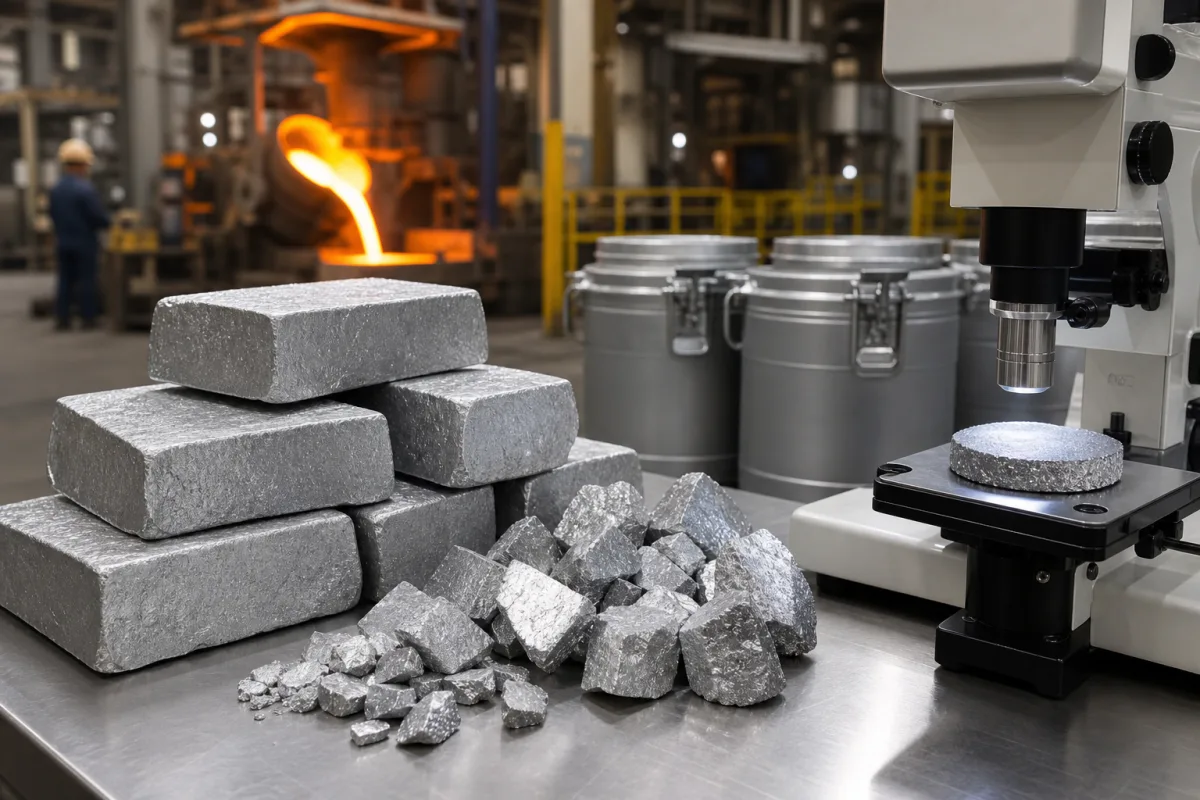
Aluminum-iron alloy used as additive in steelmaking and non-ferrous metal production
Product Specifications

Technical details and manufacturing context for High-Purity Ferroaluminum Master Alloy

Definition
High-purity ferroaluminum master alloy is a specialized metallurgical additive containing precise ratios of aluminum and iron. It serves as an efficient aluminum source for deoxidation and alloying in steel production, improving steel cleanliness and mechanical properties. In non-ferrous metallurgy, it functions as a grain refiner and strengthening agent for aluminum alloys. The controlled composition ensures predictable metallurgical reactions and consistent final product quality.
Working Principle
Dissolves in molten metal to release aluminum atoms that react with oxygen or form intermetallic compounds, modifying microstructure and properties
Common Materials
Aluminum, Iron
Technical Parameters
  • Aluminum content range (wt%) Customizable
  • Total impurity maximum (wt%) Customizable
Components / BOM
  • Aluminum Matrix
    Primary alloying element source
    Material: High-purity aluminum
  • Iron Phase
    Base metal component and carrier
    Material: Low-carbon iron
  • Trace Elements Optional
    Controlled impurities affecting properties
    Material: Various metallic elements
Engineering Reasoning
Melting point range: 1150-1250°C, Aluminum content: 40-60 wt%, Iron content: 40-60 wt%, Density: 4.5-5.5 g/cm³
Aluminum oxidation threshold at 660°C in air atmosphere, Iron-aluminum intermetallic phase embrittlement at 30-40 wt% aluminum, Thermal decomposition above 1400°C
Design Rationale: Selective oxidation of aluminum forming Al₂O₃ surface layer (Ellingham diagram ΔG° = -1582 kJ/mol at 1000K), Formation of brittle FeAl₃ and Fe₂Al₅ intermetallic phases (Hume-Rothery rules violation), Liquid metal embrittlement at grain boundaries
Risk Mitigation (FMEA)
Trigger Moisture absorption exceeding 0.5 wt% H₂O during storage
Mode: Hydrogen gas evolution and porosity formation during steel ladle addition
Strategy: Vacuum-sealed packaging with desiccant (dew point < -40°C), Controlled atmosphere storage (Argon blanket, O₂ < 100 ppm)
Trigger Insufficient superheat during addition (ΔT < 50°C above liquidus)
Mode: Incomplete dissolution forming unmelted inclusions in final steel
Strategy: Pre-heating to 300°C minimum before addition, Ladle furnace temperature control with PID regulation (±10°C)

Industry Taxonomies & Aliases

Commonly used trade names and technical identifiers for High-Purity Ferroaluminum Master Alloy.

Industrial Ecosystem & Supply Chain DNA

Complementary Systems
Downstream Applications
Specialized Tooling

Application Fit & Sizing Matrix

Operational Limits
pressure: Atmospheric to 1.5 bar (standard ladle addition conditions)
other spec: Slurry concentration: 0.5-5% by weight in molten metal, Flow rate: Batch addition (not continuous)
temperature: Ambient to 1600°C (melting point dependent on alloy composition)
Media Compatibility
✓ Carbon steel ladle refining ✓ Stainless steel AOD/VOD processes ✓ Aluminum alloy production
Unsuitable: High-sulfur environments (causes excessive sulfide formation)
Sizing Data Required
  • Target aluminum content in final product (%)
  • Molten metal batch size (tons)
  • Desired addition rate (kg/min or batch addition)

Reliability & Engineering Risk Analysis

Failure Mode & Root Cause
Oxidation-induced embrittlement
Cause: Exposure to atmospheric oxygen or moisture during storage or handling, leading to surface oxidation that compromises alloy purity and mechanical integrity, particularly in high-purity applications.
Thermal fatigue cracking
Cause: Repeated thermal cycling during alloy addition processes in steelmaking or foundry operations, causing differential expansion and contraction stresses that initiate microcracks in the master alloy structure.
Maintenance Indicators
  • Visible surface discoloration or powdery residue on alloy ingots, indicating oxidation contamination that reduces effectiveness
  • Audible popping or sputtering sounds during alloy addition to molten metal, suggesting moisture absorption or gas entrapment in the alloy
Engineering Tips
  • Implement controlled atmosphere storage with inert gas blanketing (argon/nitrogen) and moisture-proof packaging to prevent oxidation and maintain alloy purity
  • Pre-heat alloy additions to match molten metal temperature and use gradual introduction techniques to minimize thermal shock and ensure homogeneous dissolution

Compliance & Manufacturing Standards

Reference Standards
ASTM A550-06(2021) Standard Specification for Ferroaluminum ISO 5445:1980 Ferroalloys - Sampling and preparation of samples - General rules DIN 17560-1:1979 Ferroalloys; chemical analysis of ferroaluminium
Manufacturing Precision
  • Chemical composition: +/- 0.5% for major elements
  • Particle size distribution: +/- 5% for specified mesh fractions
Quality Inspection
  • Optical Emission Spectrometry (OES) for elemental analysis
  • X-ray Fluorescence (XRF) for composition verification

Factories Producing High-Purity Ferroaluminum Master Alloy

Verified manufacturers with capability to produce this product in China

✓ 98% Supplier Capability Match Found

T Technical Director from Singapore Jan 07, 2026
★★★★★
"The High-Purity Ferroaluminum Master Alloy we sourced perfectly fits our Basic Metal Manufacturing production line requirements."
Technical Specifications Verified
P Project Engineer from Germany Jan 04, 2026
★★★★☆
"Found 54+ suppliers for High-Purity Ferroaluminum Master Alloy on CNFX, but this spec remains the most cost-effective. (Delivery took slightly longer than expected, but technical support was excellent.)"
Technical Specifications Verified
S Sourcing Manager from Brazil Jan 01, 2026
★★★★★
"The technical documentation for this High-Purity Ferroaluminum Master Alloy is very thorough, especially regarding Aluminum Content (wt%)."
Technical Specifications Verified
Verification Protocol

“Feedback is collected from verified sourcing managers during RFQ (Request for Quote) and factory evaluation processes on CNFX. These reports represent historical performance data and technical audit summaries from our B2B manufacturing network.”

5 sourcing managers are analyzing this specification now. Last inquiry for High-Purity Ferroaluminum Master Alloy from Brazil (1h ago).

Supply Chain Commonly Integrated Components

Infrared Pyrometer

A non-contact temperature measurement device that detects infrared radiation emitted by objects to determine their surface temperature.

Explore Specs →
Signal Processor

Electronic device that conditions, amplifies, filters, and converts raw sensor signals into standardized outputs for temperature measurement systems

Explore Specs →
Purge Air System

A system that provides controlled airflow to clear optical paths and protect sensors in molten metal temperature measurement applications.

Explore Specs →
Degassing Chamber

A specialized vessel within a molten metal degassing system where dissolved gases are removed from molten metal through controlled processes.

Explore Specs →

Frequently Asked Questions

What are the main applications of high-purity ferroaluminum master alloy?

This master alloy is primarily used as an additive in steelmaking to improve strength and corrosion resistance, and in non-ferrous metal production to enhance aluminum-based alloys with controlled iron content for specific mechanical properties.

How does particle size affect the performance of ferroaluminum master alloy?

Controlled particle size (typically specified in mm) ensures consistent dissolution rates during melting, preventing segregation and enabling uniform distribution of aluminum and iron throughout the molten metal for predictable alloying results.

Why is low carbon content important in ferroaluminum master alloys?

Low carbon content (maximum wt% specified) minimizes unwanted carbide formation in final products, maintaining ductility and weldability in steels and preventing brittleness in non-ferrous alloys where carbon is an impurity.

Can I contact factories directly on CNFX?

CNFX is an open directory, not a transaction platform. Each factory profile provides direct contact information and production details to help you initiate direct inquiries with Chinese suppliers.

Get Quote for High-Purity Ferroaluminum Master Alloy

Request technical pricing, lead times, or customized specifications for High-Purity Ferroaluminum Master Alloy directly from verified manufacturing units.

Your business information is encrypted and only shared with verified High-Purity Ferroaluminum Master Alloy suppliers.

Thank you! Your message has been sent. We'll respond within 1–3 business days.

Need to Manufacture High-Purity Ferroaluminum Master Alloy?

Connect with verified factories specializing in this product category

Add Your Factory Contact Us
Previous Product
High-Purity Electrolytic Manganese Flake
Next Product
High-Purity Ferroboron Master Alloy