Industry-Verified Manufacturing Data (2026)

High-Purity Ferromanganese Master Alloy

Based on aggregated insights from multiple verified factory profiles within the CNFX directory, the standard High-Purity Ferromanganese Master Alloy used in the Basic Metal Manufacturing sector typically supports operational capacities ranging from standard industrial configurations to heavy-duty production requirements.

Technical Definition & Core Assembly

A canonical High-Purity Ferromanganese Master Alloy is characterized by the integration of Manganese Matrix and Iron Base. In industrial production environments, manufacturers listed on CNFX commonly emphasize Manganese ore construction to support stable, high-cycle operation across diverse manufacturing scenarios.

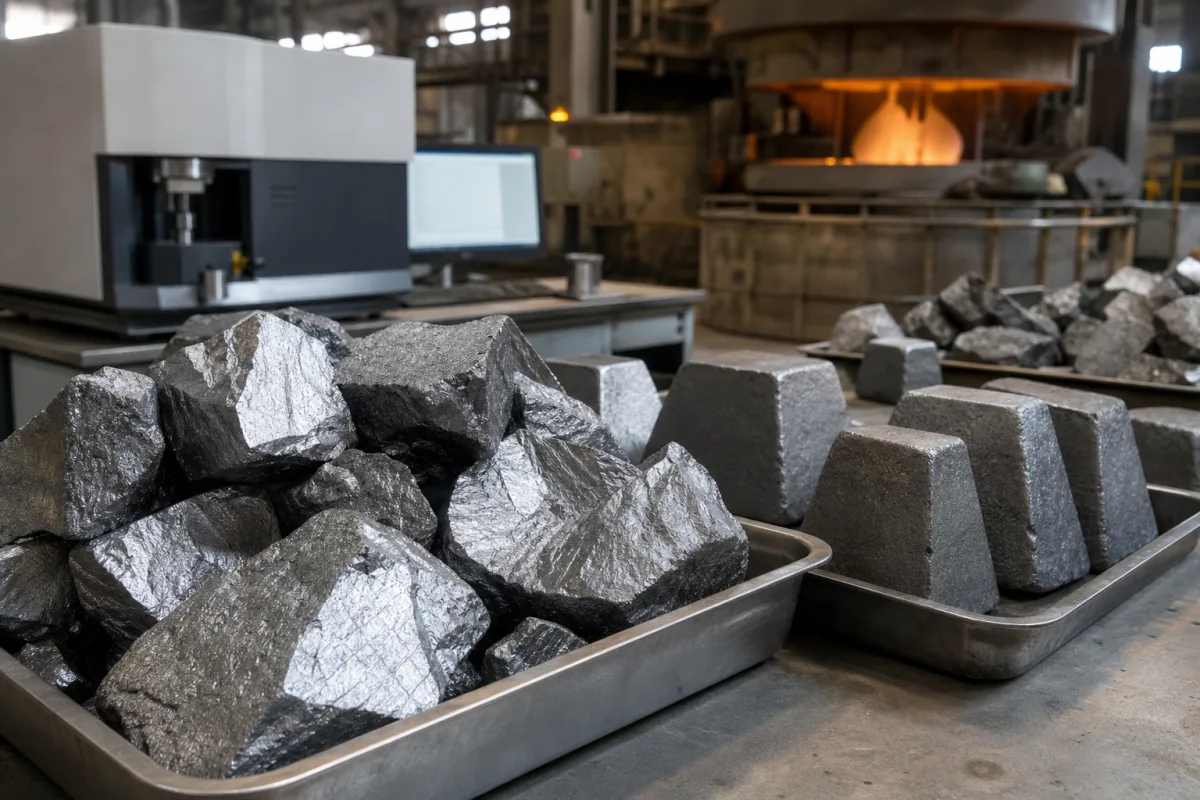
High-purity iron-manganese alloy used as additive in steel production

Product Specifications

Technical details and manufacturing context for High-Purity Ferromanganese Master Alloy

Definition
High-purity ferromanganese master alloy is a semi-finished industrial material produced through controlled smelting processes. It serves as a crucial additive in steelmaking to introduce precise manganese content while minimizing impurities. This material enables metallurgical control over steel properties including strength, hardness, and wear resistance. Its consistent composition ensures predictable outcomes in alloy steel production.
Working Principle
Acts as a carrier material that dissolves in molten steel to deliver controlled manganese content while minimizing oxidation losses and impurity introduction.
Common Materials
Manganese ore, Iron scrap, Carbon reductant
Technical Parameters
  • Manganese content by weight (%) Per Request
  • Carbon content by weight (%) Per Request
Components / BOM
  • Manganese Matrix
    Primary alloying element carrier
    Material: Metallic manganese
  • Iron Base
    Structural matrix for dissolution control
    Material: Metallic iron
  • Carbon Component
    Reductant residue affecting steel carbon balance
    Material: Elemental carbon
Engineering Reasoning
1.0-1.5 wt% manganese content in steel melt, 1550-1650°C melt temperature, 0.1-0.5 MPa ladle pressure
Manganese content exceeds 2.0 wt% causing embrittlement, temperature drops below 1520°C causing incomplete dissolution, pressure exceeds 0.8 MPa causing ladle lining failure
Design Rationale: Excessive manganese forms brittle MnS inclusions at grain boundaries (Gibbs free energy ΔG = -150 kJ/mol at 1600°C), rapid cooling creates thermal stress exceeding yield strength (σ_y = 85 MPa at 1520°C), overpressure exceeds refractory compressive strength (σ_c = 1.2 MPa)
Risk Mitigation (FMEA)
Trigger Incomplete preheating to 800°C minimum before addition
Mode: Thermal shock cracking of alloy particles (ΔT > 700°C)
Strategy: Install induction preheater with PID control (setpoint 850°C ± 10°C)
Trigger Moisture absorption exceeding 0.1% by mass during storage
Mode: Hydrogen-induced porosity in steel (H₂ concentration > 2 ppm)
Strategy: Implement nitrogen-purged storage silos with dew point monitoring (-40°C alarm)

Industry Taxonomies & Aliases

Commonly used trade names and technical identifiers for High-Purity Ferromanganese Master Alloy.

Industrial Ecosystem & Supply Chain DNA

Complementary Systems
Downstream Applications
Specialized Tooling

Application Fit & Sizing Matrix

Operational Limits
pressure: Atmospheric to 1.5 bar (handling and injection systems)
other spec: Particle size: 0.5-50mm (customizable), Mn content: 75-85%, Fe content: 15-25%, Impurities <0.5%
temperature: Ambient to 1600°C (typical steelmaking temperatures)
Media Compatibility
✓ Basic oxygen furnace (BOF) steelmaking ✓ Electric arc furnace (EAF) steel production ✓ Ladle metallurgy refining processes
Unsuitable: Acidic environments or processes with high sulfur content
Sizing Data Required
  • Required manganese addition rate (kg/ton of steel)
  • Steel production capacity (tons/hour or batch size)
  • Desired final manganese content in steel (%)

Reliability & Engineering Risk Analysis

Failure Mode & Root Cause
Thermal fatigue cracking
Cause: Repeated thermal cycling during alloy production (melting, casting, cooling) induces stress from differential expansion/contraction in the master alloy structure, leading to crack initiation and propagation.
Oxidation and slag inclusion degradation
Cause: Exposure to oxygen at high temperatures during processing or storage causes surface oxidation and formation of brittle oxide layers; improper slag control during melting introduces non-metallic inclusions that weaken structural integrity.
Maintenance Indicators
  • Visible surface discoloration (blue/gray oxide scaling) or powdery residue on alloy surfaces, indicating active oxidation.
  • Audible cracking or popping sounds during heating/cooling cycles, signaling internal stress or micro-crack propagation.
Engineering Tips
  • Implement controlled heating and cooling rates (e.g., using programmable furnaces) to minimize thermal gradients and stress during processing.
  • Maintain inert atmosphere storage (e.g., argon or nitrogen blanketing) and use fluxing agents during melting to reduce oxidation and slag formation.

Compliance & Manufacturing Standards

Reference Standards
ISO 5446:2017 Ferromanganese - Specification and conditions of delivery ASTM A99-03(2018) Standard Specification for Ferromanganese EN 1321:2000 Ferromanganese - Determination of manganese content - Electrometric method
Manufacturing Precision
  • Manganese content: +/- 1.5%
  • Particle size distribution: 90% within 10-50mm range
Quality Inspection
  • Chemical composition analysis via optical emission spectrometry
  • Microstructure examination for non-metallic inclusions

Factories Producing High-Purity Ferromanganese Master Alloy

Verified manufacturers with capability to produce this product in China

✓ 94% Supplier Capability Match Found

P Project Engineer from United Arab Emirates Jan 13, 2026
★★★★★
"Standard OEM quality for Basic Metal Manufacturing applications. The High-Purity Ferromanganese Master Alloy arrived with full certification."
Technical Specifications Verified
S Sourcing Manager from Australia Jan 10, 2026
★★★★★
"Great transparency on the High-Purity Ferromanganese Master Alloy components. Essential for our Basic Metal Manufacturing supply chain."
Technical Specifications Verified
P Procurement Specialist from Singapore Jan 07, 2026
★★★★★
"The High-Purity Ferromanganese Master Alloy we sourced perfectly fits our Basic Metal Manufacturing production line requirements."
Technical Specifications Verified
Verification Protocol

“Feedback is collected from verified sourcing managers during RFQ (Request for Quote) and factory evaluation processes on CNFX. These reports represent historical performance data and technical audit summaries from our B2B manufacturing network.”

13 sourcing managers are analyzing this specification now. Last inquiry for High-Purity Ferromanganese Master Alloy from Turkey (34m ago).

Supply Chain Commonly Integrated Components

Purge Air System

A system that provides controlled airflow to clear optical paths and protect sensors in molten metal temperature measurement applications.

Explore Specs →
Degassing Chamber

A specialized vessel within a molten metal degassing system where dissolved gases are removed from molten metal through controlled processes.

Explore Specs →
Gas Control System

A system that regulates and controls the flow, pressure, and composition of gases used in molten metal degassing processes.

Explore Specs →
Burner Assembly

A combustion system component that generates controlled flame for heating applications in industrial preheating stations.

Explore Specs →

Frequently Asked Questions

What are the main applications of high-purity ferromanganese master alloy?

This master alloy is primarily used as an additive in steel production to increase manganese content, improve steel strength and hardness, and act as a deoxidizer to remove oxygen from molten steel.

How does the carbon content affect ferromanganese alloy performance?

Lower carbon content in ferromanganese master alloy minimizes carbon pickup in steel, making it ideal for producing low-carbon and ultra-low-carbon steel grades where carbon control is critical.

What are the benefits of using high-purity ferromanganese over standard grades?

High-purity ferromanganese has reduced levels of impurities like phosphorus, sulfur, and silicon, resulting in cleaner steel with improved mechanical properties and better control over final steel composition.

Can I contact factories directly on CNFX?

CNFX is an open directory, not a transaction platform. Each factory profile provides direct contact information and production details to help you initiate direct inquiries with Chinese suppliers.

Get Quote for High-Purity Ferromanganese Master Alloy

Request technical pricing, lead times, or customized specifications for High-Purity Ferromanganese Master Alloy directly from verified manufacturing units.

Your business information is encrypted and only shared with verified High-Purity Ferromanganese Master Alloy suppliers.

Thank you! Your message has been sent. We'll respond within 1–3 business days.

Need to Manufacture High-Purity Ferromanganese Master Alloy?

Connect with verified factories specializing in this product category

Add Your Factory Contact Us
Previous Product
High-Purity Ferrocolumbium Master Alloy
Next Product
High-Purity Ferromolybdenum Master Alloy