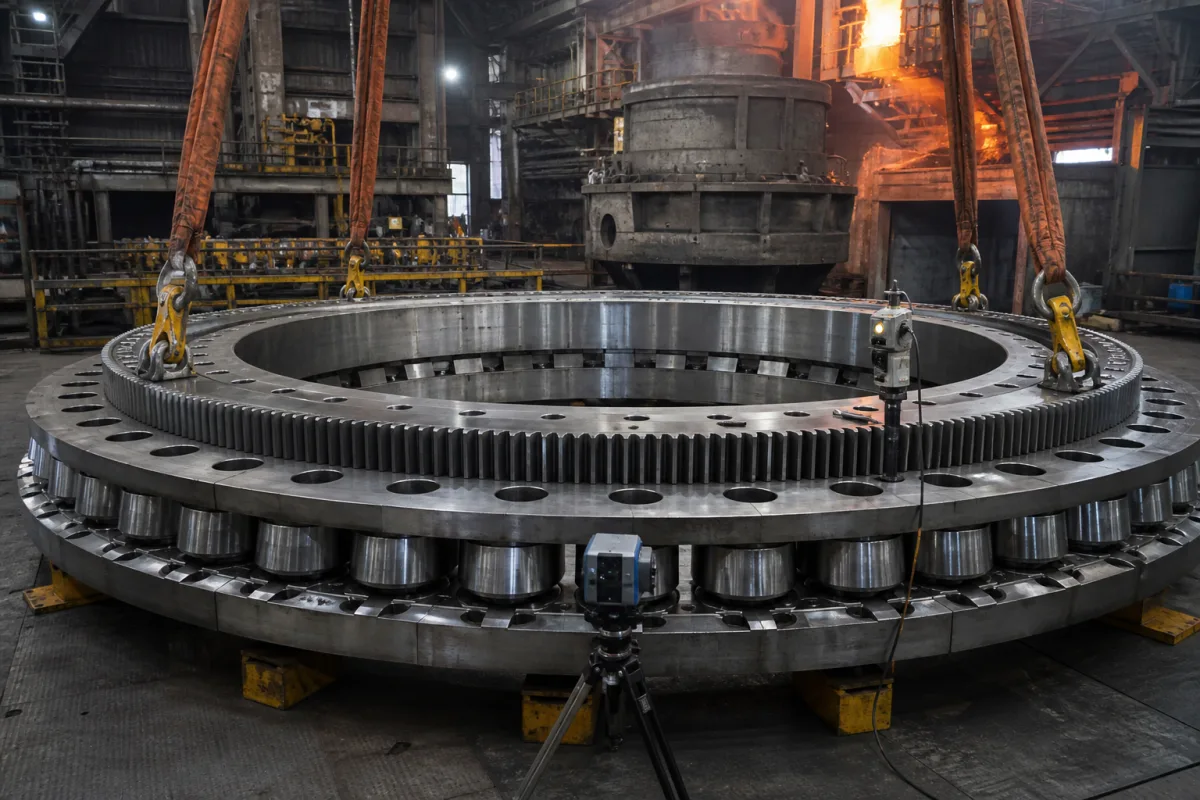
Ladle turret slewing bearing: triple-row roller ring that carries the ladle arms of a continuous caster
The large slewing ring that lets a caster's ladle turret swing full ladles over the tundish · triple-row roller design, axial play as the raceways wear, and changing a 4,400 mm bearing in a planned stop
A ladle turret stands at the head of a continuous caster and rotates two ladle arms so that a full ladle can be brought over the tundish while the empty one is exchanged. The rotation runs on a large-diameter slewing bearing, a geared ring driven by pinions, which carries axial load and overturning moment from the ladles on both arms. Its design questions are those of a slewing ring under heavy, eccentric and hot loads: the roller arrangement, how much axial play the raceways may develop before capacity falls, and how the bearing will be changed when it is worn.
Large slewing (turntable) bearings that carry the rotating part of ladle turrets on continuous casters: triple-row roller and other slewing ring designs, their gearing, seals and cages, wear and axial play, and their replacement. Complete casting machines are covered on the Billet continuous caster page; secondary cooling sprays and spray-chamber structures, and strand cutting machines, are covered on their own pages. Roller bearings for caster segments and rolls are outside this page.
CNFX editorial research · Sources checked October 12, 2026 · 5 sources
Two axial roller rows at 90° and a separate radial row under a turret carrying two ladles
The turret bearing sees the weight of both arms and ladles and the moment from whichever ladle is full; a triple-row roller ring separates these loads between its rows.
Liebherr lists triple-row roller bearings for ladle turrets, describing them as resistant to both axial forces and tilting moments, and specifies steel cages combined with special seals designed for the high temperatures of ladle turret service. [1]
In a three-row roller slewing bearing, Krynke, Borkowski and Selejdak describe the rollers in the load-carrying and supporting rows as working at an operating angle of 90°, so radial displacement of the ring does not change the range of axial force and moment the bearing can carry; a third row of side rollers, with axes parallel to the bearing axis, takes the radial load. Their example bearing has 1,400 mm and 1,396 mm rolling diameters, 25 mm and 30 mm rollers, 126 and 151 rollers in the two rows and 54 HRC raceways. [2]
The size of the load is set by the ladles: at a South Wales steel plant, Belzona reports a turret carrying two ladles, one draining into the caster while the other is recharged, each weighing 500 tons when full of metal. [4] Editorial calculation: with both ladles full, the turret carries 1,000 tons of ladle and steel before the weight of arms and structure is added. A US patent for a revolving-ladle turret describes the platform turning on a ring bearing whose circumferential toothing meshes with motorised pinions on the turret member. [5]
For a quotation, give the bearing supplier the full and empty ladle masses on each arm, arm radius, the load cases (one ladle full, both full, ladle landing), slewing speed, gear and pinion data, ambient and radiant temperature at the ring, seal and cage requirements, and the mounting structure drawings.
02
Axial play that grows with raceway wear, and why it cuts static capacity more in three-row roller rings
A turret bearing is chosen on static load capacity, and that capacity depends on how much play the worn bearing is allowed to reach.
Editorial note: the 4,400 mm bearing in the Siderar turret described below is more than twice the 2 m limit of the rigid-ring profiles, so for a turret bearing ask for a capacity check that includes the stiffness of the turret column and bolted joint, and for the supplier's permissible axial play or tilting clearance limit in writing.
Point from the study
Value or finding
How play develops
Small at first, then increasing as the raceways wear; manufacturers state the permissible limit. [2]
Effect on capacity
Rigid-ring calculations show a high loss of static capacity at small clearances; the effect is larger in three-row roller than in single-row roller bearings. [2]
Permissible axial play used in the example
0.5 mm for the three-row roller bearing; 1.4 mm for the double-row ball bearing. [2]
Limit of the method
Profiles apply to bearings up to 2 m diameter on a very rigid seat; for less rigid structures the authors advise higher safety factors or methods that include ring, seat and bolt stiffness. [2]
Assumptions
Induction-hardened, ground raceways at Ra 0.63 µm; rolling element diameters within ±1 µm in a batch. [2]
Agree how axial play will be measured on the installed bearing (positions, load state, instrument), the reading at installation, and the limit at which the bearing must be changed.
03
Changing a 4,400 mm turret bearing: from a 14-day plan to about 60–72 h
Siderar's slab caster, the only caster processing the company's steel after 1992, gives a record of what replacing a turret bearing involves.
Siderar's ladle turret has a 4,400 mm bearing that turns the arms and two bronze bushings, given as 50 × 300 × 3,000 mm, that guide the hydraulic vertical movement. The equipment designer's 1995 replacement plan took 14 days and used a 15,000 mm × 6,000 mm hanger weighing 50 t lifted by two overhead cranes; the upper bushing alone was changed in 2.5 days in June 1999. By then the bearing had about 1,400 h of use against a limit life considered by the supplier of about 1,000 h, as the paper states. The supplier's later alternative took 8 days and Siderar's own method about 5; after the January 2007 replacement, with a new outer column, Siderar puts bushing changes at planned 24 h stops and bearing replacement at about 60–72 h. [3]
Editorial calculation: 60–72 h is 2.5–3 days, against the 14-day original plan.
Ask the turret and bearing suppliers for the replacement method, lifting tools and stop length before purchase, and plan the spare bearing's lead time against the expected wear life.
04
Data for a ladle turret bearing enquiry
Paste it into your enquiry below or into an email to a maker, then replace every bracket.
Turret: [maker and type; arm radius; ladle capacity; full and empty ladle mass]
Loads: [axial force; overturning moment; radial force; load cases]
Bearing: [type (triple-row roller); raceway diameter; gear (external or internal), module, teeth]
Environment: [temperature at the ring; radiant heat; dust and scale]
Seals and cage: [high-temperature seals; steel cage]
Mounting: [bolt size, number and grade; seat flatness]
Service: [axial play limit; measurement method; replacement method and stop length]
Explore company information and manufacturing capabilities, then discuss the scope of your project with a relevant supplier.
Share this page
Compiled and source-reviewed by the CNFX editorial team.
Each manufacturer above links to the page on that company's own website where the product is listed, with the date we checked it. How we source and review
· Page last updated 13 October 2026
Buyer questions
What type of bearing is used on a ladle turret?
Liebherr supplies triple-row roller slewing bearings for ladle turrets, with steel cages and special high-temperature seals. [1]
Why does axial play matter in a three-row roller slewing bearing?
Play grows as raceways wear and reduces static capacity; Krynke and co-authors found the effect larger in three-row roller bearings than in single-row roller bearings. [2]
How long does it take to replace a ladle turret bearing?
At Siderar, a 4,400 mm turret bearing replacement first planned at 14 days was brought to about 60–72 h with dedicated tools and a new outer column. [3]
Sources and what still needs a direct check
Sources checked 2026-10-12. Liebherr describes its own ladle turret bearings; the Periodica Polytechnica paper is a calculation study of slewing bearings; the ABM paper is a steelmaker's maintenance report; Belzona describes a repair at a steel plant; the patent describes one turret design.