Industry-Verified Manufacturing Data (2026)

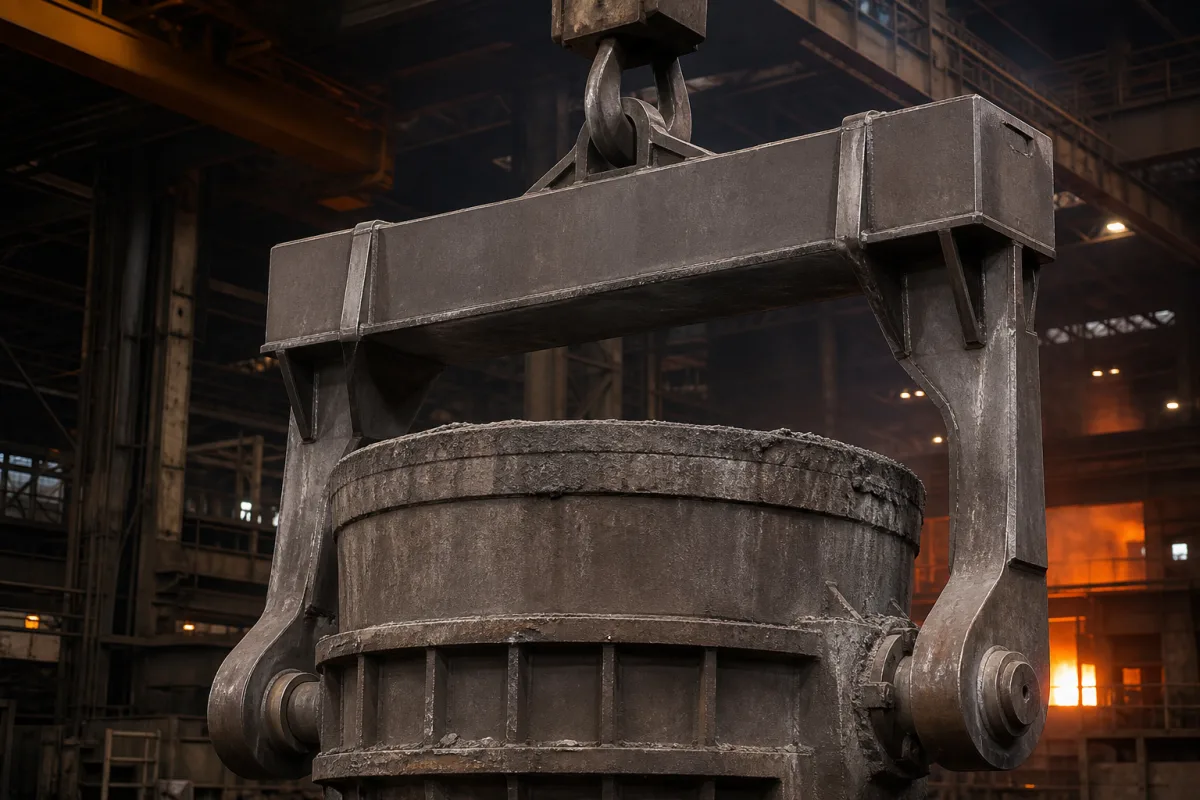
Ladle Carrier / Yoke

Based on aggregated insights from multiple verified factory profiles within the CNFX directory, the standard Ladle Carrier / Yoke used in the Basic Metal Manufacturing sector typically supports operational capacities ranging from standard industrial configurations to heavy-duty production requirements.

Technical Definition & Core Assembly

A canonical Ladle Carrier / Yoke is characterized by the integration of Main Beam and Trunnion Hooks. In industrial production environments, manufacturers listed on CNFX commonly emphasize Carbon Steel construction to support stable, high-cycle operation across diverse manufacturing scenarios.

Structural component that supports and transfers molten metal ladles during lifting and sealing operations
Product Specifications

Technical details and manufacturing context for Ladle Carrier / Yoke

Definition
A robust structural frame or yoke assembly that forms part of the Ladle Lift & Seal Mechanism, designed to securely cradle and support ladles containing molten metals during transfer, pouring, and sealing processes in metal manufacturing operations
Working Principle
The carrier/yoke is mounted to the lifting mechanism and engages with the ladle's trunnions or lifting lugs. When the mechanism activates, the yoke distributes the ladle's weight evenly while maintaining proper alignment for controlled lifting, transfer, and sealing operations
Common Materials
Carbon Steel, Alloy Steel, Heat-Resistant Steel
Technical Parameters
  • Span between lifting points, overall width, and load-bearing capacity dimensions (mm) Standard Spec
Components / BOM
  • Main Beam
    Primary load-bearing structural member that spans between lifting points
    Material: Alloy Steel
  • Trunnion Hooks
    Engagement points that connect to the ladle's trunnions for secure lifting
    Material: Forged Steel
  • Mounting Brackets
    Attachment points for connecting to the lifting mechanism
    Material: Carbon Steel
  • Reinforcement Plates
    Additional structural support at high-stress points
    Material: Steel Plate
Engineering Reasoning
Load capacity: 15-80 metric tons, Temperature exposure: 300-1650°C, Lifting speed: 0.1-0.5 m/s
Yield strength threshold: 355 MPa (S355 structural steel), Creep deformation limit: 1% strain at 600°C after 1000 hours, Fatigue crack initiation: 10^6 cycles at 150 MPa stress amplitude
Design Rationale: Thermal fatigue from cyclic heating (300-1650°C) causing differential expansion stresses exceeding 250 MPa, Creep deformation at sustained temperatures above 550°C reducing yield strength by 40%, Stress corrosion cracking from sulfur compounds in molten metal at temperatures above 400°C
Risk Mitigation (FMEA)
Trigger Thermal shock from rapid ladle temperature changes exceeding 200°C/min
Mode: Crack propagation at weld joints due to thermal stress concentration exceeding 300 MPa
Strategy: Integral forged yoke design with controlled cooling channels maintaining temperature gradient below 50°C/cm
Trigger Asymmetric loading from ladle tilt exceeding 5° angular deviation
Mode: Plastic deformation of support arms causing permanent deflection >10 mm
Strategy: Redundant load path design with dual hydraulic cylinders maintaining parallel alignment within 0.5° tolerance

Industry Taxonomies & Aliases

Commonly used trade names and technical identifiers for Ladle Carrier / Yoke.

Applied To / Applications

This component is essential for the following industrial systems and equipment:

Industrial Ecosystem & Supply Chain DNA

Complementary Systems
Downstream Applications
Specialized Tooling

Application Fit & Sizing Matrix

Operational Limits
pressure: N/A (structural load bearing only)
other spec: Max ladle capacity: 50-300 tons, Lifting speed: 0.1-0.5 m/s, Duty cycle: Continuous/intermittent with cooling periods
temperature: Ambient to 1500°C (surface temp near ladle), continuous exposure to radiant heat
Media Compatibility
✓ Molten steel/iron handling ✓ High-temperature slag transport ✓ Foundry/casting shop environments
Unsuitable: Marine/coastal environments (salt corrosion)
Sizing Data Required
  • Ladle weight capacity (tons)
  • Lifting hook/attachment interface dimensions
  • Required clearance for ladle rotation/tilting

Reliability & Engineering Risk Analysis

Failure Mode & Root Cause
Structural fatigue cracking
Cause: Cyclic thermal stresses from repeated exposure to molten metal temperatures (typically 1500-1600°C) combined with mechanical loading during ladle transport, leading to crack initiation at stress concentration points like weld joints and geometric transitions.
Bearing and pivot joint degradation
Cause: Contamination from airborne metallurgical dust and slag particles entering lubrication systems, combined with inadequate lubrication intervals, resulting in abrasive wear, increased clearances, and eventual seizure or catastrophic failure during operation.
Maintenance Indicators
  • Visible cracks or deformation in yoke arms or structural welds, particularly after thermal cycles
  • Abnormal grinding, knocking, or uneven motion during ladle rotation or carrier movement indicating bearing/pivot issues
Engineering Tips
  • Implement regular thermal imaging inspections to detect early-stage stress concentration areas and schedule repairs during planned outages before cracks propagate
  • Establish a precision lubrication program with sealed bearing systems and contamination control measures, using high-temperature grease specified for metallurgical applications

Compliance & Manufacturing Standards

Reference Standards
ISO 12480-1:2018 Cranes - Safe use - Part 1: General ANSI/ASME B30.20-2018 Below-the-Hook Lifting Devices DIN 15018-1:1984 Cranes; principles for steel structures; analysis and design
Manufacturing Precision
  • Bearing bore diameter: +/-0.025mm
  • Parallelism of lifting arm mounting surfaces: 0.15mm
Quality Inspection
  • Magnetic Particle Testing (MT) for weld integrity
  • Load Testing to 125% of rated capacity

Factories Producing Ladle Carrier / Yoke

Verified manufacturers with capability to produce this product in China

✓ 97% Supplier Capability Match Found

S Sourcing Manager from Canada Jan 08, 2026
★★★★★
"Great transparency on the Ladle Carrier / Yoke components. Essential for our Basic Metal Manufacturing supply chain."
Technical Specifications Verified
P Procurement Specialist from United States Jan 05, 2026
★★★★☆
"The Ladle Carrier / Yoke we sourced perfectly fits our Basic Metal Manufacturing production line requirements. (Delivery took slightly longer than expected, but technical support was excellent.)"
Technical Specifications Verified
T Technical Director from United Arab Emirates Jan 02, 2026
★★★★★
"Found 22+ suppliers for Ladle Carrier / Yoke on CNFX, but this spec remains the most cost-effective."
Technical Specifications Verified
Verification Protocol

“Feedback is collected from verified sourcing managers during RFQ (Request for Quote) and factory evaluation processes on CNFX. These reports represent historical performance data and technical audit summaries from our B2B manufacturing network.”

15 sourcing managers are analyzing this specification now. Last inquiry for Ladle Carrier / Yoke from Germany (1h ago).

Supply Chain Compatible Machinery & Devices

Electromagnetic Induction Heater

Industrial heating device using electromagnetic induction for metal processing

Explore Specs →
Vacuum Induction Melting Furnace

Industrial furnace for melting metals under vacuum using electromagnetic induction

Explore Specs →
Electroslag Remelting Furnace

Secondary refining furnace for high-quality metal ingots

Explore Specs →
Molten Metal Flow Control Valve

Precision valve for regulating molten metal flow in casting and pouring operations.

Explore Specs →

Frequently Asked Questions

What materials are recommended for ladle carriers in high-temperature applications?

For high-temperature molten metal handling, heat-resistant steel is recommended due to its ability to withstand thermal stress and oxidation, while carbon and alloy steels are suitable for standard temperature operations with proper maintenance.

How does the ladle carrier ensure safe lifting of molten metal?

The ladle carrier features a robust main beam with trunnion hooks that securely engage the ladle, reinforced plates for structural integrity, and mounting brackets that distribute weight evenly, preventing spills during lifting and sealing operations.

What maintenance is required for ladle carriers in basic metal manufacturing?

Regular inspection for wear, cracks, or deformation in the main beam and hooks, lubrication of moving parts, and checking reinforcement plates for integrity are essential. Material-specific maintenance includes monitoring for thermal fatigue in heat-resistant steel components.

Can I contact factories directly on CNFX?

CNFX is an open directory, not a transaction platform. Each factory profile provides direct contact information and production details to help you initiate direct inquiries with Chinese suppliers.

Get Quote for Ladle Carrier / Yoke

Request technical pricing, lead times, or customized specifications for Ladle Carrier / Yoke directly from verified manufacturing units.

Your business information is encrypted and only shared with verified Ladle Carrier / Yoke suppliers.

Thank you! Your message has been sent. We'll respond within 1–3 business days.

Need to Manufacture Ladle Carrier / Yoke?

Connect with verified factories specializing in this product category

Add Your Factory Contact Us
Previous Product
Integrated Steelmaking and Continuous Casting System
Next Product
Ladle Lift & Seal Mechanism