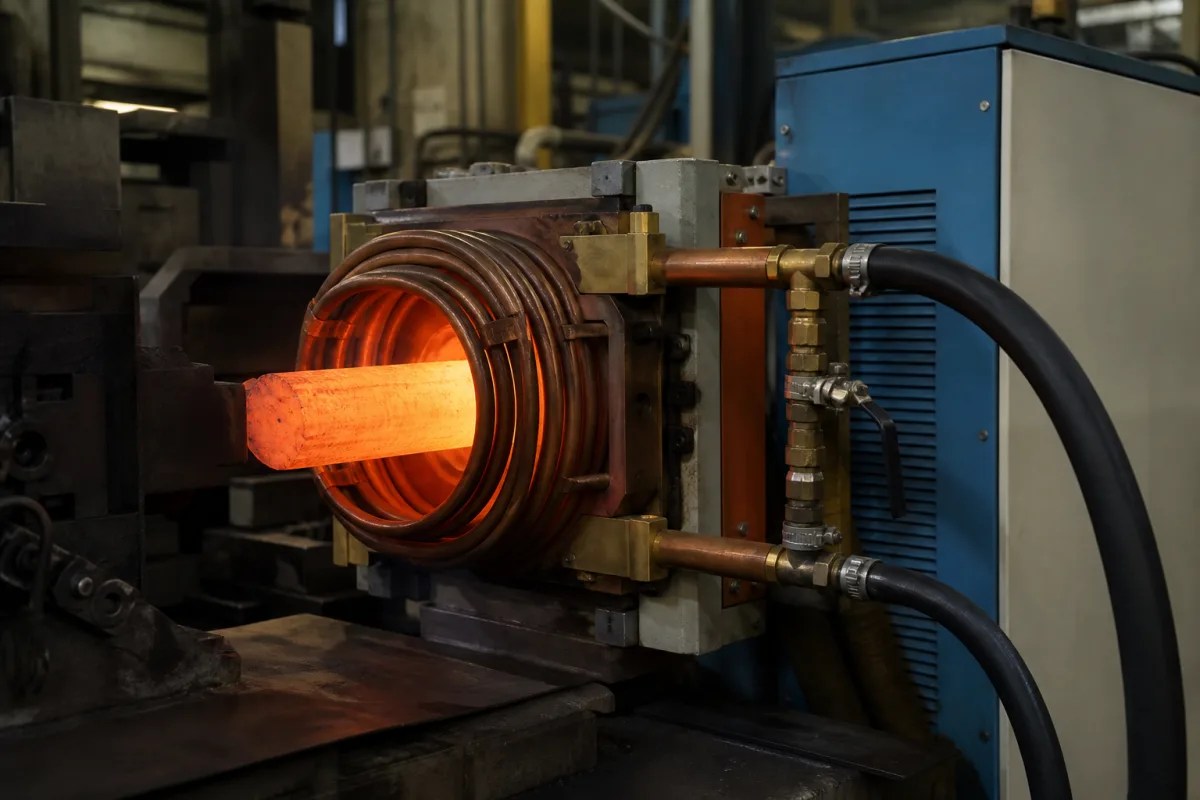
Thermal processing · Frequency, power, coil and coupling
An induction heater drives alternating current through a water-cooled copper coil; the field induces current in a conductive part, which heats itself. Frequency decides how deep the heat goes, power decides how fast, and the coil and its coupling decide where.
Induction heating systems for heating workpieces and fluids: forging billet heaters, hardening and annealing, brazing, shrink fitting, pipe and fluid heating, and handheld units. Induction melting furnaces and cooking appliances are outside this page.
CNFX editorial research · Sources checked October 12, 2026 · 5 sources
Ambrell explains that induced current “will be most intense on the surface of your part”, with more than 80% of the heat produced in the skin; lower-frequency, higher-power systems suit large parts that need through-heating, and higher-frequency, lower-power systems suit surface heating. The higher the frequency, the shallower the heating. [1]
SimuTech gives the reference (skin) depth as δ = √(1 / (π f σ μ0 μr)), depending on frequency f, electrical conductivity σ and relative permeability μr, all of which change with temperature. At one reference depth the current density is about 37% and the power density about 13.5% of the surface values, so nearly all the power is inside that layer. [2]
Editorial calculation using SimuTech's baseline material (σ = 10⁶ S/m, μr = 1): δ ≈ 16 mm at 1 kHz, 5.0 mm at 10 kHz and 1.6 mm at 100 kHz. Ten times the frequency gives about a third of the depth.
Give the supplier the part material, dimensions and drawing, the zone to heat, the target temperature and depth, and the cycle time. Frequency, power and coil follow from these.
02
Account for the material
Ambrell notes that magnetic materials heat more easily than non-magnetic ones because of hysteresis, so “nonmagnetic materials often require more power”, and that high-resistivity metals such as steel heat quickly while low-resistivity copper and aluminium take longer. Non-conductive materials can be heated through a conductive susceptor. [1]
Because conductivity and permeability change with temperature, the reference depth changes during heating; SimuTech's formula includes temperature and field dependence for this reason. Ask the supplier how it modelled or tested your material across the temperature range. [2]
03
Size the power, coil, coupling and cooling
Ambrell lists the factors: output power sets heating speed and must cover part mass, temperature rise and convection and conduction losses; a faster rate needs more power. The water-cooled copper coil must follow the part shape; poor design heats slowly with the wrong pattern; close coupling between coil and part increases induced current and efficiency. [1]
Altair's induction heating guide lists the same levers for efficient energy transfer: inductor geometry and material, its position relative to the part (magnetic coupling), frequency, and the part's magnetic, electrical and thermal properties. [3]
Ambrell notes that every system needs cooling: small systems a compact water-to-air heat exchanger, larger ones a water-to-water exchanger or chiller, plus space and electrical supply for the power unit. Pyrometers and data recording can be added where temperatures must be logged. [1]
04
From handheld bolt heaters to 1,500 kW IGBT forging supplies
Duolin lists IGBT induction heater power from 7 to 1,500 kW at 0.1–400 kHz for forging, hardening, tempering, brazing and pipe heating; JKZ lists high, ultrasonic, medium and ultra-high frequency series; Sinton lists electromagnetic heaters for thermal oil and process fluids; Karjoys lists a 1,500 W handheld heater for freeing seized bolts. These are suppliers' own data. [4][5]
05
Power supply, water-cooled coil, cooling unit and pyrometer in an induction cell
The coil is the one part made for your workpiece, since Ambrell says it must follow the part shape; the cooling equipment grows with the system, from a water-to-air exchanger on small units to a water-to-water exchanger or chiller on larger ones. [1]
Power, frequency, coil size and cooling water for an induction heating quotation
Frequency and power are the two rows with a published relationship: a higher frequency gives a shallower reference depth, and the power must cover part mass, temperature rise and losses within the cycle time. [1][2]
Field
What it means and published values
Ask the supplier for
Power output (kW)
Sets heating rate; covers mass, ΔT and losses. [1]
Send the part, the heat pattern and the site data together
Paste it into your enquiry below or into an email to a maker, then replace every bracket.
Part: [material; dimensions; drawing; zone to heat]
Process: [forging, hardening, brazing, shrink fit or other; target temperature; depth; cycle time; parts per hour]
Coil: [shape; coupling gap; quick-change; fixture]
Power supply: [power; frequency; input voltage, phase and kVA]
Cooling: [chiller or heat exchanger; water quality; flow]
Control: [pyrometer; recipes; data logging; automation interface]
Documents: [heating trial report on your part; layout; manuals]
12 companies list this product among what they make. Company figures are quoted from each
company's own website; every card states where the relationship came from.
Chengdu Duolin Electric Co., Ltd.
Manufacturing site to be confirmed for the order
Lists IGBT induction heating power supplies and machines for forging, hardening, brazing and pipe bending.
Explore company information and manufacturing capabilities, then discuss the scope of your project with a relevant supplier.
Share this page
Compiled and source-reviewed by the CNFX editorial team.
Each manufacturer above links to the page on that company's own website where the product is listed, with the date we checked it. How we source and review
· Page last updated 13 October 2026
Buyer questions
How do I choose induction heating frequency?
Higher frequency heats a shallower layer; lower frequency suits through-heating of larger parts. Reference depth is √(1/(π f σ μ0 μr)). [1][2]
Why does copper or aluminium heat slower than steel in an induction coil?
Ambrell notes low-resistivity metals take longer and that “nonmagnetic materials often require more power”. [1]
Why does coil coupling matter?
A closely coupled part draws more induced current, heating faster and more efficiently; poor coupling slows heating. [1][3]
Sources and what still needs a direct check
Sources checked 2026-10-12. Ambrell is an induction heating system manufacturer explaining selection factors. SimuTech Group is a simulation consultancy explaining reference depth and frequency effects. Altair's Flux documentation explains induction heating fundamentals. Supplier pages describe their own offers.