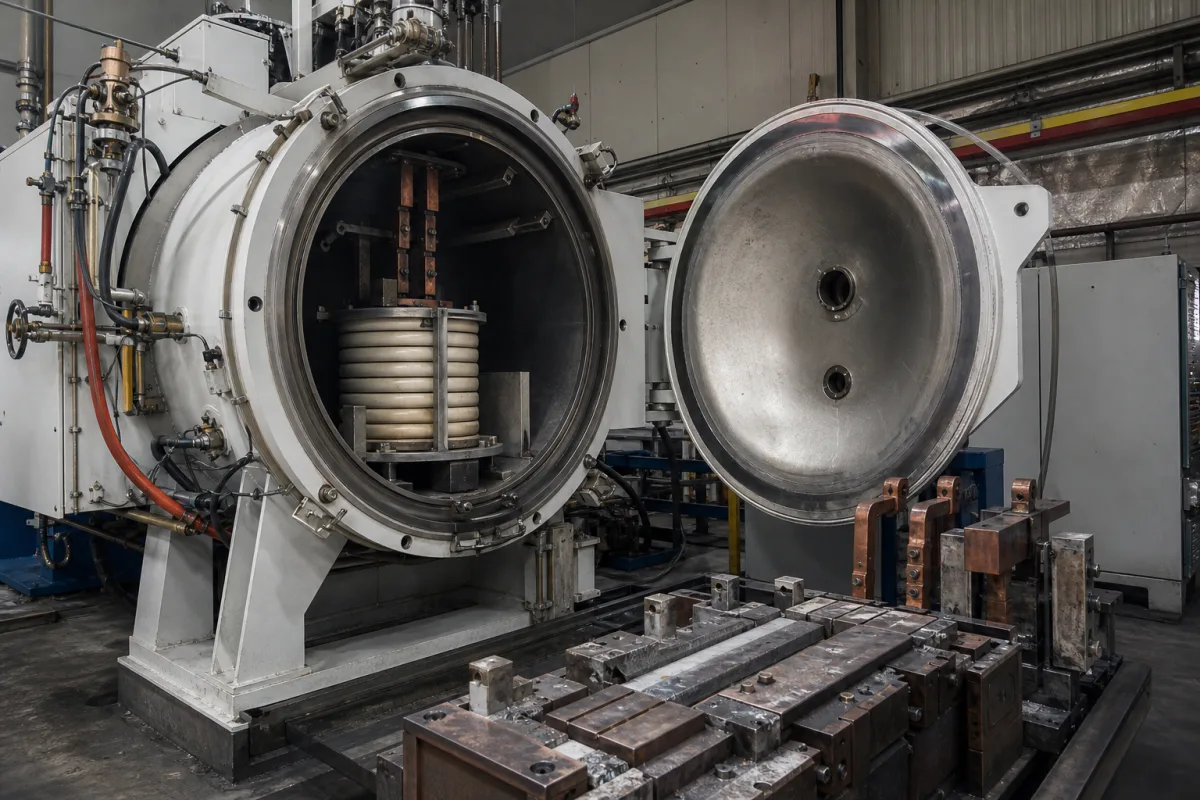
VIM furnaces · Crucible size and melt power, frequency by size, vacuum level by pump set, mould chambers and reactive-metal options
A vacuum induction melting (VIM) furnace melts metal in an induction-heated crucible inside a vacuum chamber, so alloys can be degassed, refined and cast without air contamination. Ask three things first: what crucible capacity and melt power you need for your alloy, what vacuum level the pump set reaches, and how the furnace casts — into moulds in the melt chamber, a separate mould chamber, or a continuous caster.
Vacuum induction melting and casting furnaces for superalloys, special steels, reactive and precious metals, from laboratory to production size. Air induction furnaces, vacuum arc remelting, electroslag remelting and vacuum degassing of ladles are outside this page.
CNFX editorial research · Sources checked October 12, 2026 · 4 sources
ALD Vacuum Technologies lists its VIM02 to VIM70 furnaces by crucible volume and maximum steel charge (at 7.2 g/cm³): from 0.1–0.2 L and 1.5 kg (VIM02) through 5.5–12 L and 85 kg (VIM12) to 50–70 L and 500 kg (VIM70). Recommended medium-frequency melting power rises from 6 kW at 20 kHz (VIM02) to 120 kW at 4 kHz (VIM12) and 450 kW at 1 kHz (VIM70), with connected loads of 20–650 kVA, cooling water of 20–700 L/min at 4 bar minimum, 6 bar compressed air, and total weights from about 475 kg to 15,200 kg. [1]
ALD describes VIM as giving close compositional tolerances, precise temperature control and removal of undesired volatile trace elements, because melt temperature, vacuum, gas atmosphere, pressure and kinetics can be set independently; backfilling with inert gas after melting preserves purity. [1] The Royce Institute's Consarc 25 kg VIM melts up to 25 kg of iron, cobalt, nickel or copper alloys and, with an induction skull melting (ISM) crucible, up to 3 kg of reactive titanium or zirconium; inductive stirring helps homogenise the alloy. [2]
Editorial calculation: specific melt power falls with size in ALD's table — about 4 kW/kg for VIM02 (6 kW, 1.5 kg), 1.4 kW/kg for VIM12 (120 kW, 85 kg) and 0.9 kW/kg for VIM70 (450 kW, 500 kg) — while frequency falls from 20 to 1 kHz; ask suppliers for power and frequency matched to your crucible and alloy. [1]
Give the supplier the alloys (including reactive or volatile elements), charge weight per heat and heats per day, crucible type (ceramic, cold-wall or ISM), required vacuum level and leak rate, casting method (static moulds, mould chamber, continuous, directional solidification), mould sizes, inert gas backfill or partial pressure needs, sampling and temperature measurement, utilities and floor space.
02
Set vacuum level, pump set and casting chamber
ALD gives the vacuum range as the 10⁻² mbar range with a medium-vacuum mechanical pump set alone, and the 10⁻⁴ mbar range with a high-vacuum pumping system, across the VIM02–VIM70 line. Its furnaces come as a single melt chamber or with a separate horizontal or vertical mould chamber, which lets moulds be locked in without breaking the furnace atmosphere and avoids heat loss from preheated moulds; options include mould treatment, directional solidification, over-pressure operation and continuous casting. [1]
The Royce Consarc furnace uses a diffusion pump to reach 10⁻⁵ mbar rapidly, can run at partial pressure between 20 and 100 mbar, has power-driven crucible tilting and accepts moulds up to 700 mm high. [2] Linked suppliers include a precious-metal vacuum melting furnace stated to reach 2,600 °C and melt 4 kg of platinum in about three minutes at 10 kW. [3]
Editorial calculation: 10⁻² mbar is 1 Pa and 10⁻⁴ mbar is 0.01 Pa, the units used in pascal-based specifications. A partial pressure of 20–100 mbar is 2–10 kPa, used to limit evaporation of volatile elements. [1][2]
03
Precious-metal bench units and steel and nickel-alloy furnaces among the linked listings
Listings include small high-vacuum furnaces for gold, silver and platinum-group metals and vacuum melting furnaces alongside air induction furnaces for steel and nickel alloys; ask each for crucible capacity, pump set and achieved vacuum.
04
Check usable charge, not only rated capacity, on a lab VIM
The Institut für Metallformung at TU Bergakademie Freiberg publishes the data sheet of the laboratory vacuum induction melting furnace it runs for metallic materials. The furnace has a total capacity of 20 kg, but its usable charge is 8 kg of steel because the 1 L crucible limits it. It has a water-cooled 6 kHz, 50 kW induction generator, a maximum melting temperature of 1,800 °C, a vacuum of 10⁻³ mbar and an argon protective atmosphere with adjustable partial pressure. [4]
Temperature is measured by pyrometer or thermocouple, a servomotor tilts the crucible and the casting curve is programmable; a water-cooled or heated casting mould is optional. The institute casts steel in magnesite crucibles and aluminium and brass in graphite crucibles, and couples the furnace with a hot rolling line to simulate direct, hot and warm charging. [4]
Editorial calculation: the usable charge is 40% of the rated capacity (8 kg ÷ 20 kg), and 10⁻³ mbar is 0.1 Pa. Ask each supplier to state crucible volume and usable charge for your alloy next to the rated capacity. [4]
05
Melt chamber, coil and crucible, MF supply, pump set and mould chamber of a VIM furnace
Charge, vacuum, frequency, power, cooling water and leak-rate values for a VIM quotation
Values in this table come from ALD's VIM02–VIM70 range, the Royce Institute's Consarc furnace and SuperbMelt's listing; where none states a value, the row says what to obtain from the supplier.
2 companies list this product among what they make. Company figures are quoted from each
company's own website; every card states where the relationship came from.
SuperbMelt
Manufacturing site to be confirmed for the order
Lists a high-vacuum melting furnace for gold, silver, platinum and palladium, 4 kg platinum capacity.
Explore company information and manufacturing capabilities, then discuss the scope of your project with a relevant supplier.
Share this page
Compiled and source-reviewed by the CNFX editorial team.
Each manufacturer above links to the page on that company's own website where the product is listed, with the date we checked it. How we source and review
· Page last updated 13 October 2026
Buyer questions
What sizes do VIM furnaces come in?
ALD's VIM02–VIM70 range holds 1.5 kg to 500 kg of steel, with 6–450 kW melting power. [1]
What vacuum does a VIM furnace reach?
ALD gives the 10⁻² mbar range with mechanical pumps and 10⁻⁴ mbar with a high-vacuum set; the Royce Consarc unit reaches 10⁻⁵ mbar. [1][2]
Can a VIM furnace melt titanium?
With an ISM crucible, the Royce Consarc VIM melts up to 3 kg of titanium or zirconium. [2]
Why use a separate mould chamber?
ALD says it lets moulds be locked in without breaking the furnace atmosphere and avoids heat loss from preheated moulds. [1]
Does a 20 kg laboratory VIM furnace melt 20 kg?
Not always: TU Bergakademie Freiberg's laboratory VIM has a 20 kg total capacity but melts 8 kg of steel, limited by its 1 L crucible. [4]
Sources and what still needs a direct check
Sources checked 2026-10-12. ALD Vacuum Technologies is a VIM furnace maker publishing its own product range; the Royce Institute describes a Consarc VIM in its facilities; SuperbMelt is a linked supplier.