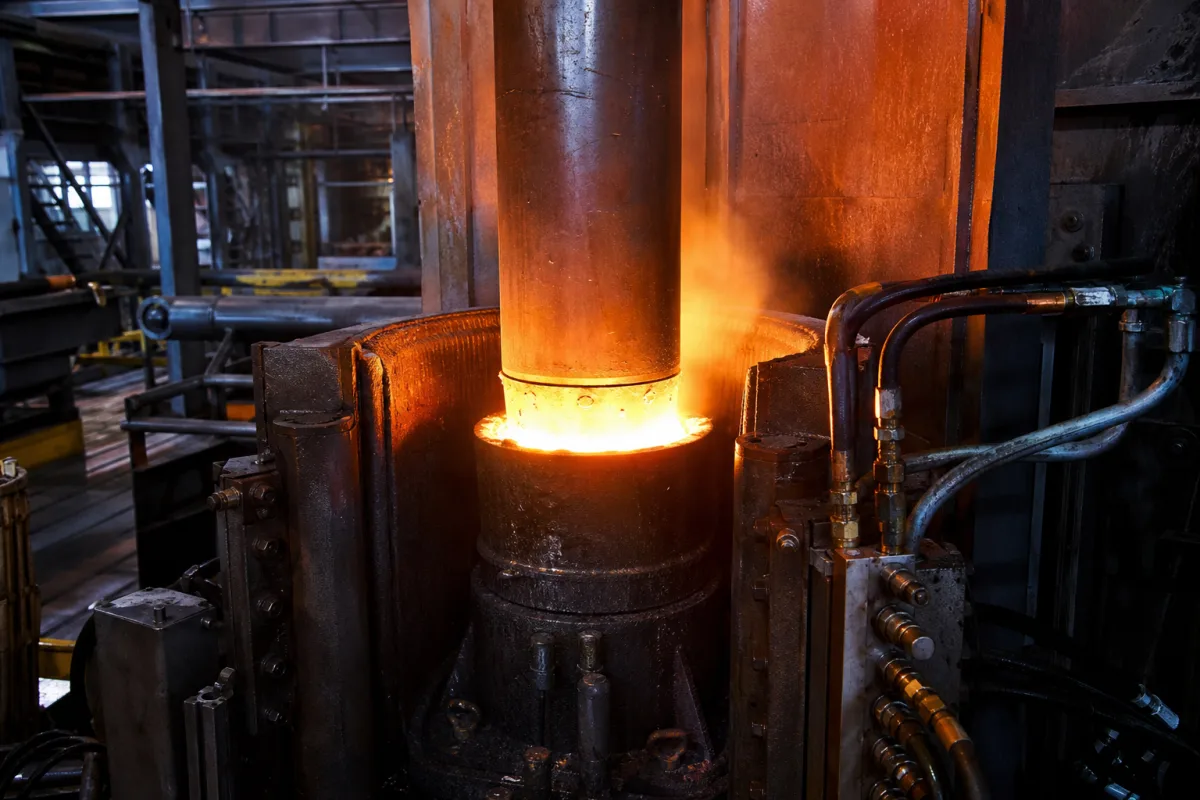
ESR furnaces · Energy per tonne and what drives it, fill ratio and electrode layout, slag resistance, melt rate and pool depth
An electroslag remelting (ESR) furnace remelts a consumable steel or alloy electrode through a bath of molten, electrically resistive slag in a water-cooled copper mould, so that refined droplets build a new, cleaner ingot from the bottom up. Ask three things first: what energy per tonne the furnace and slag will need, how the electrode-to-mould fill ratio and electrode layout suit your ingot, and how melt rate will be controlled to keep the liquid pool shallow enough for your alloy.
Electroslag remelting furnaces for steel, superalloy and other alloy ingots, single- or multi-electrode, open or under protective gas, with their power supplies, moulds and controls. Vacuum arc remelting, vacuum induction melting and electroslag welding equipment are outside this page.
CNFX editorial research · Sources checked October 12, 2026 · 5 sources
Presoly (University of Leoben), Korp (Böhler Edelstahl) and Schneider, writing in Archives of Metallurgy and Materials (2008), describe ESR as energy-intensive at roughly 1,500 kWh/t. Specific power consumption is governed above all by melting rate, and "Measures which serve to increase the melting rate normally bring about a reduction in the specific power consumption"; the main influences are electrical input, degree of filling (electrode-to-ingot diameter ratio), slag layer height and slag resistance. They put the specific slag resistance of "commonly used ESR slags" of the CaF2–CaO–Al2O3 system at 0.2–0.8 Ω·cm, and their tests found that adding MgO or CaO to CaF2 lowers conductivity. [1]
Liu, Medovar and co-authors, in China Foundry (2021), give 1,100–1,500 kWh per tonne of ingot for modern single-phase, single-electrode furnaces making ingots up to 1.5 m in diameter, noting that the long high-current loops of the monofilar layout need large copper busbars and water-cooled cables to limit losses. [2] In the Leoben–Böhler field trial, a 260 mm electrode was remelted in a 400 mm mould to make an ingot of about 2 t with just under 60 kg of slag. [1]
Editorial calculation: at 1,500 kWh/t, a 2 t ingot like the trial's needs about 3,000 kWh; at 1,100 kWh/t, about 2,200 kWh. The trial's 260/400 mm electrode and mould give a diameter ratio of 0.65, or about 0.42 by cross-section area — note that the two papers define fill ratio differently. [1][2]
Give the supplier the alloys, ingot diameter or section, ingot weight and length, electrode size and source, annual output, required melt rate and cleanliness targets, slag system, atmosphere (open, inert gas or pressurised), power supply available, cooling water, and the automation and recording required.
02
Set fill ratio, electrode layout and melt rate
Liu and co-authors explain that a single electrode allows a high filling ratio of 0.6–0.7 by cross-sectional area, letting the furnace melt at a lower rate with a shallower liquid metal pool, but large high-quality electrodes are difficult and expensive to make, and the ingot inherits segregation from the electrode. Three-phase bifilar furnaces need at least six electrodes, giving a low filling ratio of 0.15–0.35; their smaller electrodes melt faster, giving a good ingot surface but a deeper pool. [2]
Radwitz, Morscheiser and Friedrich at RWTH Aachen remelted twelve 110 mm alloy 718 electrodes in a 400 kW laboratory ESR furnace with CaF2–CaO–Al2O3 slags, varying average power from 80 to 140 kW and bulk slag height. They found a roughly linear increase of liquid pool depth with rising melt rate, with melt rate dominating over slag skin thickness, and noted that segregation-prone alloys need rapid heat extraction to shorten local solidification time. [3]
Editorial note: because faster melting saves energy per tonne but deepens the pool, ask the supplier for the melt-rate control method, the recommended melt rate for your alloy and ingot size, and evidence of pool depth or macrostructure on similar ingots.
03
Choose the plant layout and atmosphere for your ingot size and alloy
Two ESR plant builders show how layouts differ. INTECO lists static-mould plants with or without electrode exchange, combined static and collar-mould plants, an ESRR process for near-net-size blocks at a higher melting rate, pressure ESR plants up to 40 bar, laboratory furnaces, and large furnaces for ingots up to 250 t; its options include a Current Conductive Mould for segregation-prone alloys, a protective-gas system, a vacuum-tight design for evacuation before starting, a coaxial high-current loop, and a weighing system with XY adjustment for remelting control. Its reference list includes a 145 t combined furnace at Saarstahl, a 150 t static-mould furnace at Erzhong, a 250 t static-mould furnace at Forgiatura Vienna and 4 × 30 t static-mould furnaces at Uddeholm. ALD Vacuum Technologies lists a laboratory furnace for moulds up to 240 mm and 500 kg ingots, production furnaces for ingot diameters from 250 mm to 2,300 mm and weights above 150 t, round, square or slab moulds, twin stationary moulds with a pivoting furnace head, ingot-withdrawal stations with electrode exchange, and fully sealed furnaces for vacuum, inert gas or raised pressure when making ingots high in nitrogen or reactive elements. [4][5]
Editorial calculation: at the 1,100–1,500 kWh/t given above, a 150 t ingot needs about 165–225 MWh, and the 250 t reference about 275–375 MWh, so the plant's transformer, high-current loop and cooling are sized around the largest ingot. For nitrogen-alloyed steels, ask whether the furnace can run under pressure (INTECO lists up to 40 bar); for segregation-prone alloys ask about mould options such as a current-conductive mould. [4][5][2]
ESR furnaces listed with refining and induction-melting lines
Listings include ESR furnaces offered with other secondary refining equipment and large ESR furnaces from an international induction-melting group; ask each for references at your ingot size and alloy.
05
Power supply, current loop, electrode drive, mould and slag
Ingot diameter, melt rate, kWh per tonne and electrode stroke for an ESR order
Ingot diameter, energy per tonne and rated capacity carry published figures here; electrode stroke, bath voltage and cooling-water rows need the supplier's values for your ingot range. [2][5]
Field
What it means and published values
Ask the supplier for
Ingot diameter (mm)
Example 400 mm mould; single-electrode furnaces up to 1.5 m; 250–2,300 mm range. [1][2][5]
3 companies list this product among what they make. Company figures are quoted from each
company's own website; every card states where the relationship came from.
Explore company information and manufacturing capabilities, then discuss the scope of your project with a relevant supplier.
Share this page
Compiled and source-reviewed by the CNFX editorial team.
Each manufacturer above links to the page on that company's own website where the product is listed, with the date we checked it. How we source and review
· Page last updated 13 October 2026
Buyer questions
How much energy does electroslag remelting use?
About 1,500 kWh/t per the Leoben–Böhler paper; 1,100–1,500 kWh/t for single-electrode furnaces per Medovar and co-authors. [1][2]
What is fill ratio in ESR?
The electrode-to-mould ratio; single-electrode furnaces reach 0.6–0.7 by area, six-electrode bifilar ones 0.15–0.35. [2]
What slag is used in ESR?
Presoly and co-authors put the specific resistance of the CaF2–CaO–Al2O3 slags they call “commonly used ESR slags” at 0.2–0.8 Ω·cm. [1]
How does melt rate affect the ingot?
RWTH Aachen found liquid pool depth increasing roughly linearly with melt rate. [3]
How large can electroslag remelted ingots be?
ESR plant builders list ingot weights above 150 t and up to 250 t, ingot diameters up to 2,300 mm, and pressure ESR up to 40 bar for nitrogen-alloyed steels. [4][5]
Sources and what still needs a direct check
Sources checked 2026-10-12. The three sources are peer-reviewed or conference papers from the University of Leoben with Böhler, from Medovar's group with Chinese co-authors, and from RWTH Aachen; figures are those papers' results and literature values.