Industry-Verified Manufacturing Data (2026)

Metal Casting Mold Core

Based on aggregated insights from multiple verified factory profiles within the CNFX directory, the standard Metal Casting Mold Core used in the Basic Metal Manufacturing sector typically supports operational capacities ranging from standard industrial configurations to heavy-duty production requirements.

Technical Definition & Core Assembly

A canonical Metal Casting Mold Core is characterized by the integration of Core Body and Venting Channels. In industrial production environments, manufacturers listed on CNFX commonly emphasize tool steel construction to support stable, high-cycle operation across diverse manufacturing scenarios.

Removable insert for creating internal cavities in metal casting molds

Product Specifications

Technical details and manufacturing context for Metal Casting Mold Core

Definition
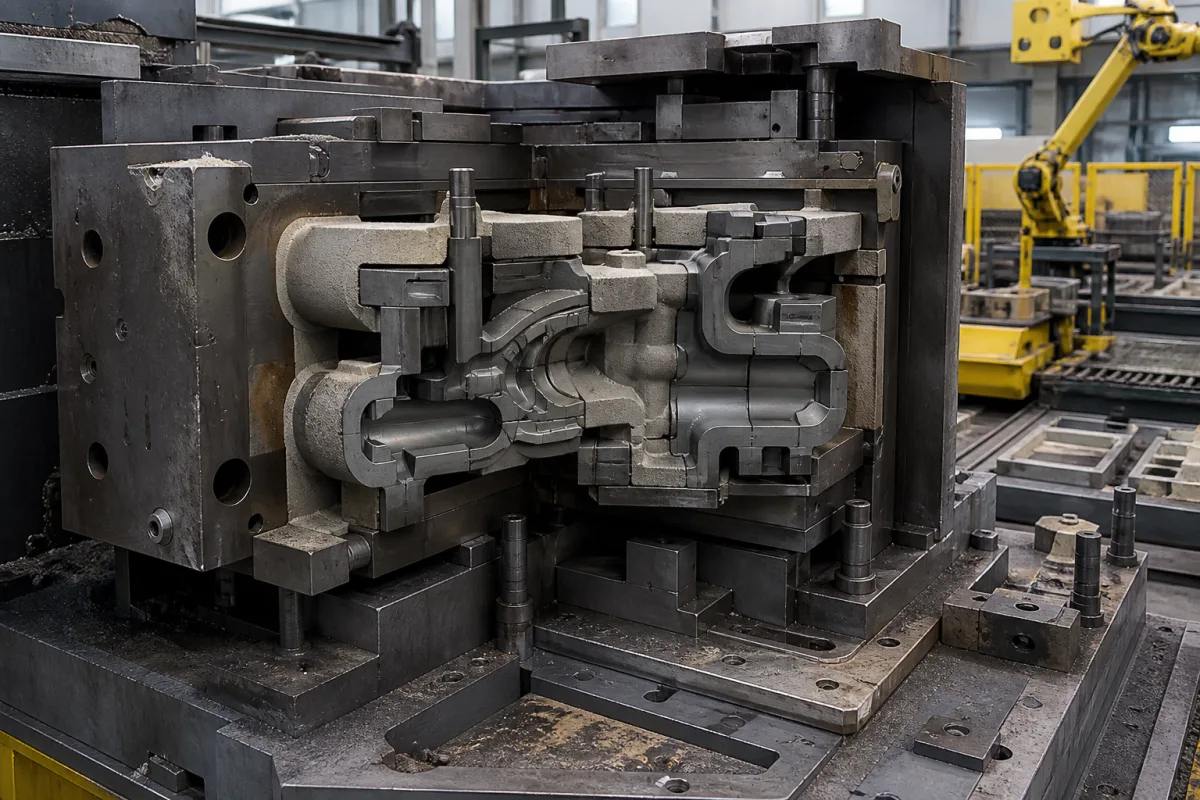
A precision-machined metal component used as a removable insert in casting molds to form internal cavities, channels, or complex geometries in cast metal products. These cores are essential for producing hollow castings, internal passages, and intricate features that cannot be formed by the main mold alone. They are manufactured to exact specifications and inserted into mold assemblies before pouring molten metal. After casting solidification, cores are removed through mechanical or chemical means, leaving the desired internal features in the finished casting.
Working Principle
Inserted into casting mold to define internal geometry, withstands molten metal pressure and temperature, then removed after casting solidification
Common Materials
tool steel, graphite, ceramic composite, sand-resin mixture
Technical Parameters
  • Precision tolerance level (mm) Per Request
  • Maximum operating temperature (°C) Per Request
Components / BOM
  • Core Body
    Forms internal casting geometry
    Material: Tool Steel
  • Venting Channels Optional
    Allows gas escape during casting
    Material: Same as body
  • Extraction Feature
    Enables core removal after casting
    Material: Same as body
Engineering Reasoning
0-850°C, 0-150 MPa compressive stress, 0.1-10 μm surface roughness
Thermal fatigue cracking at 900°C differential, compressive yield at 180 MPa, dimensional distortion beyond ±0.05 mm tolerance
Design Rationale: Thermal expansion mismatch (α=12×10⁻⁶/K for H13 steel vs α=23×10⁻⁶/K for aluminum), cyclic plastic deformation at 0.2% strain amplitude, creep deformation at 0.0001%/hour above 700°C
Risk Mitigation (FMEA)
Trigger Incomplete binder pyrolysis at 200-400°C
Mode: Gas evolution causing blowholes and porosity in castings
Strategy: Controlled thermal decomposition with 2°C/minute ramp rate to 600°C
Trigger Silica sand phase transformation at 573°C (α→β quartz)
Mode: Sudden 0.45% volume expansion causing mold cracking
Strategy: Zircon sand substitution (ZrSiO₄ stable to 1670°C)

Industry Taxonomies & Aliases

Commonly used trade names and technical identifiers for Metal Casting Mold Core.

Industrial Ecosystem & Supply Chain DNA

Complementary Systems
Downstream Applications
Specialized Tooling

Application Fit & Sizing Matrix

Operational Limits
pressure: Up to 100 MPa (14,500 psi) during injection, depending on casting process
flow rate: Not applicable - static component during casting
temperature: Ambient to 1600°C (2912°F) for ferrous alloys, lower for non-ferrous
slurry concentration: Not applicable - used with molten metal, not slurry
Media Compatibility
✓ Aluminum alloys ✓ Zinc alloys ✓ Cast iron
Unsuitable: Highly corrosive molten metals (e.g., magnesium with certain fluxes, reactive alloys)
Sizing Data Required
  • Cavity dimensions (length, width, depth)
  • Draft angle requirements
  • Required core pull force/mechanism

Reliability & Engineering Risk Analysis

Failure Mode & Root Cause
Thermal fatigue cracking
Cause: Repeated heating and cooling cycles during casting cause expansion and contraction stresses, leading to crack initiation and propagation in the mold core material.
Metal penetration and soldering
Cause: Molten metal infiltrates microscopic pores or cracks in the core surface, adhering to the core material and causing dimensional inaccuracies or core breakage during ejection.
Maintenance Indicators
  • Visible surface cracks or crazing on the core, especially in high-stress areas like corners or thin sections
  • Excessive flash or finning on cast parts, indicating core wear or dimensional degradation
Engineering Tips
  • Implement controlled preheating and cooling protocols to minimize thermal shock and reduce thermal stress gradients in the core material
  • Apply specialized refractory coatings to the core surface to enhance thermal resistance, reduce metal penetration, and improve release properties

Compliance & Manufacturing Standards

Reference Standards
ISO 8062:2020 (Dimensional and geometrical tolerances for castings) ASTM A703/A703M-22 (Steel castings, general requirements) DIN EN 1563:2018 (Founding - Spheroidal graphite cast iron)
Manufacturing Precision
  • Core print location: +/-0.5mm
  • Surface finish: Ra 3.2μm max
Quality Inspection
  • Coordinate Measuring Machine (CMM) dimensional verification
  • Visual inspection for surface defects and integrity

Factories Producing Metal Casting Mold Core

Verified manufacturers with capability to produce this product in China

✓ 97% Supplier Capability Match Found

S Sourcing Manager from Canada Jan 04, 2026
★★★★★
"Found 46+ suppliers for Metal Casting Mold Core on CNFX, but this spec remains the most cost-effective."
Technical Specifications Verified
P Procurement Specialist from United States Jan 01, 2026
★★★★☆
"The technical documentation for this Metal Casting Mold Core is very thorough, especially regarding Core Length (mm). (Delivery took slightly longer than expected, but technical support was excellent.)"
Technical Specifications Verified
T Technical Director from United Arab Emirates Dec 29, 2025
★★★★★
"Reliable performance in harsh Basic Metal Manufacturing environments. No issues with the Metal Casting Mold Core so far."
Technical Specifications Verified
Verification Protocol

“Feedback is collected from verified sourcing managers during RFQ (Request for Quote) and factory evaluation processes on CNFX. These reports represent historical performance data and technical audit summaries from our B2B manufacturing network.”

9 sourcing managers are analyzing this specification now. Last inquiry for Metal Casting Mold Core from Vietnam (46m ago).

Supply Chain Commonly Integrated Components

Purge Air System

A system that provides controlled airflow to clear optical paths and protect sensors in molten metal temperature measurement applications.

Explore Specs →
Degassing Chamber

A specialized vessel within a molten metal degassing system where dissolved gases are removed from molten metal through controlled processes.

Explore Specs →
Gas Control System

A system that regulates and controls the flow, pressure, and composition of gases used in molten metal degassing processes.

Explore Specs →
Burner Assembly

A combustion system component that generates controlled flame for heating applications in industrial preheating stations.

Explore Specs →

Frequently Asked Questions

What materials are best for high-temperature metal casting applications?

For high-temperature applications, tool steel and ceramic composite cores offer excellent thermal resistance and durability, with ceramic composites providing superior heat insulation for complex castings.

How do venting channels in mold cores prevent casting defects?

Venting channels allow gases to escape during the metal pouring process, preventing air pockets, porosity, and incomplete filling that can compromise casting quality and structural integrity.

What factors determine the optimal surface finish (Ra) for a casting mold core?

The required Ra depends on the casting metal type, desired final product surface quality, and ease of core extraction. Smoother finishes reduce friction during removal but may require specific material treatments.

Can I contact factories directly on CNFX?

CNFX is an open directory, not a transaction platform. Each factory profile provides direct contact information and production details to help you initiate direct inquiries with Chinese suppliers.

Get Quote for Metal Casting Mold Core

Request technical pricing, lead times, or customized specifications for Metal Casting Mold Core directly from verified manufacturing units.

Your business information is encrypted and only shared with verified Metal Casting Mold Core suppliers.

Thank you! Your message has been sent. We'll respond within 1–3 business days.

Need to Manufacture Metal Casting Mold Core?

Connect with verified factories specializing in this product category

Add Your Factory Contact Us
Previous Product
Material Hoppers / Lock Hoppers
Next Product
Metal Outlet