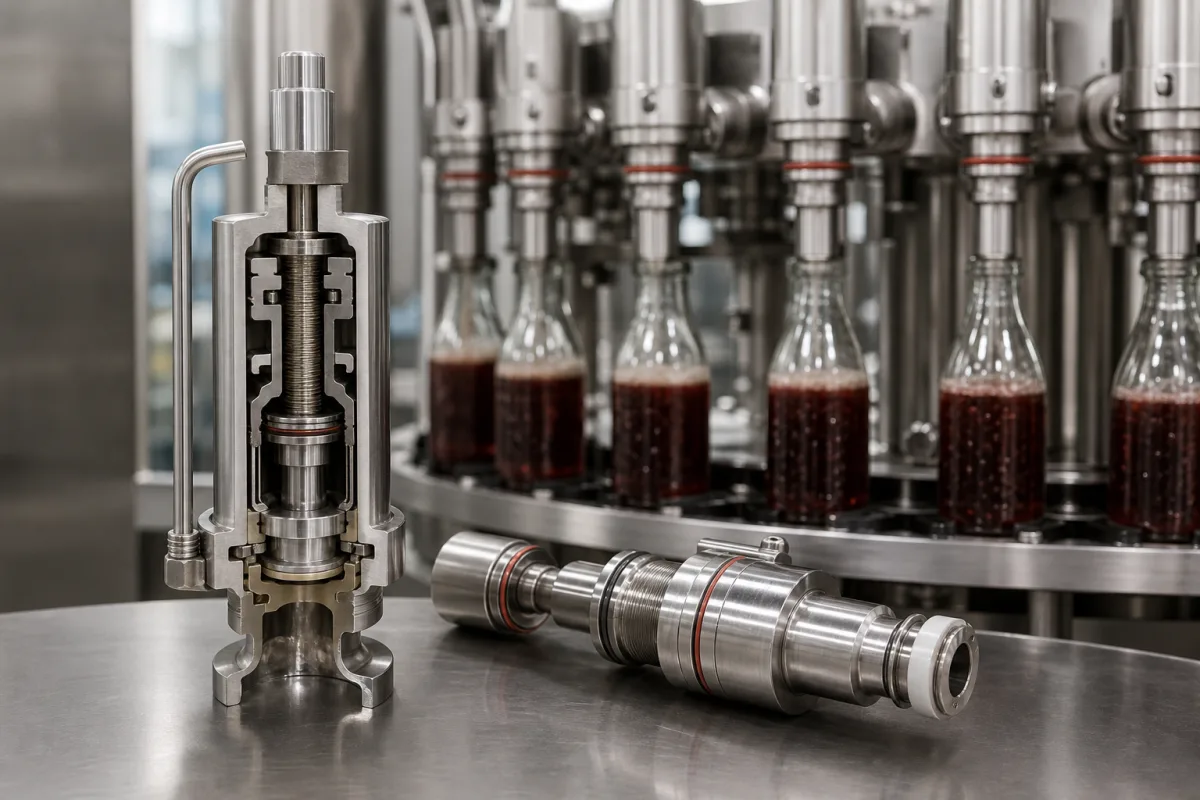
Hot-fill valve for pulpy juices and drinks with fruit pieces: single-flow valves, two-stage piece dosing and hot recirculation
Hot-fill valves and piece-dosing valves for juices, nectars and drinks with pulp, sacs, fibres or fruit pieces · single-flow or two-stage filling, particle size, product recirculation at 92–95 °C
A juice with pulp or fruit pieces is hard on a filling valve in two ways. The pieces must pass the valve seat without being crushed or jamming it, and the dose of pieces in every bottle must stay the same. When the drink is also hot-filled without preservatives, the valve has to keep product at filling temperature all the time, including when no bottle is under it. Fillers answer this either with a single valve whose passage and cut-off suit the pulp, or with two stages: the pieces dosed first as a slurry, the clear juice filled after.
Filling valves and piece-dosing valves for still juices, nectars, teas and similar drinks containing pulp, sacs, fibres or fruit pieces, mainly for hot filling into glass and PET: single-flow valves for pulp and fibres, double valves with in-line particle dosing, pre-dosing valves for fruit pieces, and hot-fill gravity valves with product recirculation. Counter-pressure valves for carbonated drinks and flowmeter valves for clear still drinks are covered on the Beverage filling nozzle assembly page; aseptic valve units with diaphragm, bellows or steam barriers on the Aseptic filling valve page, and their replaceable cores on the Aseptic beverage filling valve core page; beer fillers for glass on the Sanitary rotary bottle filler for beer page; drum and pail filling heads on the Filling head for drum and container filling of chemical liquids page; blow-fill-cap blocks on the Blowing-filling-capping combiblock page.
CNFX editorial research · Sources checked October 12, 2026 · 5 sources
Particle size decides the valve: single-flow filling below 5 mm, separate piece dosing up to 10 × 10 × 10 mm
Krones' brochure on dosing systems for particles sets out the choice by maximum particle size. In its chart, single-flow filling (conventional, hot or aseptic) stops short of the 5 × 5 × 5 mm column, while the twin-flow options reach 10 × 10 × 10 mm: a double filling valve with in-line particle dosing for aseptic lines, and the FlexiFruit pre-dosing system for hot fill. [1]
Krones says its pre-dosing stage replaced piston fillers that are not, or not completely, cleanable in place, and whose after-drip spoiled dosing accuracy; it chose diaphragm valves to stop the drip and reduce damage to the pieces. The dosing stage itself carries no measuring instrument: the whole fill is weighed on the downstream weighing-cell filler that adds the juice. [2]
Krones also states that the pre-dosing system only opens its filling valve when a bottle is positioned under it, and that its double valve keeps fruit pieces in their original shape, including sensitive juice sacs. [1] Sidel describes its particle filling as having a precise flow cut-off without dripping and contactless valves. [4] These are the makers' descriptions, not test reports; ask for piece-damage and dose-accuracy results on your own product.
Valve arrangement
How pieces reach the bottle
Published limits
Single-flow valve
Juice and pulp pass the same valve in one stream [1]
Below the 5 × 5 × 5 mm column in Krones' chart [1]
Juice and fruit dosed through the same valve, fill quantity from an inductive flowmeter, two filling speeds [1]
Particles up to 10 × 10 × 10 mm; fibres up to 2 × 15 mm [1]
Pre-dosing valve before a hot filler (Krones FlexiFruit)
Hot fruit stream dosed into the empty container by diaphragm valves, juice filled hot afterwards on the main filler [1]
Pieces up to 10 × 10 × 10 mm; mixture of around 50% fruit and 50% juice [2]
Two-stage in-line hot filler (Sidel Veloce ISD)
A set amount of particles dosed as a pumpable slurry, then the bottle filled with juice [4]
Particles up to 10 × 10 × 10 mm; slurry dose 10 to 200 ml depending on recipe and bottle of 200 ml to 2 L [4]
Give the supplier the largest piece size in three dimensions, the fibre length, the share of pieces by volume, the bottle size and the target piece dose per bottle, and ask which valve arrangement each of these figures puts you in.
02
Product at up to 92–95 °C at the valve: recirculation, bottle-opened valves and cleaning without dummy bottles
GEA's leaflet for the Fillstar HF hot-fill gravity filler describes product arriving from the pasteuriser at up to 92–95 °C depending on the product, which also sterilises the container, so bottles must be built to stand that temperature and are a few grams heavier than cold-fill bottles. [3]
Its HF RC P valve is a mobile valve: it moves down onto the bottle, contact with the bottle opens it and recirculation stops; air leaving the bottle is vented through the recirculation pipe, and once the fill level is reached recirculation restarts and a pneumatic valve closes the filling head. GEA guarantees total product recirculation through the machine of less than 10% with all bottle formats, and the head keeps recirculating when no bottles are on the machine so that it stays hot. [3]
A timed opening of the pneumatic valve sets the recirculation rate, and a membrane valve in the pneumatic version controls that rate and prevents splash-out. The valve has a closed cleaning loop, so CIP does not need dummy bottles, and the filling head converts between brimful and level filling without tools. [3]
For glass bottles Krones names the Modulfill HES as its hot-fill filler, and the Modulfill VFJ for PET; it lists automatic heating circulation in all production conditions among their features. [1] Sidel's Matrix hot filler, as reported by BeverageDaily, handles high- and low-acid products in PET from 200 ml to 2 L at 6,000 to 60,000 bottles per hour, including drinks with pulp, fruit pieces, sacs or fibres through its Integrated Slurry Dosing. [5]
Hot-fill valve item
Published value or behaviour
Product temperature at the filler
Up to 92–95 °C depending on product (GEA Fillstar HF) [3]
Mobile valve opened by contact with the bottle [3]
Cleaning
Closed loop inside the valve; no dummy bottles for CIP [3]
Fill mode
Brimful or level filling, changed without tools [3]
Container
Glass (Krones Modulfill HES) or PET (Modulfill VFJ; Sidel Matrix 200 ml–2 L) [1][5]
Ask for the product temperature the valve holds with no bottles running, the recirculation share, the fill mode (brimful or level), and whether CIP needs dummy bottles or cups.
03
Product and container data a pulpy-juice valve quote needs
Paste it into your enquiry below or into an email to a maker, then replace every bracket.
Product: [juice/nectar/tea; pH; viscosity; pulp, sacs, fibres or pieces]
Pieces: [largest size L × W × H mm; fibre length; share by volume; dose per bottle ml]
Process: [hot fill temperature; aseptic or preserved]
Container: [glass or PET; volume; neck finish; heat-set rating]
Filling: [single-flow or two-stage; brimful or level; bottles per hour]
Cleaning: [CIP with or without dummy bottles]
Evidence: [piece-damage and dose-accuracy trials on our product]
Explore company information and manufacturing capabilities, then discuss the scope of your project with a relevant supplier.
Share this page
Compiled and source-reviewed by the CNFX editorial team.
Each manufacturer above links to the page on that company's own website where the product is listed, with the date we checked it. How we source and review
· Page last updated 13 October 2026
Buyer questions
What size of fruit pieces can a filling valve handle?
Krones and Sidel both publish 10 × 10 × 10 mm as the upper limit of their separate piece-dosing systems; Krones gives fibres up to 2 × 15 mm for its double valve. [1][4]
Why dose fruit pieces before the juice?
Krones and Sidel dose the pieces separately so each bottle gets a set quantity and the pieces are not damaged; Sidel doses 10 to 200 ml of slurry before the juice depending on recipe and bottle. [1][4]
How does a hot-fill valve stay hot between bottles?
GEA's Fillstar HF valve keeps product recirculating when no bottle is present, with total recirculation under 10%, and product arrives at up to 92–95 °C. [3]
Sources and what still needs a direct check
Sources checked 2026-10-12. The valve data come from Krones and GEA literature; Sidel's figures and further Krones detail are the makers' statements as reported by FoodIngredientsFirst, BeverageDaily and Petnology.