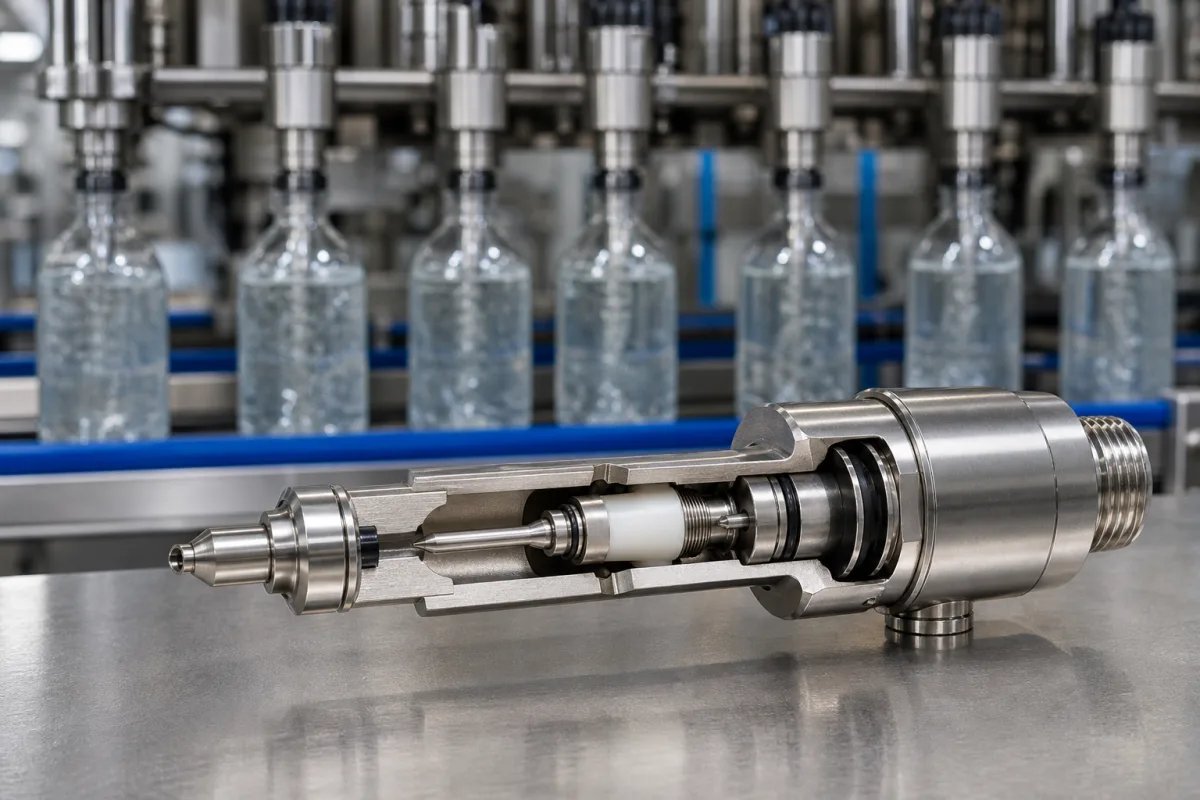
Beverage filling nozzle assembly for bottle and can fillers
Bottle filler valve · counter-pressure gas for carbonated drinks, flowmeter dosing for still drinks, food-contact seals
A beverage filling nozzle assembly is the valve-and-nozzle unit fitted at each station of a bottle or can filler: a stainless body, a valve stem and seat that open and close the liquid path, seals, and an actuator, with a vent tube or gas path when the drink is carbonated. Decide three things before asking for a quotation: whether the drink needs counter-pressure filling, how the dose is measured, and which seal materials touch the product.
Per-station filling valves and nozzle assemblies for rotary and inline beverage fillers that fill bottles and cans with water, soft drinks, juice, beer and similar drinks, including counter-pressure valves for carbonated products and flowmeter-controlled valves for still products. Filling heads and lances for drums, pails and chemical liquids are covered on the Filling head for drum and container filling of chemical liquids page; complete filling machines, cappers and adhesive dispensing needles are outside this page. For the machines these valves are mounted on, see the Sanitary rotary bottle filler for beer in glass bottles page and the Blowing-filling-capping combiblock page.
CNFX editorial research · Sources checked October 12, 2026 · 4 sources
Pressurise the container before a carbonated drink flows
Crown Cork & Seal's European patent application EP0492030A1 for an improved filling valve describes counterpressure filling machines in which the containers are first filled with a gas under pressure, for example CO₂ at about 40 psi, before the carbonated liquid is admitted. In its described embodiment the reservoir above the liquid holds nitrogen or carbon dioxide at 40–45 psi. [1]
The same application places a vent tube in the valve body, sliding from a retracted position into the container as the counterpressure gas enters, so the filling bell only has to travel about 1/4 inch to seal against the container. [1] Editorial calculation: 40–45 psi is about 2.8–3.1 bar, and 1/4 inch is 6.35 mm.
Editorial note: the gas pressure, vent tube length and snift (pressure relief) sequence are matched to the drink's carbonation and the container; give the supplier the CO₂ volumes, product temperature and container type so the valve and vent tube can be specified together.
Give the supplier the drink (still or carbonated, CO₂ level, pulp or particles), product temperature, container type and neck, fill volume and level tolerance, line output, cleaning method (CIP/SIP), seal material compliance required, and the filler model the valves must fit.
02
Meter the dose with a flowmeter on each valve
European patent application EP0274338A1, filed by Construcciones y Estructuras Metálicas, describes volumetric filling with a flowmeter in the supply line: its pulses are counted, and when the preset count is reached a circuit closes the solenoid valve on the filling head. The applicant states that earlier devices did not reach ±0.5% accuracy and that its device achieves better than ±0.1%. [2]
Editorial calculation: on a 500 ml fill, ±0.5% is ±2.5 ml and ±0.1% is ±0.5 ml.
SIPA's Bigfill filler for large PET bottles uses a valve with a magnetic flow meter to define the content of each bottle, with no filling tube entering the bottle, and lists 12 to 36 valves, output of 2,800 to 18,000 bottles per hour on 5 litres of water, containers up to 20 litres, AISI 316L steel for all product-contact parts, and a circuit preset for CIP and SIP up to 100 °C. [3] Editorial calculation: 18,000 bottles per hour over 36 valves is 500 bottles per valve per hour, or one cycle every 7.2 seconds.
03
Filling valves, not SMT or adhesive nozzles
No manufacturer listing linked to this page has been confirmed to offer beverage filling valves; the companies reviewed list SMT pick-and-place nozzles or adhesive dispensing nozzles, which are different products.
When comparing quotations, ask each supplier whether the valve is mechanical (gravity or counter-pressure) or electronic (flowmeter or weight controlled), which filler models it fits, and for the material certificates of every part that touches the drink.
04
Body, valve stem, vent tube and gas valve: what a filling nozzle is built from
Part
Role
Fix in the order
Nozzle body
Carries the liquid path from the filler bowl or manifold; SIPA lists AISI 316L for product-contact parts. [3]
Material grade and surface finish.
Valve stem and seat
Opens and closes the liquid flow.
Stroke, seat geometry and seal.
Vent tube (carbonated)
Returns gas and sets the fill level; slides into the container in the Crown Cork & Seal design. [1]
Length and fill-level setting.
Counterpressure gas valve
Admits CO₂ or nitrogen to the container before filling. [1]
Under 21 CFR 177.2600, rubber articles for repeated use in contact with aqueous food, when extracted with distilled water at reflux temperature, may yield total extractives of no more than 20 mg per square inch in the first 7 hours and no more than 1 mg per square inch in the following 2 hours; for fatty foods the n-hexane limits are 175 mg and 4 mg per square inch. The regulation also requires finished rubber articles to be thoroughly cleansed before their first use with food. [4]
Editorial note: drinks such as water, juice and soft drinks are aqueous, so the water-extraction limits apply to the seal kit in those uses; ask the supplier for the compound name and its compliance statement, not a generic "food grade" label.
06
Seal compounds, counterpressure and dosing accuracy at the valve
Field
What it means and published values
Ask the supplier for
Orifice diameter (mm)
Outlet size; sets flow and splash.
Diameter for your neck finish.
Maximum flow rate (L/min)
Liquid flow with the valve fully open.
Rated flow for your product.
Operating pressure range (bar)
Example counterpressure of 40–45 psi (about 2.8–3.1 bar). [1]
Explore company information and manufacturing capabilities, then discuss the scope of your project with a relevant supplier.
Share this page
Compiled and source-reviewed by the CNFX editorial team.
Each manufacturer above links to the page on that company's own website where the product is listed, with the date we checked it. How we source and review
· Page last updated 13 October 2026
Buyer questions
Why do carbonated drinks need a counter-pressure filling valve?
The container is pressurised with gas before the liquid flows; a Crown Cork & Seal patent gives CO₂ at about 40 psi as an example. [1]
How accurate can a flowmeter-controlled filling valve be?
One patent applicant claims better than ±0.1%, against earlier devices that did not reach ±0.5%; ask for tested figures at your fill volume. [2]
What rules apply to rubber seals in a beverage nozzle?
In the US, 21 CFR 177.2600 sets extractive limits for rubber articles in repeated food contact, such as 20 mg per square inch in the first 7 hours of water extraction. [4]
How many filling valves does a rotary filler carry?
It depends on the model; SIPA lists 12 to 36 valves for its Bigfill large-bottle filler. [3]
Sources and what still needs a direct check
Sources checked 2026-10-12. Two European patent applications describe counter-pressure and flowmeter filling valves in their applicants' own words; SIPA describes its own filler; 21 CFR 177.2600 is the US FDA regulation for rubber in repeated food contact.