Central PLC for a beverage blending and bottling line: equipment phases, ISA-88 states and PackML interfaces
How the line PLC of a beverage blending and bottling plant is programmed · one ISA-88 equipment phase per activity (add water, mix, fill), a shared state model, and PackML modes, speeds and interlocks to talk to filler and packer
A beverage plant's central PLC starts the water feed, runs the mixer, holds the tank when the filler backs up and tells the packer how fast to run. How well it does that depends less on the CPU than on how its program is structured. Batch-control and packaging-machine standards give the structure: each activity of the plant becomes an equipment phase with a fixed set of states, and machines on the line exchange modes, states and speeds through standard tags, so that the blending room and the bottling line speak the same language.
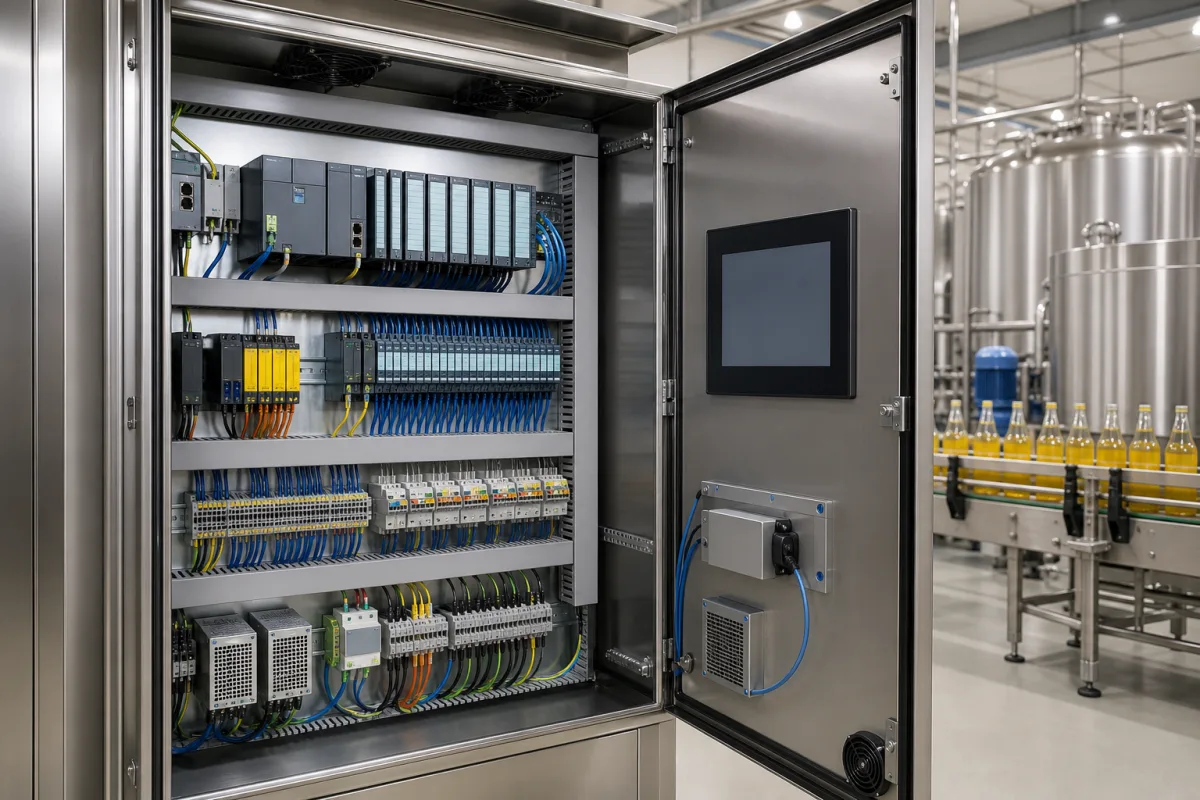
The central programmable controller of a beverage blending and bottling line, viewed through its control program: ISA-88 equipment phases, state models (S88, PackML, PhaseManager), unit modes, and the PackML tags exchanged with fillers, labellers and packers. PLC hardware selection, I/O expansion and 24 V budgeting are covered on the Programmable logic controller page; engineering delivery and acceptance tests on the PLC control system as an engineered delivery page; EtherCAT bus masters, fieldbus remote I/O, redundant and safety PLCs on their own pages; the blending process, metering and Brix control on the Automated beverage batch blending system page; the stainless washdown cabinet and HMI on the PLC/HMI control panel for washdown beverage lines page; line control for car-body welding on the Central control system for robotic body-in-white welding lines page.
CNFX editorial research · Sources checked October 12, 2026 · 3 sources
One equipment phase per activity: add water, mix ingredients, fill bottles
Rockwell Automation's PhaseManager manual describes an equipment phase as a program that uses a state model and directs one activity of the equipment, with the controller's embedded state machine calling the routine for each state and enforcing allowed transitions. Its sizing rule is that each phase should be a relatively independent activity, and three of its examples — fill bottles, run a bottling line, brew ingredients — are drinks-plant activities. [1]
The manual's tank example splits cooking into five phases — add water, heat the water, add other ingredients, mix, dispense — and pairs each phase with its equipment, such as Add_Water with the water pump, water valve and limit switch. [1] It caps the count per task at 100 programs and equipment phases on ControlLogix and SoftLogix, and 32 on CompactLogix and FlexLogix. [1]
Editorial calculation: a five-phase blending tank uses 5 of the 32 phases a CompactLogix task allows; a syrup room with six such tanks would need 30, which is near that limit, while a ControlLogix task would still have 70 left. Count phases per task before choosing the controller family.
Ask the integrator for a phase list — each activity, its equipment and the task it runs in — with the count per task against the controller's limit.
02
The states every phase reports, and how S88, PackML and PhaseManager names line up
PhaseManager's model has acting states (Resetting, Running, Holding, Restarting, Stopping, Aborting) and waiting states (Idle, Complete, Held, Stopped, Aborted); from Complete or Stopped the phase can only go to Resetting, which the manual says reduces the interlocking the programmer must write. [1] The manual compares the three models:
Ownership decides who may command a phase: the programming software, an internal sequencer in the controller, or an external batch server; whichever owns it locks the others out, except that an override instruction can still issue hold, stop or abort. [1] The manual's case for the model is practical: an HMI that shows idle, run or hold means the same thing on every machine, and consistent tags make it easier to plug equipment into the plant. [1]
Editorial note: the table maps PackML's 'Producing' and 'Standby' to S88 and PhaseManager states as Rockwell's manual presents it; the current PackML technical report uses its own state names (next section), so agree one mapping table for the whole line before programming starts.
Talking to the filler and packer: PackML modes, speed in primary packages per minute, material interlocks
The OPC Foundation's PackML companion specification (OPC 30050) carries ISA-TR88.00.02-2015 into OPC UA. It describes unit modes such as producing, maintenance, manual, clean and calibration, each an ordered subset of states; the Suspended state, used when equipment stops because of an external event, exists in producing mode but not in maintenance mode, and neither does Complete. [2]
Machine speed set points are expressed in primary packages per minute so that every machine on the line is driven from one normalised rate. A material interlock word carries one bit per material, 1 for ready and 0 for not ready or low, with the bit meanings set by the machine supplier; a remote interface array coordinates upstream and downstream machines. [2] The specification also defines product and ingredient data structures — a product ID with its process variables and an array of ingredients, each with an ID and parameters. [2]
The specification's state machines name Stopped, Starting, Idle, Suspending, Suspended, Unsuspending, Execute, Stopping, Aborting, Aborted, Holding, Held, Unholding, Completing, Complete, Resetting and Clearing, grouped under Cleared and Running super-states. [2] Editorial count: that is 17 named states. ISA has since issued ISA-TR88.00.02-2022, whose contents list production, maintenance, manual and user-defined mode examples and an annex of changes from the earlier report. [3]
Editorial note: a blending room upstream of the filler can use the material interlock bits to tell the filler that syrup or finished beverage is ready; agree the bit list between the blending-room PLC and the filler supplier.
Machine on a 1,000 packages/min bottle line (OPC 30050 example)
State the PackML edition (2015 or 2022), the modes each machine must support, the line's primary-package unit, and the material interlock bits exchanged between blending room, filler and packer.
04
What to send for a beverage line's central PLC program
Paste it into your enquiry below or into an email to a maker, then replace every bracket.
Plant: [syrup room / blending tanks / filler / labeller / packer]
Phases: [activity list with equipment per phase; phases per task]
State model: [S88 / PackML / vendor model; mapping table]
Modes: [producing; maintenance; manual; clean]
Line interface: [primary-package unit and line speed; material interlock bits; remote interface]
Recipes: [product IDs; ingredients and parameters]
Explore company information and manufacturing capabilities, then discuss the scope of your project with a relevant supplier.
Share this page
Compiled and source-reviewed by the CNFX editorial team.
Each manufacturer above links to the page on that company's own website where the product is listed, with the date we checked it. How we source and review
· Page last updated 13 October 2026
Buyer questions
What is an equipment phase in a PLC?
In Rockwell's PhaseManager it is a program for one activity, such as adding water or filling bottles, that runs a built-in state model. [1]
How many equipment phases can a controller run?
Rockwell lists up to 100 programs and equipment phases per task on ControlLogix and SoftLogix, and 32 on CompactLogix and FlexLogix. [1]
Why express machine speed in primary packages?
OPC 30050 normalises every machine to one line rate; at 1,000 bottles/min a 24-pack depalletiser runs 41.667 and a 15-pack packer 66.667 actual counts. [2]
Is there a newer PackML report than 2015?
Yes, ISA-TR88.00.02-2022, which includes production, maintenance, manual and user-defined mode examples. [3]
Sources and what still needs a direct check
Sources checked 2026-10-12. Equipment phases, their limits and the state-model comparison come from Rockwell Automation's PhaseManager user manual; PackML modes, machine speed, interlocks and data structures from the OPC Foundation's PackML companion specification; the 2022 edition of the PackML technical report from ISA's published preview.