Industry-Verified Manufacturing Data (2026)

In-line Mixer/Static Mixer

Based on aggregated insights from multiple verified factory profiles within the CNFX directory, the standard In-line Mixer/Static Mixer used in the Beverage Manufacturing sector typically supports operational capacities ranging from standard industrial configurations to heavy-duty production requirements.

Technical Definition & Core Assembly

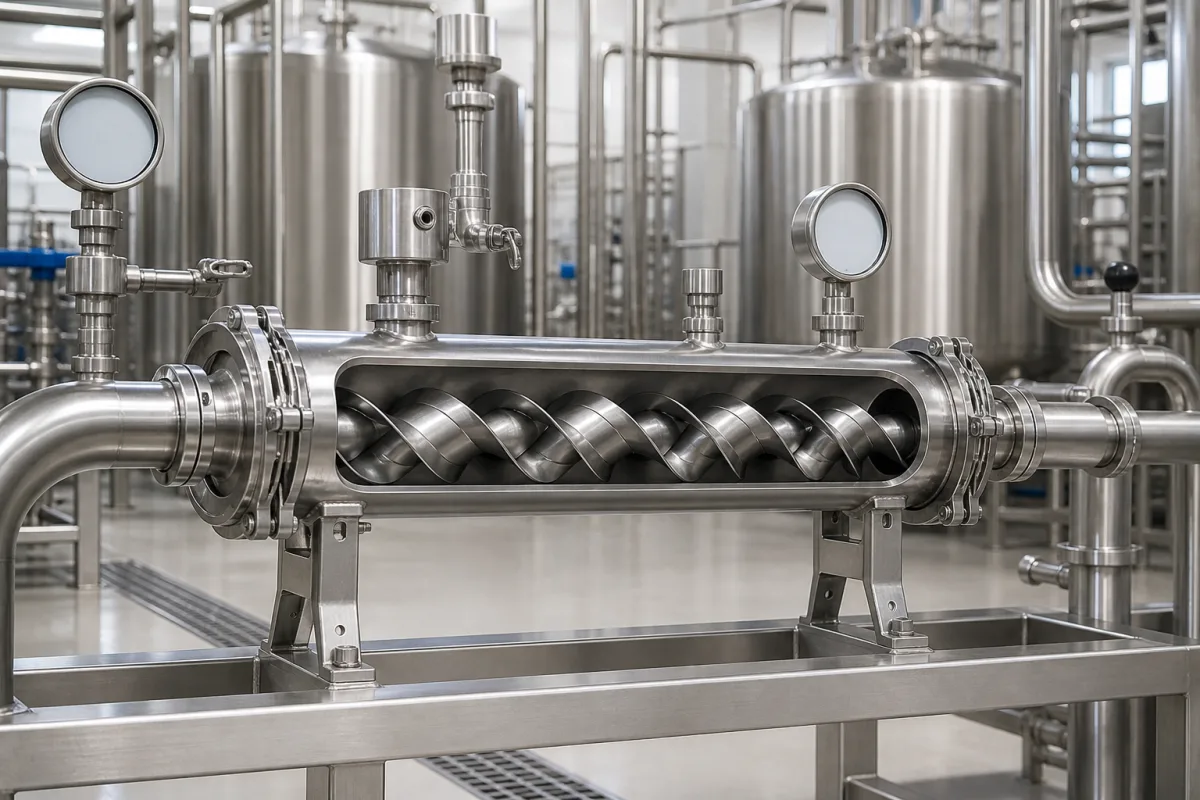
A canonical In-line Mixer/Static Mixer is characterized by the integration of Mixing Element and Housing/Pipe Section. In industrial production environments, manufacturers listed on CNFX commonly emphasize Stainless Steel 316L construction to support stable, high-cycle operation across diverse manufacturing scenarios.

A stationary mixing device installed directly in a pipeline that blends beverage ingredients through geometric flow manipulation without moving parts.
Product Specifications

Technical details and manufacturing context for In-line Mixer/Static Mixer

Definition
An in-line mixer/static mixer is a fixed-element component within an Automated Beverage Batch Blending System that ensures homogeneous blending of liquid ingredients (water, syrups, flavorings, additives) as they flow through the pipeline. It operates continuously during the transfer process between storage tanks and final blending vessels, providing consistent mixing without external energy input beyond the system's pumping pressure.
Working Principle
The mixer contains a series of fixed helical or geometric elements arranged inside a pipe. As beverage ingredients flow through under system pressure, these elements repeatedly divide, rotate, and recombine the fluid streams, creating turbulent flow patterns that achieve thorough mixing through laminar flow redistribution and interfacial surface area generation.
Common Materials
Stainless Steel 316L, Food-Grade Plastics
Technical Parameters
  • Pipe diameter of the in-line mixer/static mixer (mm) Standard Spec
Components / BOM
  • Mixing Element
    Geometric insert that divides and recombines fluid streams to create mixing action
    Material: Stainless Steel 316L
  • Housing/Pipe Section
    Structural enclosure that contains mixing elements and connects to pipeline
    Material: Stainless Steel 316L
  • End Connections
    Flanged or threaded fittings for pipeline integration
    Material: Stainless Steel 316L
  • Inspection Port
    Removable cover for visual inspection and cleaning access
    Material: Stainless Steel 316L
Engineering Reasoning
0.5-6.0 bar differential pressure, 1-10 m/s flow velocity, -10°C to 120°C temperature
Material yield strength exceeded at 207 MPa (304 stainless steel), cavitation threshold at vapor pressure <0.023 bar absolute, erosion-corrosion at flow velocity >15 m/s
Design Rationale: Pressure-induced material fatigue from cyclic stress exceeding endurance limit (σ_e=138 MPa for 304 SS), cavitation bubble collapse causing pitting at implosion pressures >1000 bar, turbulent flow erosion at Reynolds numbers >4000 with abrasive particles
Risk Mitigation (FMEA)
Trigger Particulate contamination exceeding 50 μm diameter at concentrations >100 ppm
Mode: Geometric element clogging with 80% flow restriction
Strategy: Install 20 μm absolute filtration upstream with differential pressure monitoring at 0.3 bar threshold
Trigger Thermal cycling between 20°C and 100°C at >5 cycles/hour
Mode: Differential thermal expansion stress cracking at weld joints
Strategy: Design with controlled expansion joints using Invar 36 inserts (α=1.2×10^-6/°C) at critical connections

Industry Taxonomies & Aliases

Commonly used trade names and technical identifiers for In-line Mixer/Static Mixer.

Applied To / Applications

This component is essential for the following industrial systems and equipment:

Industrial Ecosystem & Supply Chain DNA

Complementary Systems
Downstream Applications
Specialized Tooling

Application Fit & Sizing Matrix

Operational Limits
pressure: Up to 150 psi (10 bar) standard, higher ratings available
flow rate: 0.5 to 500 GPM (1.9 to 1893 L/min)
temperature: -20°C to 150°C (dependent on material of construction)
slurry concentration: Up to 40% solids by weight (dependent on particle size and viscosity)
Media Compatibility
✓ Carbonated beverages (CO2 dispersion) ✓ Fruit juice concentrates (viscous blending) ✓ Dairy-based drinks (emulsion stabilization)
Unsuitable: Highly abrasive slurries with large particulate (>500 microns)
Sizing Data Required
  • Required flow rate (GPM or L/min)
  • Fluid viscosity (cP) at operating temperature
  • Desired mixing intensity (number of mixing elements or length)

Reliability & Engineering Risk Analysis

Failure Mode & Root Cause
Internal fouling and material buildup
Cause: Accumulation of process materials, solids, or scale on mixing elements due to improper material compatibility, inadequate cleaning procedures, or operating outside design flow rates and temperatures
Structural fatigue and weld failure
Cause: Cyclic pressure fluctuations, flow-induced vibration, or thermal expansion stresses exceeding design limits, often exacerbated by improper installation, support, or operating beyond rated pressure/temperature ranges
Maintenance Indicators
  • Significant pressure drop increase across mixer (exceeding 10-15% of baseline)
  • Audible vibration, rattling, or hammering noises during operation
Engineering Tips
  • Implement regular pigging or chemical cleaning protocols based on process analysis to prevent fouling, and install pressure gauges upstream/downstream for continuous monitoring
  • Ensure proper piping alignment during installation, add vibration dampeners if needed, and maintain operating parameters within 80-110% of design flow rates to minimize stress concentrations

Compliance & Manufacturing Standards

Reference Standards
ISO 28580:2011 (Static mixers - General requirements) ASME BPE-2019 (Bioprocessing equipment standards) DIN 11850-1:2014 (Stainless steel tubes for the food, chemical and pharmaceutical industries)
Manufacturing Precision
  • Bore diameter tolerance: +/-0.05 mm
  • Flatness of flange faces: 0.1 mm per 300 mm diameter
Quality Inspection
  • Dye Penetrant Testing (PT) for weld integrity
  • Material Composition Verification via Spectrographic Analysis

Factories Producing In-line Mixer/Static Mixer

Verified manufacturers with capability to produce this product in China

✓ 93% Supplier Capability Match Found

T Technical Director from Germany Jan 14, 2026
★★★★★
"Impressive build quality. Especially the Flow Rate (L/min) is very stable during long-term operation."
Technical Specifications Verified
P Project Engineer from Brazil Jan 11, 2026
★★★★☆
"As a professional in the Beverage Manufacturing sector, I confirm this In-line Mixer/Static Mixer meets all ISO standards. (Delivery took slightly longer than expected, but technical support was excellent.)"
Technical Specifications Verified
S Sourcing Manager from Canada Jan 08, 2026
★★★★★
"Standard OEM quality for Beverage Manufacturing applications. The In-line Mixer/Static Mixer arrived with full certification."
Technical Specifications Verified
Verification Protocol

“Feedback is collected from verified sourcing managers during RFQ (Request for Quote) and factory evaluation processes on CNFX. These reports represent historical performance data and technical audit summaries from our B2B manufacturing network.”

12 sourcing managers are analyzing this specification now. Last inquiry for In-line Mixer/Static Mixer from Vietnam (15m ago).

Supply Chain Compatible Machinery & Devices

Automated Beverage Batch Blending System

Automated system for precise multi-ingredient beverage batch preparation.

Explore Specs →
Automated Beverage Container Sterilization System

Automated system for sterilizing beverage containers before filling.

Explore Specs →
Automated Beverage Labeling and Coding System

Integrated system for applying labels and printing codes on beverage containers.

Explore Specs →
Automated Beverage Ingredient Dispensing System

Automated system for precise dispensing of beverage ingredients into production lines.

Explore Specs →

Frequently Asked Questions

How does a static mixer blend beverages without moving parts?

A static mixer uses precisely engineered internal elements to create turbulent flow patterns that thoroughly blend beverage ingredients as they pass through the pipeline, eliminating the need for mechanical agitation.

Why is stainless steel 316L preferred for beverage static mixers?

Stainless steel 316L offers superior corrosion resistance against acidic beverage ingredients, meets food safety standards, and provides durability for high-volume production environments while maintaining product purity.

What factors determine the number of mixing elements needed?

The number of elements depends on beverage viscosity, required mixing homogeneity, flow rate, and pipeline diameter. More elements typically provide more thorough blending but increase pressure drop.

Can I contact factories directly on CNFX?

CNFX is an open directory, not a transaction platform. Each factory profile provides direct contact information and production details to help you initiate direct inquiries with Chinese suppliers.

Get Quote for In-line Mixer/Static Mixer

Request technical pricing, lead times, or customized specifications for In-line Mixer/Static Mixer directly from verified manufacturing units.

Your business information is encrypted and only shared with verified In-line Mixer/Static Mixer suppliers.

Thank you! Your message has been sent. We'll respond within 1–3 business days.

Need to Manufacture In-line Mixer/Static Mixer?

Connect with verified factories specializing in this product category

Add Your Factory Contact Us
Previous Product
In-Line Homogenizer
Next Product
In-Line Temperature Control Unit