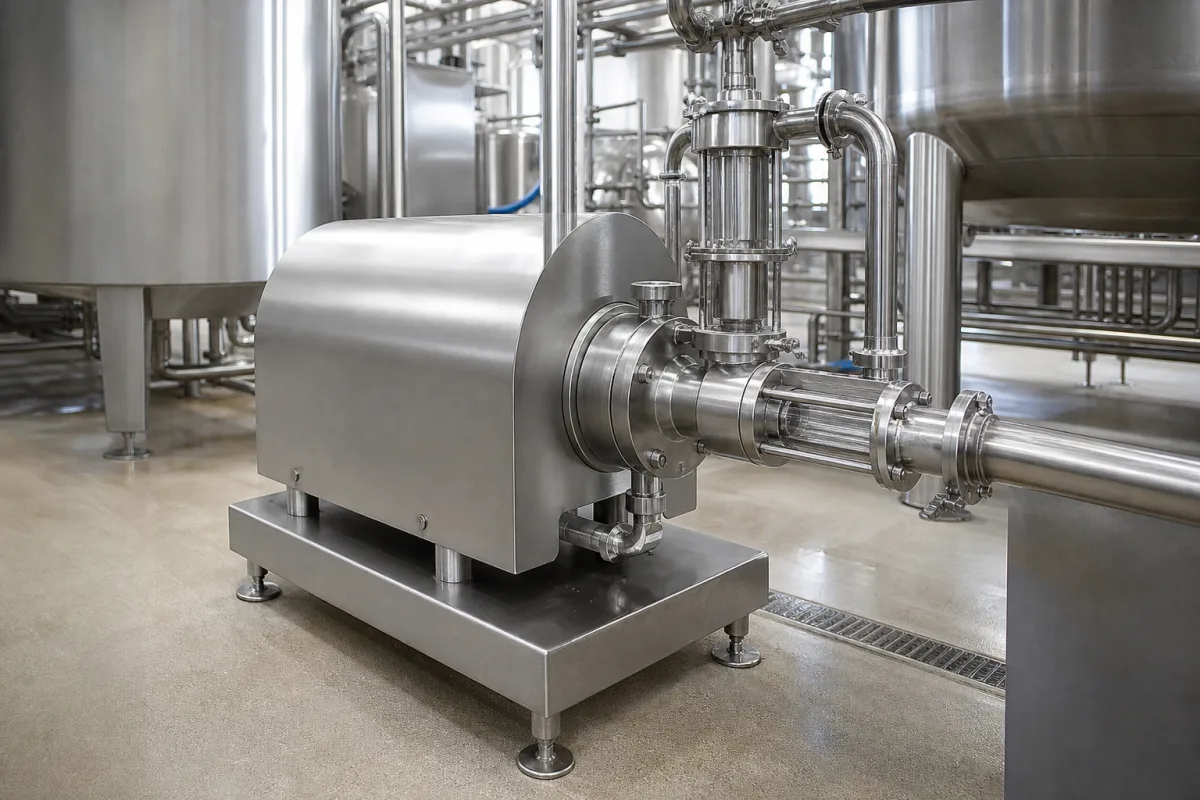
Rotor–stator in-line mixers · how the workhead shears, tip speed and shear-rate claims, self-pumping capacity, pressure rating, sanitary build and CIP
An in-line homogenizer, in the sense used here, is a high-shear rotor–stator mixer mounted in a pipeline or recirculation loop: a high-speed rotor draws product into a close-fitting stator and forces it out through the stator openings, emulsifying, dispersing and dissolving solids in syrups, sauces and similar liquids as they pass. Ask three things first: which workhead and how many passes your product needs, what flow and pressure the unit handles with your viscosity, and whether its seals, materials and connections suit your cleaning regime.
In-line (continuous) high-shear rotor–stator mixers and homogenizers for food, beverage, cosmetic and pharmaceutical liquids, single- or multistage. High-pressure valve homogenizers (a separate product page), batch high-shear mixers in tanks, colloid mills and static mixers are outside this page except where compared.
CNFX editorial research · Sources checked October 12, 2026 · 4 sources
Silverson describes its in-line mixers in three stages: the high-speed rotor draws liquid and solids into the rotor/stator workhead; centrifugal force drives them to the periphery, where they are milled in the clearance between rotor blade tips and stator wall; then they are forced at high velocity out through the stator perforations, under intense hydraulic shear, into the outlet pipe while fresh material is drawn in. Interchangeable workheads let one machine mix, emulsify, homogenize, disperse or disintegrate, and multistage workheads add shearing actions per revolution for faster mixing or single-pass processing. [1]
Ginhong, a mixer maker linked to this page, distinguishes batch high-shear mixers in a tank from inline high-shear mixers with an inlet and outlet that run continuously with the impeller acting as a centrifugal pump, and states that high-shear mixers have tip speeds of 10 to 50 m/s and shear rates of 20,000 to 100,000 s⁻¹. [3]
Editorial calculation: a 100 mm rotor at 3,600 rpm has a tip speed of π × 0.1 m × 3,600 / 60 ≈ 18.8 m/s. Rotor diameter is an assumed example (motor speed from Silverson's 60 Hz table); ask the supplier for the rotor diameter, gap and tip speed of the workhead quoted, since tip speed and shear rate are not interchangeable figures. [2]
Give the supplier the product and its viscosity and solids, the result needed (emulsion droplet size, dissolution, dispersion), batch size or continuous flow, number of passes, inlet pressure and temperature, viscosity changes during processing, cleaning (CIP/SIP), connection standard, motor and hazardous-area requirements, and power supply.
02
Check flow, pressure, materials and cleaning
Silverson's technical sheet for its in-line mixers lists self-pumping throughputs of up to 1,100 US gallons per minute, a standard operating pressure of 150 psi (10 bar) with higher pressures on request, product-contact parts in 316L stainless steel, Viton as standard elastomer with EPDM and PTFE options, single, double or ultra-sanitary mechanical seals, Tri-Clamp or flange connections, and design for CIP and SIP; its 60 Hz table lists motors from 2 hp to 125+ hp at 3,600 rpm with 1½ to 4 inch connections. [2]
Editorial calculation: recirculating a 2,000 L syrup tank through an in-line mixer at 200 L/min turns the tank over once every 2,000 / 200 = 10 minutes; if the product needs five passes on average, allow about 50 minutes. Tank volume, flow and pass count are assumed examples; confirm pass requirements in a trial.
03
Compare tip speed, stages, power and seal pressure from a second maker
Ross (Charles Ross & Son) describes its inline high-shear mixer as a single-, dual- or four-stage rotor turning at high speed inside a stationary stator, with tip speeds of 3,000 to 4,000 ft/min, and says the inline rotor/stator mixer behaves like a centrifugal pumping device. Its production models run from 1.5 HP to 200 HP on explosion-proof (Class 1, Group D) 230/460 V three-phase inverter-duty motors, with a standard single-stage rotor/stator and a choice of disintegrating, slotted or fine-screen stator head, a single mechanical seal for operating pressures up to 75 psig with Viton elastomers, and type 316 stainless wetted parts. Its laboratory model has a 1 HP motor running at 10,000 rpm, the three stator heads, and a seal rated to 45 psig. Ross also states that once an equilibrium size distribution is reached, further passes through the rotor/stator give diminishing returns. [4]
Set these figures against the Silverson workhead description and its 150 psi (10 bar) standard operating pressure above: the seal pressure rating is one of the points where makers' standard offers differ. [1][2][3]
Editorial calculation: 3,000–4,000 ft/min is about 15.2–20.3 m/s; 75 psig is about 5.2 bar, against Silverson's 10 bar standard.
Ross inline HSM point
Published value
Tip speed
3,000–4,000 ft/min
Rotor stages
Single, dual or four stage
Production motor
1.5–200 HP; explosion-proof, inverter duty
Production seal rating
Up to 75 psig (single mechanical seal, Viton)
Laboratory model
1 HP, 10,000 rpm; seal to 45 psig
Stator heads
Disintegrating, slotted, fine screen
Ask each supplier for tip speed at your motor speed, number of rotor/stator stages, the seal type and its pressure rating, and the flow rate with your product viscosity.
04
Inline homogenizers listed with vacuum emulsifiers, planetary mixers and mixing tanks
The listing reviewed covers inline homogenizers and high-shear mixers alongside vacuum emulsifiers, multi-shaft and planetary mixers and mixing tanks. Ask for workhead design, tip speed, seals and a product trial.
05
Rotor, stator workhead, mechanical seal, housing, motor and base
The stator row is where duty is set: Silverson's workheads are interchangeable, so screen type and number of stages can change without changing the machine. [1]
Drives rotor; TEFC, washdown or explosion-proof. [2]
Power, speed, enclosure.
Base or skid
Mounting and alignment.
Frame and supports.
06
Flow at your viscosity, pressure rating, shear claim, motor and seal compounds for a homogenizer order
The shear-rate row is a maker's claim, so ask how the figure is defined; voltage, maximum temperature and weight have no published value in the sources reviewed. [3]
1 company lists this product among what they make. Company figures are quoted from each
company's own website; every card states where the relationship came from.
Ginhong
Manufacturing site to be confirmed for the order
Lists ZX inline homogenizers and high-shear mixers with vacuum emulsifiers and mixing tanks.
Explore company information and manufacturing capabilities, then discuss the scope of your project with a relevant supplier.
Share this page
Compiled and source-reviewed by the CNFX editorial team.
Each manufacturer above links to the page on that company's own website where the product is listed, with the date we checked it. How we source and review
· Page last updated 13 October 2026
Buyer questions
How does an in-line high-shear homogenizer work?
Silverson describes suction into the rotor/stator, milling in the rotor–stator gap, then hydraulic shear as product is forced through the stator openings. [1]
What tip speed do high-shear mixers run at?
Ginhong states 10–50 m/s with shear rates of 20,000–100,000 s⁻¹; ask for the figure for the workhead quoted. [3]
What pressure can an in-line mixer handle?
Silverson lists 150 psi (10 bar) as standard, with higher-pressure units on request. [2]
What tip speed does an inline high-shear mixer run at?
Ross gives tip speeds of 3,000 to 4,000 ft/min (about 15–20 m/s) for its inline rotor/stator mixers, with single-, dual- or four-stage rotors. [4]
Sources and what still needs a direct check
Sources checked 2026-10-12. Silverson, Ginhong and Ross are mixer makers describing their own machines; their figures are examples and claims, not general limits.