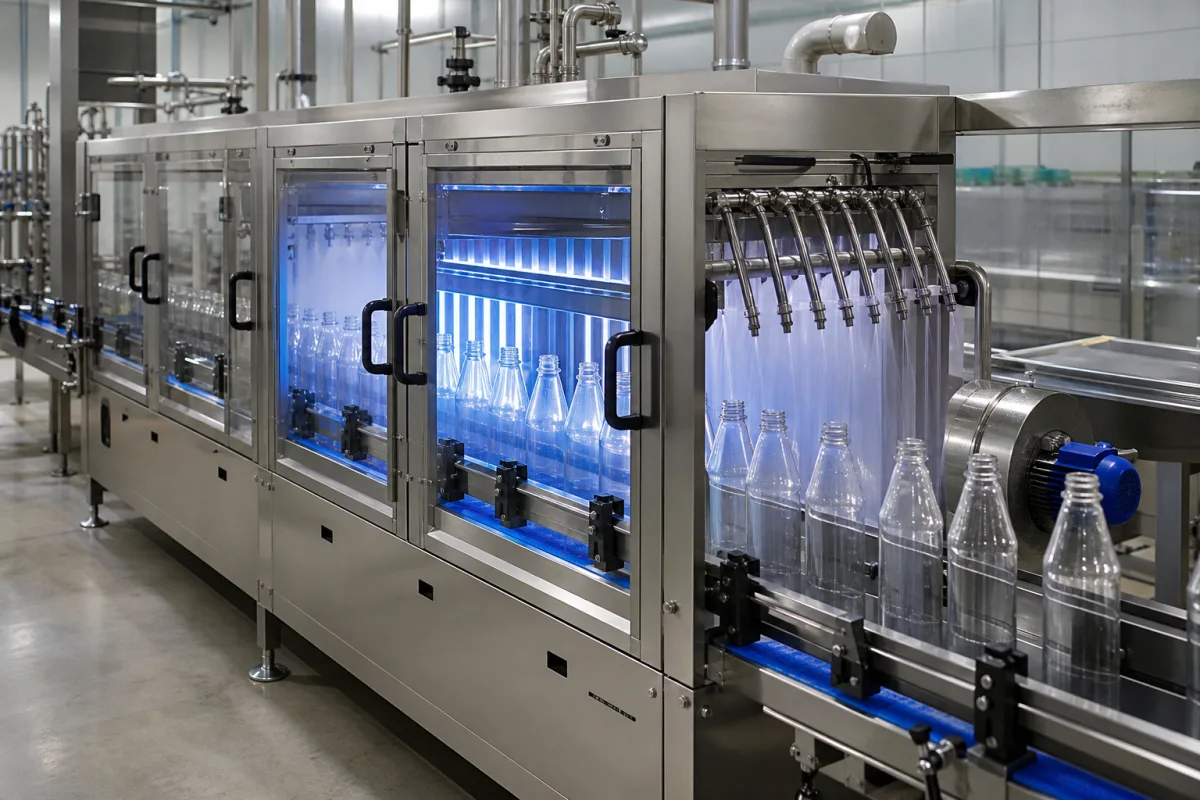
Beverage container sterilizers · Hydrogen peroxide and other sterilants for bottles and preforms, residual peroxide limit, sterilant concentration and contact time recording, speed lock, loss-of-sterility diversion, rinse and sterile-air drying
A beverage container sterilization system treats empty bottles, preforms, cans or closures before aseptic or hygienic filling by spraying, misting or vapourising a sterilant such as hydrogen peroxide, holding the containers in contact for a set time and temperature, then rinsing or drying them with sterile water or air on a conveyor enclosed from the plant. Ask three things first: which sterilant and container materials it must handle, how sterilant concentration, temperature and contact time are controlled and recorded, and how residues are kept below the legal limit and loss of sterility is handled.
Machines that sterilise empty beverage containers and closures before filling: chemical (hydrogen peroxide or peracetic acid) bottle and preform sterilisers, rinse and sterile-air drying sections. Product UHT sterilisation lines (see automated ultra high temperature sterilization line), tunnel pasteurisers, tunnel sterilizers for pharmaceutical vials (see tunnel sterilizer) and complete aseptic fillers are outside this page except where integrated.
CNFX editorial research · Sources checked October 11, 2026 · 4 sources
21 CFR 178.1005 allows hydrogen peroxide solution of no more than 35% by weight, meeting Food Chemicals Codex and USP specifications, to sterilise listed polymeric food-contact surfaces, alone or with other processes, to reach commercial sterility at least equivalent to thermal processing of metal containers. The listed materials include olefin polymers, polycarbonate, polyethylene terephthalate, polystyrene and ethylene copolymers such as ethylene-vinyl acetate. [1]
The rule is not met if more than 0.5 ppm of hydrogen peroxide can be found in distilled water packaged under production conditions, assayed immediately after packaging, and foods packed in these materials must comply with 21 CFR parts 108, 110, 113 and 114 as applicable. [1]
Editorial calculation: 0.5 ppm in a 500 mL bottle of water corresponds to 0.25 mg of hydrogen peroxide left in the container; ask the supplier how the rinse or hot-air drying stage removes peroxide to below that level at full line speed and how residue is checked. [1]
Give the supplier the containers and closures (material, sizes, neck finish), output in containers per hour, sterilant (hydrogen peroxide, peracetic acid or other) and concentration, product category (low-acid aseptic or high-acid), required log reduction or validation basis, rinse water or sterile air supply, enclosure and sterile zone design, CIP/SIP, data recording and regulatory jurisdiction.
02
Build in records, speed control and loss-of-sterility handling
For aseptic processing and packaging, 21 CFR 113.40(g) requires the container and closure sterilisation system to be instrumented to show continuously that the required sterilisation is achieved, recording sterilisation media flow rates, temperature, concentration or other factors; a method to give the containers' retention time in the sterilising environment or to control the cycle rate, with a lock or posted notice to prevent unauthorised speed changes; and, before packaging starts, bringing the container sterilising, filling and closing systems to commercial sterility. [2]
It also requires a system to stop packaging, or to segregate any product packed, when conditions fall below the scheduled process, for example by diverting product away from the filler or keeping containers from entering it. [2]
Editorial note: the scheduled process for the container steriliser is set by the processor and its process authority; ask the equipment supplier which parameters the machine controls and records, and how alarms tie into filler interlocks.
03
Container sterilizer maker listed below and the validation data to request
One maker in the list below shows a container sterilization system on its own site; before comparing it with GEA's preform route, ask for the recorded parameters 21 CFR 113.40(g) requires and its hydrogen peroxide residue results. [2][1]
04
Ask for spore-kill data at your PET bottle's dose and temperatures
PET is harder to sterilise with vapourised hydrogen peroxide than heat-tolerant materials because of its temperature sensitivity, according to a peer-reviewed study by the Technical University of Munich and an aseptic-packaging machine builder, published in Food Packaging and Shelf Life (2023). The authors tested vapour temperatures from 65 °C to 115 °C in a Design of Experiments and reached a maximum count reduction of log (N0/N) = 6.6 against Bacillus atrophaeus DSM 675 spores. Raising gas temperature helped only when the liquid hydrogen peroxide (35% v/v) dose was above 0.186 mL per 500 mL bottle; gas temperatures above 80 °C combined with two vapour injections instead of one raised kill rates, and preheating bottles to at least 35 °C with 80 °C gas also improved results. [3]
The study found that parameter combinations, not only single settings, had a significant effect on spore inactivation. [3] Editorial note: ask the supplier for its validated count-reduction result on your own bottle at production settings, stating the test organism, peroxide dose per bottle, gas temperature, number of injections and bottle preheat temperature, and check that the same settings still meet the residue limit set out above.
05
Compare preform sterilisation before blowing with bottle sterilisation
GEA describes its ABF 2.0 aseptic blow-fill system as sterilising preforms with vaporised hydrogen peroxide (VHP) immediately after they leave the oven, treating internal and external surfaces in a condensation-free process to reach 6 log decontamination, then blowing them with sterile air inside a microbiological isolator kept at an overpressure of class 100 sterile air. GEA lists H2O2 residuals in the container below 0.5 ppm, 3-hour cleaning and sterilisation cycles for product changeovers, continuous aseptic production runs of 165 hours without stoppages or intermediate cleaning, and a 6 log reduction for caps and preforms in a single sterilisation phase. [4]
GEA states that the preforms' temperature profile after the oven allows sterilisation at lower VHP temperatures, reducing energy requirements. [4] Editorial note: GEA's stated residual sits below the 0.5 ppm limit in 21 CFR 178.1005 set out above [1]; ask for the residue test method and results at full line speed, and for the validation report behind the 6 log figure, naming the test organism and whether it was run on preforms, caps or blown bottles.
06
Infeed, peroxide dosing, contact zone, rinse and sterile enclosure
Container material, peroxide concentration, residue and retention-time control
The regulatory limits fill the published values here: no more than 35% hydrogen peroxide and no more than 0.5 ppm left in packed water; output per hour and utilities depend on your containers. [1]
Field
What it means and published values
Ask the supplier for
Container material
PET, polyolefins and other listed polymers for H₂O₂ in the US. [1]
Find beverage container sterilization systems manufacturers
1 company lists this product among what they make. Company figures are quoted from each
company's own website; every card states where the relationship came from.
Guangzhou Tech-Long Packaging Machinery Co., Ltd.
Manufacturing site to be confirmed for the order
Its website lists “Preform Chemical Dry Sterilization”.
Explore company information and manufacturing capabilities, then discuss the scope of your project with a relevant supplier.
Share this page
Compiled and source-reviewed by the CNFX editorial team.
Each manufacturer above links to the page on that company's own website where the product is listed, with the date we checked it. How we source and review
· Page last updated 13 October 2026
Buyer questions
How strong can hydrogen peroxide be for sterilising PET bottles in the US?
21 CFR 178.1005 allows a solution of not more than 35% hydrogen peroxide for listed polymers including PET. [1]
What residual hydrogen peroxide is allowed?
No more than 0.5 ppm determined in distilled water packaged under production conditions. [1]
What must an aseptic container sterilizer record?
Sterilisation media flow rates, temperature, concentration or other factors, plus retention time control under 21 CFR 113.40(g). [2]
What spore reduction can hydrogen peroxide vapour achieve on PET bottles?
A Technical University of Munich study in Food Packaging and Shelf Life reached a maximum log reduction of 6.6 against Bacillus atrophaeus spores, with results depending on peroxide dose, gas temperature above 80 °C, double injection and bottle preheating to at least 35 °C. [3]
Can preforms be sterilised before blowing instead of sterilising finished bottles?
GEA describes its ABF 2.0 as sterilising preforms with vaporised hydrogen peroxide after the oven, stating 6 log decontamination and H2O2 residuals below 0.5 ppm in the container. [4]
Sources and what still needs a direct check
Sources checked 2026-10-11. 21 CFR 178.1005 and 113.40 are US FDA regulations; other markets have their own rules. The scheduled process and validation for your line must come from your process authority and the supplier's test data.