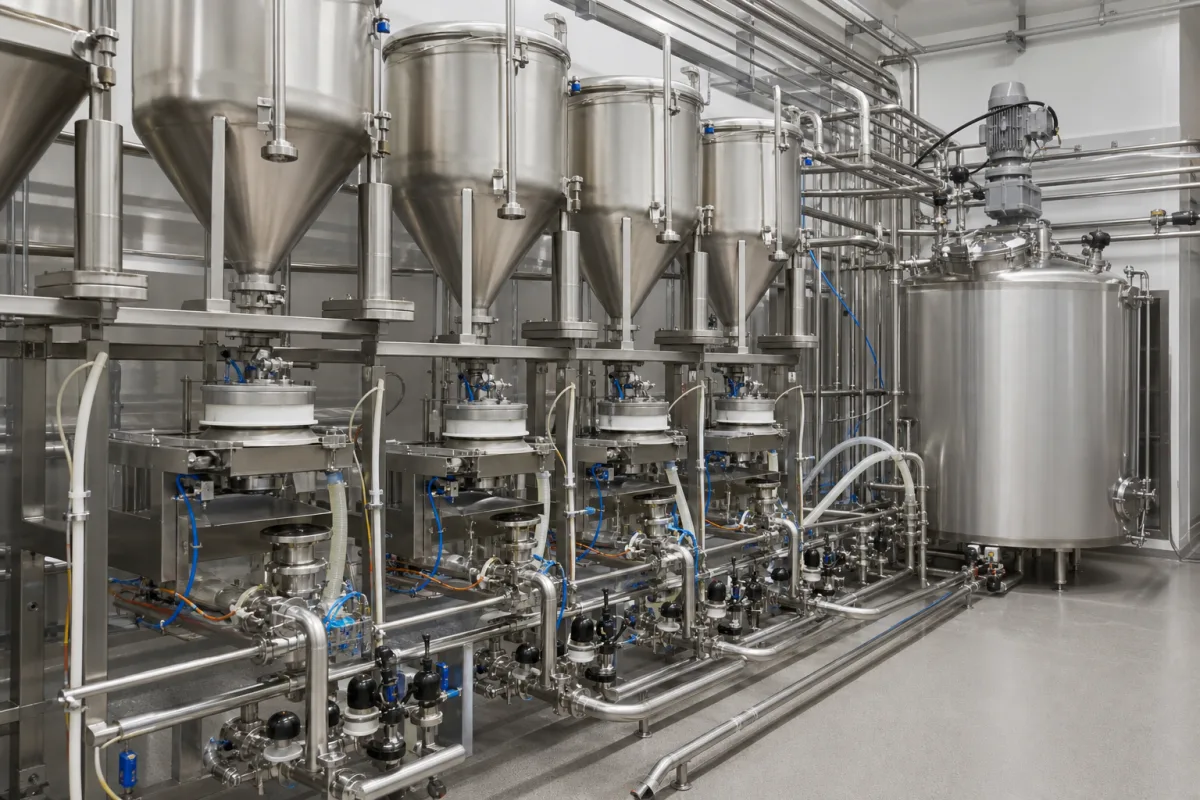
Beverage ingredient dosing station: loss-in-weight, Coriolis and weighed-hopper dosing of each ingredient into the batch
The dosing stations that put each ingredient into the batch · loss-in-weight liquid feeders, Coriolis mass dosing and weighed ingredient hoppers, with the accuracy each states and the piping rules that keep a hopper scale honest
Before a beverage batch is blended, every ingredient — water, sugar syrup, acids, flavours, colours, concentrates — has to arrive in the recipe quantity. An ingredient dosing station is the row of metering points that does this: a weighed hopper or tank per ingredient, a loss-in-weight feeder for small continuous streams, or a mass flowmeter on a dosing valve for liquids piped from storage. Each method states its accuracy differently, and each fails in its own way — a hopper scale reads wrong when stiff pipes carry part of its weight, and a percentage accuracy means a different number of grams at each end of an instrument's range. The sections below set out the published numbers for each and the installation rules behind them.
Automated dosing stations that meter individual ingredients (liquid concentrates, flavours, acids, colours, syrups and dry minor ingredients) into a beverage batch or blend line by weight or mass flow: weighed hoppers and tanks on weigh modules, loss-in-weight feeders and Coriolis dosing meters with their valves and controls. Batch blending tanks, in-line blending and Brix control of the finished syrup or drink are covered on the Automated beverage batch blending system page. Continuous loss-in-weight powder feeders with feed screws and refill control are covered on the Powder feeder with loss-in-weight control page; this page covers liquid loss-in-weight feeders, Coriolis dosing meters and weighed ingredient hoppers that put each beverage ingredient into the batch. Container filling machines and bar or fountain dispensers are outside this page.
CNFX editorial research · Sources checked October 12, 2026 · 3 sources
Loss-in-weight feeder, Coriolis dosing meter or weighed hopper: the accuracy and range each one states
The three methods measure different things: a loss-in-weight feeder controls a rate from the weight lost per unit of time, a Coriolis meter measures mass flowing through a tube, and a weighed hopper reads the gain or loss of a batch quantity. The table puts two published instruments side by side.
Qlar places the pump outside the weighed section so that the MET LQ S can work against back pressure without affecting measurement accuracy; the weighed hopper hangs on a hermetically encapsulated strain-gauge weighing module with overload, lift-off and anti-rotation protection. [1] Its datasheet names oils, acids and water as liquids dosed and plastics and chemicals as the main industries, so a beverage user should ask for the food-contact options and a test on the actual concentrate. [1]
Editorial calculation: ±0.5% at the MET LQ S's lowest rate of 0.25 kg/h is ±1.25 g/h, and at 150 kg/h is ±0.75 kg/h; ±0.15% of a 50 kg Coriolis dose is ±75 g. The percentages apply to the rate or flow, so the gram error of a small flavour or colour dose depends on where in the range the instrument runs.
Item
Loss-in-weight liquid feeder (Qlar MET LQ S)
Coriolis dosing meter (Endress+Hauser Dosimass 8BE)
Stated accuracy
Feeding accuracy ±0.5% and feed constancy ±0.5%, both typical [1]
Maximum measurement error, mass flow (liquid) ±0.15%; density ±0.0005 g/cm³ [2]
Controller compares actual rate from weight loss with set rate and adjusts the dosing pump; pump detached from the weighed section [1]
Measures mass flow, density, temperature and volume flow; no inlet or outlet runs needed [2]
02
Sizing and piping a weighed ingredient hopper: 1.25× load factor, three supports and flexible horizontal connections
METTLER TOLEDO's installation booklet for weigh modules sets the sizing rule: add the total dead load — the empty vessel with mixers, jackets and heating or cooling fluids — to the scale capacity, multiply by a safety factor of 1.25 (higher for special situations), and divide by the number of weigh modules to get the load per module, then choose the next larger module. [3] It asks for at least three supports, since a single module cannot take a bending moment; three give the best weight distribution, four or more are more stable in wind and seismic conditions. [3]
Editorial calculation: a hopper with 150 kg dead load and 300 kg capacity on three modules needs (150 + 300) × 1.25 ÷ 3 = 187.5 kg per module before choosing the next larger size; the same hopper on four modules needs about 141 kg per module.
Installation point
Rule in the METTLER TOLEDO booklet
Attached pipes
Lower pipe forces mean higher scale accuracy; minimise the number of attached pipes and their stiffness [3]
Pipe layout
Use flexible horizontal hoses (bellows or braided hose); avoid stiff vertical pipes; allow a long horizontal run before the first clamp [3]
Neighbouring vessels
Prevent crosstalk between pipes and independent pipe movement [3]
Pressure
Filling overpressure and emptying vacuum cause weighing errors; keep pressure constant, for example with a vent pipe [3]
Heat and shock
Thermal isolation pads and heat shields for hot vessels; shock pads where loads are dropped in [3]
Calibration
Provide anchor points for calibration with test weights or a calibration module [3]
Editorial note: on a row of ingredient hoppers that share one discharge manifold, ask how each hopper is decoupled from the manifold and from its neighbours, since the booklet treats pipe crosstalk as a weighing error source.
03
Wetted materials, seals and cleaning on the dosing points
The two dosing instruments list their wetted materials and cleaning provisions differently. The Dosimass 8BE has a 1.4539 (904L) measuring tube with 1.4404 (316/316L) connections, hygienic process connections conforming to 3-A, CIP and SIP cleanability and an IP67, type 4X housing. [2]
The MET LQ S has hopper and lid in 1.4301 with pipes in 1.4404/1.4571 as standard, with 1.4404/1.4571 hopper and lid, silicone-free seals, an agitator, electric heating or insulation and a mobile drip tray among the options; seals and decoupling elements are silicone in the standard build. [1] For a beverage plant the order should state which of these options are needed and which food-contact declarations the supplier provides for each wetted part.
04
Data for an ingredient dosing station enquiry
Paste it into your enquiry below or into an email to a maker, then replace every bracket.
Ingredients: [each ingredient; liquid or dry; viscosity; density; temperature]
Doses: [smallest and largest dose per batch, or rate in kg/h; batch cycle time]
Method: [weighed hopper, loss-in-weight feeder or mass flowmeter per ingredient]
Accuracy: [required tolerance per ingredient, in % and in grams]
Installation: [hopper dead load and capacity; connections to the manifold; vent]
Hygiene: [wetted materials; seal materials; CIP/SIP; 3-A or other hygienic design requirement]
Explore company information and manufacturing capabilities, then discuss the scope of your project with a relevant supplier.
Share this page
Compiled and source-reviewed by the CNFX editorial team.
Each manufacturer above links to the page on that company's own website where the product is listed, with the date we checked it. How we source and review
· Page last updated 13 October 2026
Buyer questions
How accurate is loss-in-weight liquid dosing?
Qlar's MET LQ S states ±0.5% feeding accuracy and ±0.5% feed constancy, typical, over 0.25–150 kg/h. [1]
What accuracy does a Coriolis dosing meter state?
The Endress+Hauser Dosimass 8BE states a maximum mass-flow error of ±0.15% for liquids, over 0–18,000 kg/h in DN 8 to 25. [2]
How are weigh modules sized for an ingredient hopper?
METTLER TOLEDO's rule is (total dead load + scale capacity) × 1.25 ÷ number of modules, then the next larger module, with at least three supports. [3]
Why do pipes matter on a weighed hopper?
Stiff or vertical pipes carry part of the load and cause weighing errors; METTLER TOLEDO recommends few, flexible, horizontal connections and constant vessel pressure. [3]
Sources and what still needs a direct check
Sources checked 2026-10-12. Loss-in-weight liquid feeding figures come from Qlar's MET LQ S datasheet; Coriolis dosing figures from Endress+Hauser's Dosimass 8BE data sheet (copy hosted by Lenntech); weigh-module sizing and piping rules from METTLER TOLEDO's Dos and Don'ts booklet for weigh modules.