Editorial Technical Reference

Calandria or Heat Exchanger Bundle

This page explains how Calandria or Heat Exchanger Bundle is classified within Chemical Manufacturing. Technical values and manufacturer relationships are research references; confirm the current specification and supplier evidence for each order.

Technical Definition & Core Assembly

A heat transfer assembly consisting of multiple tubes arranged in a bundle, used for evaporation or heating within vacuum evaporator systems.
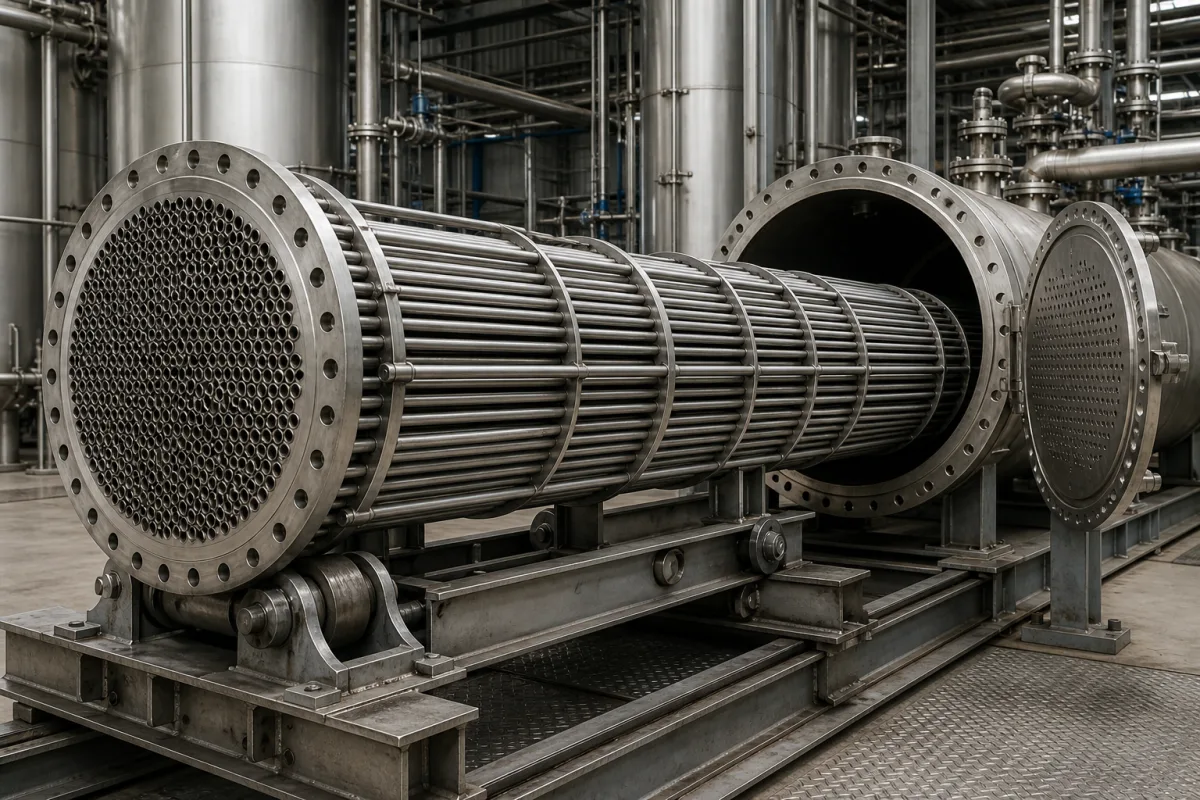
Representative product image. Confirm appearance and specifications with the manufacturer.

Product Specifications

Technical details and manufacturing context for Calandria or Heat Exchanger Bundle

Definition
The Calandria or Heat Exchanger Bundle is a critical component of a Multi-Stage Vacuum Evaporator Train. It comprises a collection of tubes through which a heating medium, typically steam, flows. The bundle provides the necessary thermal energy to evaporate liquid from the product solution under vacuum conditions, enabling concentration through multiple evaporation stages while maintaining product quality at lower temperatures. This design is essential in chemical manufacturing processes where heat-sensitive products require gentle evaporation. The bundle is typically constructed from materials such as stainless steel (304/316L), titanium, duplex steel, or nickel alloys, selected based on corrosion resistance and process requirements. Key design parameters include design pressure (1.0–1.6 MPa on the shell side), design temperature (150–200°C), tube outer diameter (25–38 mm), wall thickness (1.2–2.0 mm), tube length (3000–6000 mm), number of tubes (100–500), heat transfer area (20–150 m²), tube pitch (32–48 mm), and weight (500–3000 kg). These values are reference ranges and must be confirmed for the specific application. Standards such as GB/T 151, ISO 4200, TEMA, ASTM A312, and ASTM A240 are referenced for design, manufacturing, and material verification. The bundle's performance is verified through hydrostatic leak tests at pressures of 1.5–2.4 MPa. Proper selection and maintenance are crucial for efficient operation and longevity. Always verify model-specific values and standards with the legal manufacturer or supplier before procurement or use.
Working Principle
Heating medium (steam or hot fluid) flows through the tubes, transferring heat to the product solution surrounding the tube bundle. The temperature difference causes evaporation of the solvent (usually water) from the product, with the vacuum system reducing pressure to lower boiling points and improve energy efficiency. The bundle's design ensures efficient heat transfer while accommodating thermal expansion and maintaining structural integrity under vacuum conditions.
Common Materials
Stainless Steel (304/316L), Titanium, Duplex Steel, Nickel Alloys
Technical Parameters
ParameterTypical rangeNotes & selection driver
Design Pressure1.0–1.6 MPaMax allowable working pressure for shell side.GB/T 151
Design Temperature150–200 °CMaximum metal temperature for tube bundle.GB/T 151
Tube Outer Diameter25–38 mmCommon sizes for heat exchanger tubes.ISO 4200
Tube Wall Thickness1.2–2.0 mmAffects pressure rating and corrosion allowance.ISO 4200
Tube Length3000–6000 mmDetermines heat transfer area.ISO 4200
Number of Tubes100–500 pcsDepends on required heat duty.
Heat Transfer Area20–150 Total effective area for heat exchange.TEMA
Tube Pitch32–48 mmCenter-to-center distance between tubes.TEMA
Tube Material316LStainless steel for corrosion resistance.ASTM A312
Tube Sheet Material316LMatching material for tube sheet.ASTM A240
Leak Test Pressure1.5–2.4 MPaHydrostatic test pressure for shell side.GB/T 151
Weight500–3000 kgApproximate weight of bundle.

Ranges are indicative industry figures for RFQ preparation, not a supplier commitment. Confirm every value and standard with the legal manufacturer before ordering.

Components / BOM
  • Heat Exchange Tubes Part
    Primary heat transfer surface where heating medium flows and transfers thermal energy to the product
    Material: Stainless Steel/Titanium
  • Tube Sheets Part
    Support and secure tubes at both ends, maintaining tube alignment and sealing between tube side and shell side
    Material: Carbon Steel/Stainless Steel
  • Baffles/Support Plates Part
    Provide structural support to tubes, prevent vibration, and direct fluid flow around the tube bundle
    Material: Stainless Steel
  • Tie Rods and Spacers Part
    Maintain bundle integrity and proper spacing between baffles
    Material: Stainless Steel

Applied To / Applications

This component is essential for the following industrial systems and equipment:

Industrial Ecosystem & Supply Chain Structure

Complementary Systems
Downstream Applications
Specialized Tooling

Application Fit & Sizing Matrix

Operational Limits
pressure: Full vacuum to 10 bar (typical), up to 25 bar with reinforced design
flow rate: 0.5-5 m/s tube-side velocity (optimal range)
temperature: -20°C to 300°C (typical), up to 400°C with special materials
slurry concentration: Up to 40% solids by weight (depending on particle size and abrasiveness)
Media Compatibility
✓ Sugar syrups and juices in evaporation ✓ Chemical process brines and solutions ✓ Food-grade dairy and beverage concentrates
Unsuitable: Highly corrosive chlorinated media without appropriate corrosion-resistant materials
Sizing Data Required
  • Required evaporation/heating duty (kW or BTU/hr)
  • Available steam pressure and temperature (or heating medium conditions)
  • Desired concentration factor and final product solids content

Reliability & Engineering Risk Analysis

Failure Mode & Root Cause
Tube wall thinning due to flow-accelerated corrosion
Cause: High fluid velocity combined with corrosive conditions (e.g., oxygenated water, acidic pH) erodes protective oxide layers, leading to accelerated metal loss.
Tube-to-tubesheet joint leakage
Cause: Thermal cycling stresses, vibration, or improper initial rolling/expansion during fabrication causing fatigue cracks or loosening at the joint interface.
Maintenance Indicators
  • Visible external leaks or salt deposits around tube ends or shell connections
  • Abnormal pressure drop across the bundle or temperature approach deviation beyond design limits
Engineering Tips
  • Implement regular non-destructive testing (e.g., eddy current testing) to monitor tube wall thickness and detect thinning early
  • Ensure proper water chemistry control (e.g., pH, oxygen scavenging) and install flow straighteners to reduce localized high-velocity erosion

Indicative industry ranges for design and RFQ preparation. Confirm the exact figures and applicable standard with the manufacturer before specifying.

Compliance & Manufacturing Standards

Applicable Standards
ISO 16812:2021 - Shell-and-tube heat exchangers ASME BPVC Section VIII - Rules for construction of pressure vessels EN 13445 - Unfired pressure vessels

Quoted from the published standard.

Manufacturing Precision
  • Tube-to-tubesheet weld: 100% radiographic testing per ASME Sec. V
  • Tube bundle straightness: ±1.5mm per meter length
Quality Inspection
  • Hydrostatic pressure test at 1.5x design pressure
  • Eddy current testing of heat exchanger tubes

Manufacturers of Calandria or Heat Exchanger Bundle

Manufacturer profiles associated with Calandria or Heat Exchanger Bundle.

Sourcing Calandria or Heat Exchanger Bundle from China?
Tell us your specification and target quantity — we will match it against manufacturer records and come back with the factories that fit.
Request manufacturers We manufacture this

Manufacturer listings support early research and capability understanding. They are not certification, ranking, or transaction guarantees.

Technical documentation
Request current drawings, revision history, and a signed specification sheet.
Manufacturing capability
Verify equipment lists, process limits, capacity, and representative production evidence.
Inspection readiness
Confirm test methods, calibrated equipment, sampling plans, and traceable reports.
Supplier transparency
Check the legal entity, factory address, ownership, certifications, and direct contacts.

CNFX does not score or rank suppliers. Buyers must verify all claims and documents with the legal manufacturer before ordering.

Supply Chain Compatible Machinery & Devices

Automated pH Monitoring and Dosing System

Automated system for continuous pH monitoring and chemical dosing in process streams.

Explore Specs →
Automated Powder Dispensing and Blending System

Automated system for precise dispensing and homogeneous blending of powdered chemicals.

Explore Specs →
Automated Viscosity Control and Mixing System

The Automated Viscosity Control and Mixing System is an industrial automation solution designed for continuous monitoring and adjustment of viscosity in chemical mixing and blending operations.

Explore Specs →
Automated Catalyst Loading and Unloading System

The Automated Catalyst Loading and Unloading System is an integrated automation solution for the precise and safe transfer of catalyst materials in fixed-bed reactors, continuous stirred-tank reactors, and other catalytic process vessels.

Explore Specs →

Frequently Asked Questions

What is the primary function of a Calandria or Heat Exchanger Bundle?

It transfers heat from a heating medium (typically steam) to the product solution, causing evaporation of the solvent under vacuum conditions. This enables concentration of the product at lower temperatures, preserving quality.

Which materials are commonly used for the bundle?

Common materials include stainless steel (304/316L), titanium, duplex steel, and nickel alloys. The choice depends on corrosion resistance, temperature, and pressure requirements.

What are typical design parameters for this component?

Typical ranges include design pressure 1.0–1.6 MPa (shell side), design temperature 150–200°C, tube outer diameter 25–38 mm, wall thickness 1.2–2.0 mm, tube length 3000–6000 mm, number of tubes 100–500, heat transfer area 20–150 m², tube pitch 32–48 mm, and weight 500–3000 kg. These are reference values and must be confirmed for specific applications.

What standards are referenced for design and testing?

Standards such as GB/T 151, ISO 4200, TEMA, ASTM A312, and ASTM A240 are referenced. Hydrostatic leak tests are performed at pressures of 1.5–2.4 MPa. Always verify compliance with the legal manufacturer or supplier.

Data Basis

Editorial classification, named public sources where available, and source-reviewed manufacturer records.

Preliminary Technical Classification
This page supports structured research, RFQ preparation, and supplier evaluation. It does not replace buyer-led supplier qualification, standards review, or technical approval.
Buyer enquiry

Request manufacturing insight for Calandria or Heat Exchanger Bundle

Ask for use case, specification boundaries, supplier type, and RFQ preparation information for this product.

Where it goes
Straight to the CNFX editorial desk, and to the manufacturer if this product is linked to a claimed profile. Nothing is broadcast to a supplier list.
Your details stay here
We do not sell or rent enquiry data, and we do not add you to a mailing list. Used only to answer this request.
No commission, no middleman
CNFX is a directory. We take no cut of any order and never negotiate on a supplier's behalf.
What we don't claim
A listing is not an endorsement. Qualify every supplier and verify every figure yourself before ordering.

Your business information is used only to process this request.

Thank you! Your message has been sent. We'll respond within 1–3 business days.
Sorry, we couldn't send your message. Please try again, or email us at contact@cnfx.com.

Need to Manufacture Calandria or Heat Exchanger Bundle?

Compare manufacturer profiles with relevant product and process capability.

Previous Product
Twin-Screw Polymer Compounding Extruder
Last Product
Get QuotesChat