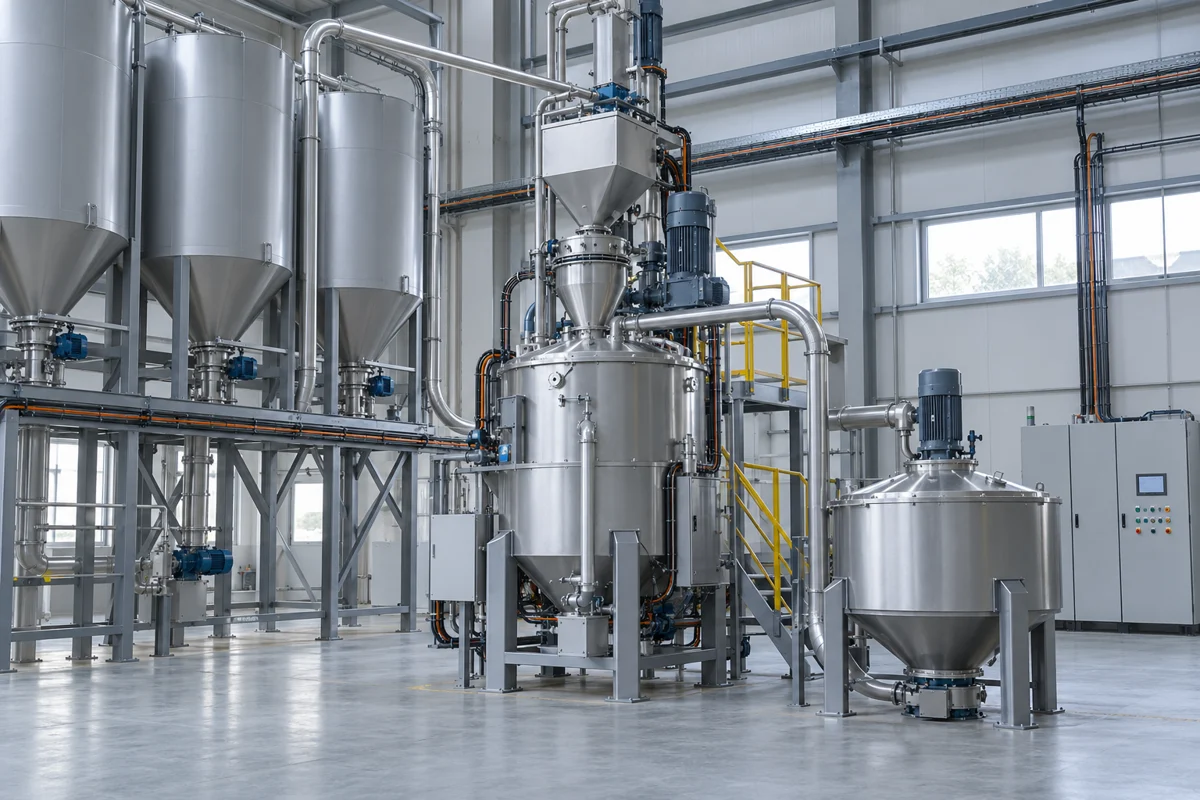
PVC pipe and profile plants replace manual weighing with automatic systems that load, weigh, mix and feed extruders. Their quality hinges on how small ingredients are weighed and how the blend survives transport to the extruder. This guide reads a Chinese turnkey system's module list against Coperion's batching technology comparison, PLAS MEC's mixer ranges and Jenike & Johanson's segregation guidance.
Editorial reference for PVC dry-blend batching. Chiyu’s integrated-system description, Coperion’s weighing comparison and PLAS MEC mixer specifications describe separate equipment; none is a validated recipe or a category-wide guarantee.
CNFX editorial research · Sources checked October 10, 2026 · 6 sources
Coperion groups batching technologies into three types [2].
Worked example
Suppose a receiving hopper has 500 kg full-scale capacity including tare, and the quoted accuracy is ±0.5% of that capacity. The arithmetic allowance is ±2.5 kg. Against a proposed 3 kg dose, that is about 83% of the target mass, so this specification alone cannot establish a tight dose tolerance. This is an illustrative specification check, not a measured Chiyu error. Coperion assigns this typical full-scale figure to its scale-hopper method and describes separate loss-in-weight feeders for small ingredients [2].
Combination systems
Coperion describes combining GIW for macroingredients and separate LIW devices for microingredients whose dose may be too small for the main hopper to resolve [2]. The weighing method and capacity must be assigned per ingredient; that comparison does not establish Chiyu’s actual microingredient configuration.
Method
How it works
Accuracy and time
Gain-in-weight, scale hopper
Ingredients enter a hopper on load cells until each target weight is reached [2]
Coperion says this type of scale weighing system "can typically achieve weigh accuracies of ±0.5 percent of the full scale capacity, including material and hopper weight"; not a universal GIW specification [2]
Gain-in-weight, volumetric feeders
Feeders deliver ingredients one after another into a weigh hopper, with bulk-and-dribble feeding [2]
Better accuracy than a scale hopper; feeders run one after another, so batch time is longer with multiple ingredients [2]
Loss-in-weight
Gravimetric feeders on their own load cells feed simultaneously [2]
High accuracy per ingredient and short batch time; higher cost [2]
Resolution, accuracy, permitted dose error and material actually discharged are different checks. Coperion notes that powder can remain on hopper walls and that vibration can worsen packing for some materials [2]. Include discharge recovery as well as the displayed weight in the test.
02
Check the modules in a turnkey offer
Chiyu describes seven modules for its PVC window-profile system and identifies a Wuhu installation at Anhui Conch in 2014 [1]. This is the manufacturer’s project statement; this review has no independent operating report for that installation.
What the list leaves out
The module list identifies main PVC and CaCO3 streams, while the mixer description also mentions auxiliary additives. It does not specify separate additive feeders, minimum doses or their error limits [1]. Establish which additions are automatically weighed, preweighed or added manually.
Payback claims
Chiyu advertises 3–5-year recovery under normal production capacity but publishes no cost, throughput or saving calculation behind it [1]. Treat that as a manufacturer claim and build a project-specific estimate; no payback period is established here.
Loading station with separate PVC and CaCO3 loaders [1]
Closed negative-pressure pneumatic conveying between silos and mixer [1]
Trace the powder and the weight signal through the system
A recipe starts and stops material delivery according to weight, then the mixing and conveying stages prepare and deliver the dry blend. Chiyu names vacuum weighing, high-speed mixing, PLC control and sealed conveying [1]. The roles below are a functional structure reference, not a manufacturing BOM or a set of approved spare parts.
Part of the process
What it does and what is established
Ingredient storage and hopper
Stores each raw material before batching. Chiyu names separate PVC and CaCO3 storage silos; ingredient count, silo capacities and contact-metal grades are not specified [1].
Metering device / feeder
Controls delivery into the weighing stage. Coperion compares volumetric and gravimetric feed devices; the Chiyu page describes vacuum conveying/weighing, not an identified screw feeder for every ingredient [2][1].
Load-cell weighing assembly
Measures mass gain in the receiving hopper or mass loss at a feeder, depending on the selected method. Each LIW feeder has its own weighing device; load-cell material, capacity and mounting details must match the installed device [2].
Mixing vessel and rotor
Contains the material and provides the selected mixing action. PLAS MEC’s TRM catalogue specifies a polished AISI 304 vessel and stainless mixing tool, with application-dependent coatings; these are TRM details, not Chiyu vessel materials [5].
Ribbon blender, only for the relevant blending duty
A helical-ribbon assembly from an older generic listing is not established for Chiyu’s high-speed PVC host. PLAS MEC separately lists horizontal cold blenders and other mixer types; specify the actual agitator geometry and duty rather than substituting a ribbon into a hot-mixing design [6][1].
Cooling stage and buffer
PLAS MEC distinguishes high-speed TRM mixing followed by HEC/RFV cooling and RFO cooled buffering. Chiyu names a mixed-compound silo but does not identify one of these cooler models; the quoted cooling duty must be explicit [3][1].
Conveying and final extruder feed
Enclosed negative-pressure pipelines transfer raw material; Chiyu also lists feeding mixed compound from storage to extruders. Receiver, valves and discharge behavior affect what reaches the process, not just the weight record [1][4].
Dust collection connection and filter
A connection port is not a complete filtration or exposure-control system. Chiyu describes sealed transfer; PLAS MEC lists a jet filter among accessories. Neither establishes a polyurethane port material or an emissions/exposure result for this installation [1][5].
PLC and operator interface
Chiyu describes central PLC control, a touch screen and storage of more than 50 formula groups. Recipe storage is not proof that every ingredient is automatically dosed, nor an identified communication protocol or batch-traceability format [1].
Motor ratings, seals, load-cell hardware, filters and replaceable mixing tools require configuration-specific drawings and identifiers. Materials specified for PLAS MEC equipment are not transferable to the Chiyu system.
04
Specify each dose, then size the complete batch route
A working quotation assigns capacities and tolerances to ingredients and stages. It does not infer the entire line from a mixer’s nominal litres or a scale’s display resolution.
Field
Meaning for this system
Ingredient count
Count separately weighed streams, premixes, liquids and manual additions. Chiyu’s seven modules are functional units, not seven ingredients; more than 50 recipe groups does not mean 50 simultaneous feed streams [1].
Batch mass · kg
Specify actual recipe mass and usable fill. For comparison, PLAS MEC’s TRM 200 table lists 130–170 L useful volume and 65–102 kg indicative batch size. The bulk-density footnote has inconsistent units, so obtain corrected density assumptions before using it as a guarantee [5].
Dispensing error · kg or %
State the target dose, absolute permitted error and percentage basis for each ingredient. Coperion’s ±0.5% full-scale scale-hopper example is not percentage of the ingredient’s small target [2].
Mixing motor power · kW
The TRM 200 comparison table lists 45 kW mixing motor power. That is one mixer’s motor rating, not whole-line input, measured energy per batch or a Chiyu specification [5].
Control interface
Identify actual HMI, recipe permissions, batch records and process interfaces. Chiyu describes touch-screen recipe selection but does not name a fieldbus or export format [1].
Operating / utility pressures
Separate pneumatic-conveying vacuum, actuator air, seal air and cooling-water circuit pressure. PLAS MEC HEC’s up-to-2.5-bar water-jacket value is not powder-vessel working pressure or a Chiyu rating [5].
Temperature · °C
Separate room limits from mixing/discharge temperatures and temperature-sensor duties. Chiyu supplies no room-temperature limit here; the old 40°C statement is not a verified limit. TRM/HEC sensors do not specify a recipe setpoint [5].
Humidity · %RH
State ambient and feed-material moisture conditions for the trial. Coperion calls for free-flowing, moisture-free material for its scale-hopper example; no general humidity percentage is established [2].
Ingress protection
Require the actual enclosure ratings of controls, motors and sensors. A sealed powder route is not an IP65 or IP54 rating for every component; no such whole-system rating is established here.
Electrical supply
Obtain the complete voltage, phases, frequency, connected load and protection schedule for the delivered layout. Chiyu’s reviewed system page does not provide these values.
Contact materials
Specify each product-contact surface, coating and seal for the formulation and cleaning method. TRM’s AISI 304 vessel example is not a universal 304 system BOM or proof of suitability for all chemical powders [5].
Footprint and access · m
Require a layout showing silos, conveyors, weighing support, mixer/cooler, controls and cleaning/service space. Module count cannot establish total floor area or available height [1].
Installed / handling masses · kg
Require empty and operating masses, support reactions and handling plans for each module. They are not stated in the Chiyu page; no floor reinforcement requirement can be concluded from an invented weight.
No anonymous temperature, pressure, material or ingress-protection range has been supplied for the product category. The PLAS MEC comparison figures remain explicitly tied to that catalogue and equipment.
05
Size the hot/cool mixer pair
PLAS MEC, an Italian mixer maker, publishes sizes for PVC dry-blend mixing [3].
500–5,500 L RFO; not the same rapid-cooling duty as HEC [3]
The web page gives endpoint pairs: HC 200/800 through 3000/8500 and RV 200/400 through 2000/4300 [3]. These do not authorize arbitrary combinations or a universal cooler-to-hot-mixer ratio. The HC catalogue distinguishes nominal model size from useful volume and labels output as indicative, based on conventional formulations and 6 P-PVC or 8 U-PVC batches per hour [5]. Its density footnote prints 0.5–0.6 L/kg alongside 31.2–37.4 lb/ft³: reciprocal specific volume and density units are inconsistent. Ask for a corrected footnote rather than silently converting it. No Chiyu capacity follows from these tables.
06
Keep the blend mixed on its way to the extruder
Jenike & Johanson explain that segregation separates particles by size, shape or density, by sifting, fluidization and dusting, and that a well-blended material does not guarantee a quality product if segregation follows [4].
Test where it matters
Propose paired samples at mixer discharge and at the extruder feed over the discharge sequence, using an agreed constituent-specific assay and sampling plan. An ash or filler test, if validated for the formula, does not by itself verify every small additive. Distinguish weighing error, poor mixing, segregation and sampling bias; this is an acceptance proposal, not a reported trial [4].
Where it happens
Filling bins and silos, pneumatic transfer, discharge [4]
Mixing needs
Some materials need gentle tumble blending, others high shear for cohesive ingredients [4]
Design response
Evaluate the actual transfer and bin discharge. Jenike & Johanson says mass flow can reduce sifting/dusting effects while funnel flow can worsen them; shortening a pipe alone does not establish segregation control [4].
For changeover and maintenance, Coperion discusses accessible frames, quick disconnects and optional wash-in-place designs [2]. That does not authorize washing a dry PVC line. Obtain the delivered isolation, cleaning, seal/filter service and weighing-check instructions, and verify retained material after discharge; no lubricant, cleaning chemical or service interval is prescribed here.
07
Copy this RFQ and fill in the brackets
Paste it into your enquiry below or into an email to a maker, then replace every bracket.
Product: PVC dry-blend dosing and mixing system, application [ ]
Recipe: each ingredient [name, target kg, phr or %, powder/liquid, bulk density, moisture]
Smallest dose and allowed error: [kg] / [absolute kg and percentage basis] per ingredient
Output: accepted dry blend [kg/h], extruders [ ], changeovers [ ]
Weighing: method and full-scale capacity per stage [ ], tare [ ], discharge-recovery test [ ]
Mixing/cooling: batch mass [ ], useful fill [ ], temperatures [ ], full cycle [ ]
Transfer: route, distances/heights, material tests and silo discharge [ ]
Controls: recipe permissions, batch records, communication interfaces [ ]
Site: electrical schedule, air/vacuum/water duties, room and material conditions [ ]
Acceptance: per-dose error, mixing and destination sampling/assay, dust-control verification [ ]
Delivery: layout/support loads, isolation/cleaning/service instructions, spares, destination/date [ ]
The company below publishes an integrated PVC system. The scope describes its current product claims, not a verified batch-accuracy result or suitability for every chemical powder.
Zhangjiagang Chiyu Automation Equipment Co., Ltd.
Suzhou, Jiangsu, CN
Its current PVC window-profile page describes loading, silos, negative-pressure conveying, vacuum weighing, high-speed mixing, compound storage and extruder feeding under central PLC control. It does not identify an individual microingredient accuracy specification or tested blend-uniformity result. Project and payback statements remain manufacturer claims.
Explore company information and manufacturing capabilities, then discuss the scope of your project with a relevant supplier.
Share this page
Compiled and source-reviewed by the CNFX editorial team.
Each manufacturer above links to the page on that company's own website where the product is listed, with the date we checked it. How we source and review
· Page last updated 13 October 2026
Buyer questions
How accurate is a gain-in-weight batching scale?
Coperion says its scale-hopper GIW system "can typically achieve weigh accuracies of ±0.5 percent of the full scale capacity, including material and hopper weight". For a hypothetical 500 kg full scale, that is ±2.5 kg; it is not ±0.5% of each small ingredient or a Chiyu specification. [2]
How should micro-ingredients be dosed?
Coperion describes individually sized loss-in-weight feeders for microingredients in combination with gain-in-weight weighing for larger ingredients. Selection still depends on the minimum dose and required tolerance; the Chiyu page does not specify its microingredient feeder configuration. [2]
What sizes are PVC hot/cool mixers?
PLAS MEC lists HC endpoints from a 200 L TRM with 800 L HEC to a 3,000 L TRM with 8,500 L HEC. RV and RO use different coolers and duties. Nominal vessel litres alone do not establish usable batch mass or output. [3]
Why does a good blend still give bad product?
Segregation by sifting, fluidization or dusting during transfer can separate it again. [4]
Sources and what still needs a direct check
Sources checked 2026-10-10. Standards bodies and regulations define the requirements; manufacturer pages show published ranges for those models only. CNFX does not certify products or suppliers.
Chiyu’s individual additive dosing methods, minimum doses and tolerances, batch capacity, mixer/cooler configuration and discharge recovery have not been supplied in the reviewed system page.
The supplier’s Wuhu project, payback, dust-isolation and unattended-operation claims have no independent operating, economic or exposure-control report in this review.
PLAS MEC HC catalogue density units conflict; its indicative figures and material details belong to that equipment, not a guaranteed Chiyu line.
Delivered line utility limits, hazard/safety documents, control interfaces, materials, cleaning procedures and site layout require configuration-specific documentation.
Buyer enquiry
Request manufacturing insight
for Automated Powder Dispensing and Blending System
Ask for use case, specification boundaries, supplier type, and RFQ preparation
information for this product.
Where it goes
Straight to the CNFX editorial desk, and to the manufacturer if this product is
linked to a claimed profile. Nothing is broadcast to a supplier list.
Your details stay here
We do not sell or rent enquiry data, and we do not add you to a mailing list.
Used only to answer this request.
No commission, no middleman
CNFX is a directory. We take no cut of any order and never negotiate on a
supplier's behalf.
What to include
Share your product specifications, quantity, destination and target delivery date.
Need to Manufacture Automated Powder Dispensing and Blending System?
Compare manufacturer profiles with relevant product and process capability.