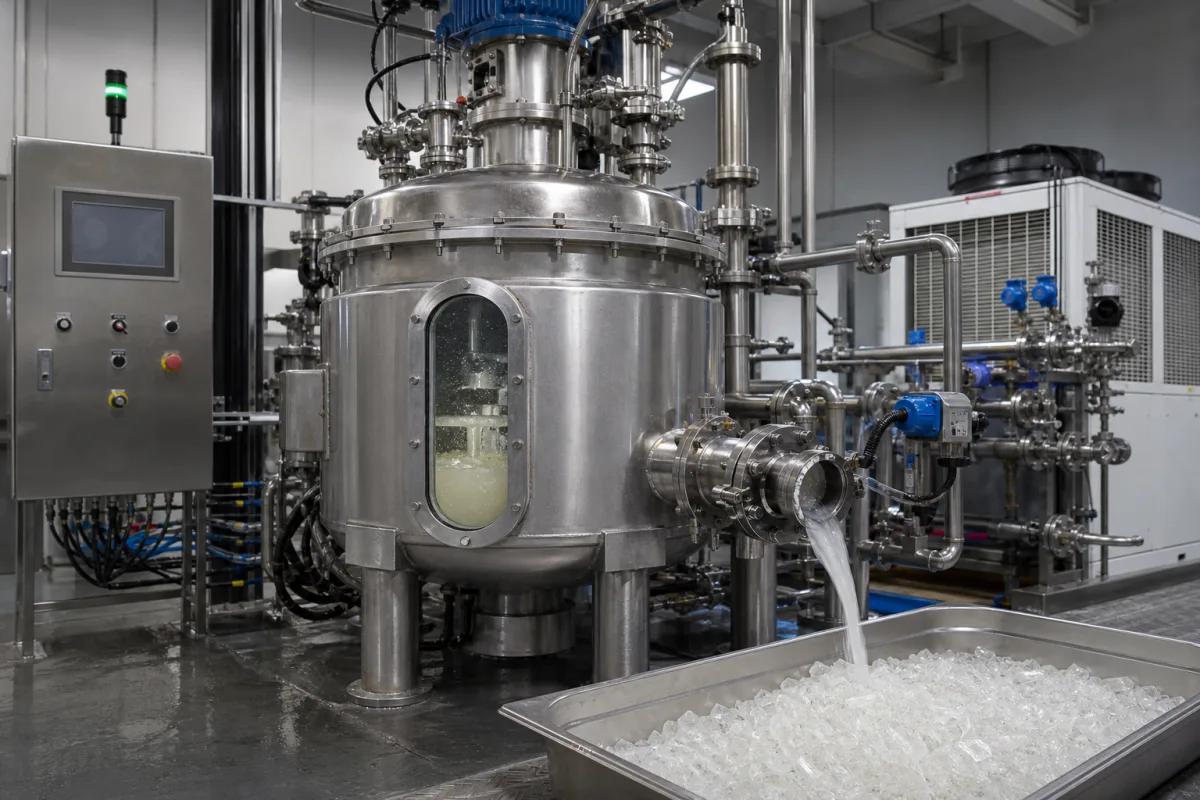
Automated batch cooling crystallizer: seeding, cooling-rate and supersaturation control in a jacketed stirred vessel
Stirred, jacketed batch crystallizers under programmed temperature control · where to seed and how much, supersaturation control from in-situ concentration, temperature cycling against agglomerates, and scaling the agitator
In a batch cooling crystallizer the vessel, jacket and agitator are fixed, and the product is set by the temperature recipe the controller runs: how far above saturation the charge is heated, where in the metastable zone seed is added, how much seed and of what size, how fast the jacket cools afterwards, and whether the temperature is cycled to dissolve fines and break agglomerates. Automation in these systems means closing that recipe on measurements — turbidity for cloud and clear points, ATR-FTIR for solution concentration, focused-beam reflectance for particle counts — rather than running a fixed ramp. The figures below come from published laboratory and scale-up studies, which show the ranges a recipe works in.
Jacketed, agitated batch crystallizers for cooling crystallization of fine chemicals, pharmaceuticals and food ingredients, with automated temperature programmes, seeding and in-situ measurement (turbidity, ATR-FTIR, particle counting) for supersaturation and size control. Continuous forced-circulation, draft-tube-baffle and OSLO crystallizers for bulk chemicals are covered on the Industrial chemical crystallization unit page. Jacketed stirred-tank reactors sized for reaction heat, design pressure and agitator seals are covered on the Chemical reactor (jacketed stirred tank) page; this page deals with the crystallization recipe run in such a vessel — seeding, cooling rate, supersaturation control and temperature cycling. Melt crystallizers and evaporative crystallizers are outside this page.
CNFX editorial research · Sources checked October 12, 2026 · 3 sources
Seed point, seed mass and the cooling ramp after seeding in three published batch recipes
The three studies below ran seeded cooling batches in jacketed lab vessels of 100 mL to 500 mL; each adds seed a few degrees below the saturation temperature and then cools on. The differences are in seed mass, seed size and how long the slurry is given to consume supersaturation.
Yield against the solubility-based theoretical crystal mass reached 99% for xylose and 94, 91 and 98% for xylitol, erythritol and glucose in the Aalto runs, and results in the 100 mL and 1 L reactors showed very similar trends. [3] In the piroxicam work, supersaturation after seeding took about 8–10 h to be consumed by growth, secondary nucleation and partly agglomeration, which is why the recipe holds at 10 °C for 10 h. [2]
Editorial calculation: at the Aalto rate of 10 K/h the 20 K span takes 2 h, matching the stated batch time; at the piroxicam rate of 0.1 °C/min the 27 °C fall from 37 to 10 °C takes 4.5 h before the 10 h hold.
Study
Vessel and agitation
Seeding
Cooling after seeding
Hexamine in ethanol (Leeds / CMAC / Syngenta)
500 mL jacketed vessel, 40 mm 4-blade pitched-blade impeller at 450 rpm [1]
1 g of 112 µm dry seed at 40 °C, then 30 min hold [1]
Controller updates the cooling rate every 30 s down to 5 °C; circulator maximum −0.6 °C/min [1]
Piroxicam (Leeds / Loughborough / Purdue)
400 mL jacketed glass vessel, PTFE pitched-blade stirrer at 325 rpm [2]
Seed at 37 °C for a 40 °C saturation temperature; 2% of dissolved piroxicam mass [2]
Closing the loop on supersaturation: metastable zone width by scale and ATR-FTIR model control
The hexamine study measured the metastable zone width (MSZW) with a turbidity probe — dissolution at 100% transmittance, crystallization below 90% — cycling the vessel three times between 5 and 50 °C at +0.15 °C/min and −0.3 °C/min. [1] The zone was 8–15 °C wide in 1.5 mL vials of a Crystal16 instrument but 5–10 °C in the 500 mL vessel; the authors conclude that the MSZW at −0.3 °C/min was narrower in the jacketed vessel than in the small vials. [1]
The authors built a population balance model, linked it to model predictive control software to form a digital twin, and found stable in-silico control over supersaturation set-points of 0.012–0.036. [1] On the physical 500 mL crystallizer the simulated concentration was replaced by calibrated in-situ ATR-FTIR readings, and higher cooling rates than in the simulations were needed to reach the same set-points; at a set-point of 0.012 an approximately doubled cooling rate brought the batch to 5 °C much sooner than expected. [1]
Temperature cycling is the other automated lever. The piroxicam study ran nine cycles of 20 °C amplitude at ±0.2 °C/min after seeding; about 2 cycles removed agglomerates with 2% membrane-made seeds against about 4 with polymorphic-transformation seeds, and the volume-weighted mean size rose 243% with 2% seeds and 205% with 6% seeds. [2]
Editorial note: ask whether the controller follows a fixed temperature ramp or a supersaturation set-point from an in-situ concentration probe, and whether it can run programmed heating-cooling cycles after seeding.
03
From a 1 L vessel to 100 m³: constant tip speed or constant energy dissipation for the agitator
Aalto's scale-up of erythritol batch cooling compares two rules for the agitator, keeping the 1 m³ case at 100 rpm in a 1,020 mm tank and scaling to 100 m³ in a 4,734 mm tank. [3]
Viscosity shifts the picture: saturated erythritol solution is below 3 mPa·s while xylitol exceeds 90 mPa·s in the 20–40 °C range, and suspensions at the end of crystallization were more viscous than the crystal-free mother liquors. [3] Editorial calculation: holding tip speed while going from 1 to 100 m³ cuts average energy dissipation to about 22% of the 1 m³ value (0.0230 ÷ 0.105) and roughly doubles micromixing time, which is the trade-off to settle with the vessel supplier before the agitator is sized.
Explore company information and manufacturing capabilities, then discuss the scope of your project with a relevant supplier.
Share this page
Compiled and source-reviewed by the CNFX editorial team.
Each manufacturer above links to the page on that company's own website where the product is listed, with the date we checked it. How we source and review
· Page last updated 13 October 2026
Buyer questions
How much seed do batch cooling recipes add?
Published runs used 1% of theoretical crystal mass for sugars and sugar alcohols, 2% of dissolved mass for piroxicam, and 1 g of 112 µm seed in a 500 mL hexamine batch. [3][2][1]
Does the metastable zone measured in small vials apply to the vessel?
Not directly: for hexamine it was 8–15 °C wide in 1.5 mL vials but 5–10 °C in a 500 mL jacketed vessel. [1]
What does supersaturation control add over a fixed cooling ramp?
The controller adjusts the cooling rate from in-situ ATR-FTIR concentration readings to hold a set-point; the hexamine study controlled set-points of 0.012–0.036 and updated the cooling rate every 30 s. [1]
How are agglomerates removed in a batch crystallizer?
By temperature cycling after seeding: the piroxicam study used nine 20 °C cycles at ±0.2 °C/min, and about 2 cycles removed agglomerates with 2% membrane seeds. [2]
Sources and what still needs a direct check
Sources checked 2026-10-12. Seeding, MSZW and supersaturation control come from the Leeds/CMAC/Syngenta hexamine study; seed mass and temperature cycling from the Leeds/Loughborough/Purdue piroxicam study; cooling rate, yields, viscosity and agitator scale-up from Aalto University's sugar and sugar-alcohol study. Values apply to the systems tested.