Industry-Verified Manufacturing Data (2026)

Distribution Plate/Sparger

Based on aggregated insights from multiple verified factory profiles within the CNFX directory, the standard Distribution Plate/Sparger used in the Chemical Manufacturing sector typically supports operational capacities ranging from standard industrial configurations to heavy-duty production requirements.

Technical Definition & Core Assembly

A canonical Distribution Plate/Sparger is characterized by the integration of Perforated Plate and Support Grid. In industrial production environments, manufacturers listed on CNFX commonly emphasize Stainless Steel 316L construction to support stable, high-cycle operation across diverse manufacturing scenarios.

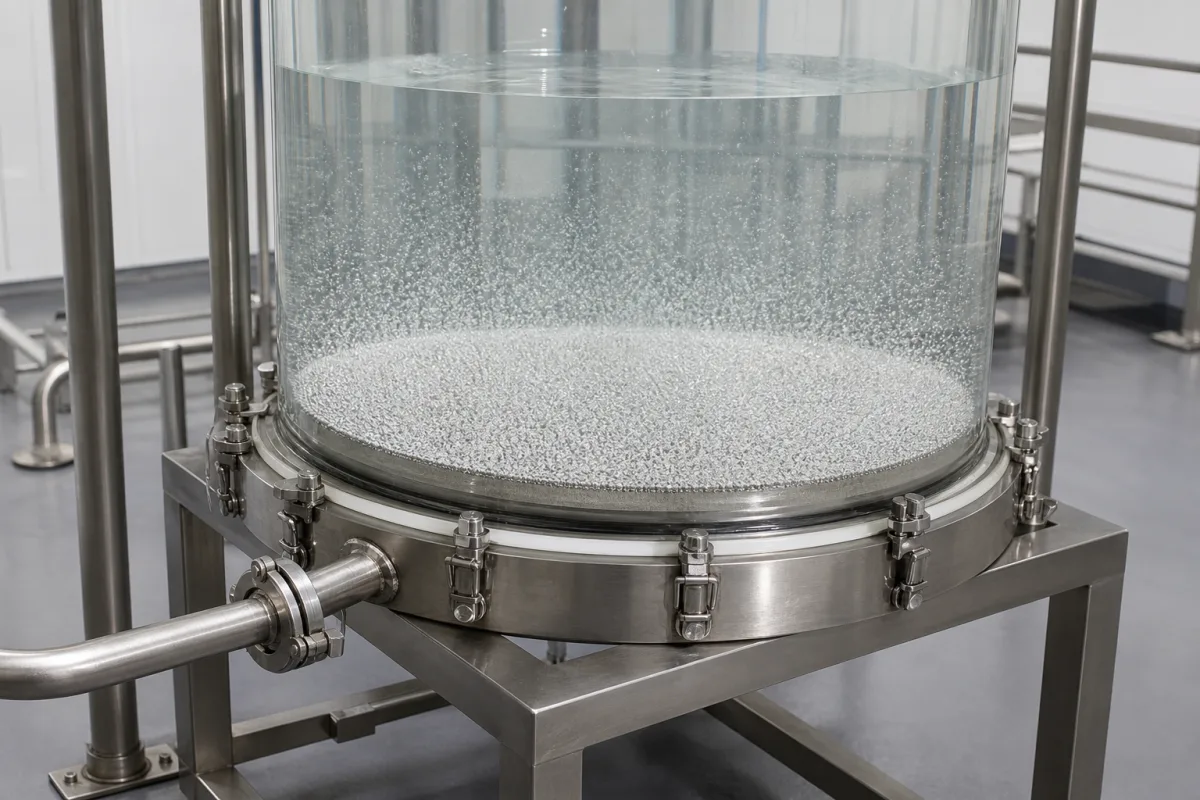
A component within gas distribution systems that evenly disperses gases into liquids or other media through perforated plates or sparging elements.
Product Specifications

Technical details and manufacturing context for Distribution Plate/Sparger

Definition
The Distribution Plate/Sparger is a critical component of Gas Distribution Systems designed to achieve uniform gas dispersion in industrial processes. It typically consists of a perforated plate or multiple sparging elements that create fine bubbles or controlled gas streams, ensuring optimal gas-liquid contact for reactions, aeration, or mixing applications.
Working Principle
Gas is forced through precisely sized holes or porous elements in the plate/sparger, creating controlled bubble formation or gas streams that disperse evenly throughout the liquid medium, maximizing surface area for efficient mass transfer.
Common Materials
Stainless Steel 316L, Hastelloy, PTFE-coated Steel
Technical Parameters
  • Hole diameter or pore size for gas dispersion (mm) Customizable
Components / BOM
  • Perforated Plate
    Primary gas distribution surface with precision holes
    Material: Stainless Steel
  • Support Grid
    Structural reinforcement to prevent plate deformation
    Material: Carbon Steel
  • Gasket/Seal
    Ensures gas-tight connection to distribution system
    Material: PTFE or Viton
Engineering Reasoning
0.5-15 bar differential pressure, 0-150°C temperature, 0.1-10 m³/h gas flow rate
Material yield strength at 250 MPa for stainless steel 316L, 0.5 mm maximum plate deflection, 20% perforation blockage threshold
Design Rationale: Stress concentration at perforation edges exceeding material fatigue limit (180 MPa for 10⁷ cycles), leading to crack initiation and propagation through Paris' law (da/dN = C(ΔK)^m)
Risk Mitigation (FMEA)
Trigger Corrosive gas composition (e.g., H₂S > 50 ppm) interacting with chloride ions (> 100 ppm)
Mode: Stress corrosion cracking initiating at perforation edges
Strategy: Material upgrade to Hastelloy C-276 with 0.02% maximum carbon content and post-weld heat treatment at 1150°C
Trigger Particulate contamination (> 25 μm particles) in gas stream at velocities > 2 m/s
Mode: Erosion-corrosion at perforation inlets reducing effective flow area by > 15%
Strategy: Upstream filtration to 5 μm absolute rating with differential pressure monitoring at 0.2 bar trigger

Industry Taxonomies & Aliases

Commonly used trade names and technical identifiers for Distribution Plate/Sparger.

Applied To / Applications

This component is essential for the following industrial systems and equipment:

Industrial Ecosystem & Supply Chain DNA

Complementary Systems
Downstream Applications
Specialized Tooling

Application Fit & Sizing Matrix

Operational Limits
pressure: Up to 10 bar (standard), up to 50 bar (high-pressure designs)
flow rate: 0.1 to 1000 Nm³/h (gas), dependent on orifice size and count
temperature: -20°C to 200°C (dependent on material)
slurry concentration: Up to 40% solids by weight (for slurry applications)
Media Compatibility
✓ Oxygen sparging in wastewater aeration ✓ Nitrogen blanketing in chemical reactors ✓ CO2 injection in beverage carbonation
Unsuitable: Hydrofluoric acid environments (corrosive to most metals)
Sizing Data Required
  • Required gas flow rate (Nm³/h)
  • Liquid/slurry properties (viscosity, density)
  • Desired bubble size/distribution pattern

Reliability & Engineering Risk Analysis

Failure Mode & Root Cause
Abrasive erosion
Cause: High-velocity particulate-laden fluid flow causing material loss at orifice edges and plate surfaces, often due to inadequate filtration or abrasive media in process streams.
Cavitation
Cause: Rapid pressure changes across orifices leading to bubble formation and implosion, typically from improper pressure differentials, oversized holes, or excessive flow rates causing localized material fatigue and pitting.
Maintenance Indicators
  • Uneven or distorted spray pattern indicating partial clogging or erosion of orifices
  • Audible hissing, whistling, or vibration noises suggesting flow restriction, cavitation, or structural loosening
Engineering Tips
  • Implement regular ultrasonic thickness testing and flow distribution mapping to detect early erosion or blockage before failure occurs
  • Optimize orifice sizing and pattern using computational fluid dynamics (CFD) to minimize pressure drops and turbulence, reducing cavitation and erosion risks

Compliance & Manufacturing Standards

Reference Standards
ISO 9001:2015 - Quality Management Systems ASME B31.3 - Process Piping DIN EN 10204 - Metallic Products - Types of Inspection Documents
Manufacturing Precision
  • Bore Diameter: +/-0.05mm
  • Flatness: 0.1mm per meter
Quality Inspection
  • Dye Penetrant Test (PT) for Surface Defects
  • Pressure Test (Hydrostatic or Pneumatic) for Leak Integrity

Factories Producing Distribution Plate/Sparger

Verified manufacturers with capability to produce this product in China

✓ 98% Supplier Capability Match Found

T Technical Director from Singapore Feb 23, 2026
★★★★★
"Reliable performance in harsh Chemical Manufacturing environments. No issues with the Distribution Plate/Sparger so far."
Technical Specifications Verified
P Project Engineer from Germany Feb 20, 2026
★★★★☆
"Testing the Distribution Plate/Sparger now; the technical reliability results are within 1% of the laboratory datasheet. (Delivery took slightly longer than expected, but technical support was excellent.)"
Technical Specifications Verified
S Sourcing Manager from Brazil Feb 17, 2026
★★★★★
"Impressive build quality. Especially the technical reliability is very stable during long-term operation."
Technical Specifications Verified
Verification Protocol

“Feedback is collected from verified sourcing managers during RFQ (Request for Quote) and factory evaluation processes on CNFX. These reports represent historical performance data and technical audit summaries from our B2B manufacturing network.”

14 sourcing managers are analyzing this specification now. Last inquiry for Distribution Plate/Sparger from Vietnam (1h ago).

Supply Chain Compatible Machinery & Devices

Continuous Flow Reactor System

Automated chemical synthesis system for continuous production.

Explore Specs →
Modular Distillation Column System

Pre-engineered modular system for continuous separation of chemical mixtures via distillation.

Explore Specs →
Automated Batch Crystallization System

Automated system for controlled crystallization of chemical compounds in batch processes.

Explore Specs →
Automated pH Monitoring and Dosing System

Automated system for continuous pH monitoring and chemical dosing in process streams.

Explore Specs →

Frequently Asked Questions

What are the main applications of distribution plates/spargers in chemical manufacturing?

Distribution plates and spargers are used in chemical reactors, fermenters, and absorption columns to evenly disperse gases like oxygen, hydrogen, or carbon dioxide into liquids for processes such as oxidation, hydrogenation, fermentation, and pH control.

How does material selection affect sparger performance in corrosive environments?

Material selection is critical for corrosion resistance and longevity. 316L stainless steel offers good general corrosion resistance, Hastelloy provides superior resistance to harsh acids and chlorides, while PTFE-coated steel combines structural strength with chemical inertness for aggressive media.

What maintenance considerations are important for gas distribution systems?

Regular inspection of perforated plates for clogging or corrosion, checking gasket/seal integrity to prevent gas leakage, and verifying support grid stability are essential. Cleaning protocols should match the chemical process to maintain optimal gas dispersion efficiency.

Can I contact factories directly on CNFX?

CNFX is an open directory, not a transaction platform. Each factory profile provides direct contact information and production details to help you initiate direct inquiries with Chinese suppliers.

Get Quote for Distribution Plate/Sparger

Request technical pricing, lead times, or customized specifications for Distribution Plate/Sparger directly from verified manufacturing units.

Your business information is encrypted and only shared with verified Distribution Plate/Sparger suppliers.

Thank you! Your message has been sent. We'll respond within 1–3 business days.

Need to Manufacture Distribution Plate/Sparger?

Connect with verified factories specializing in this product category

Add Your Factory Contact Us
Previous Product
Distribution Head
Next Product
Distribution Trough/Pan