Industry-Verified Manufacturing Data (2026)

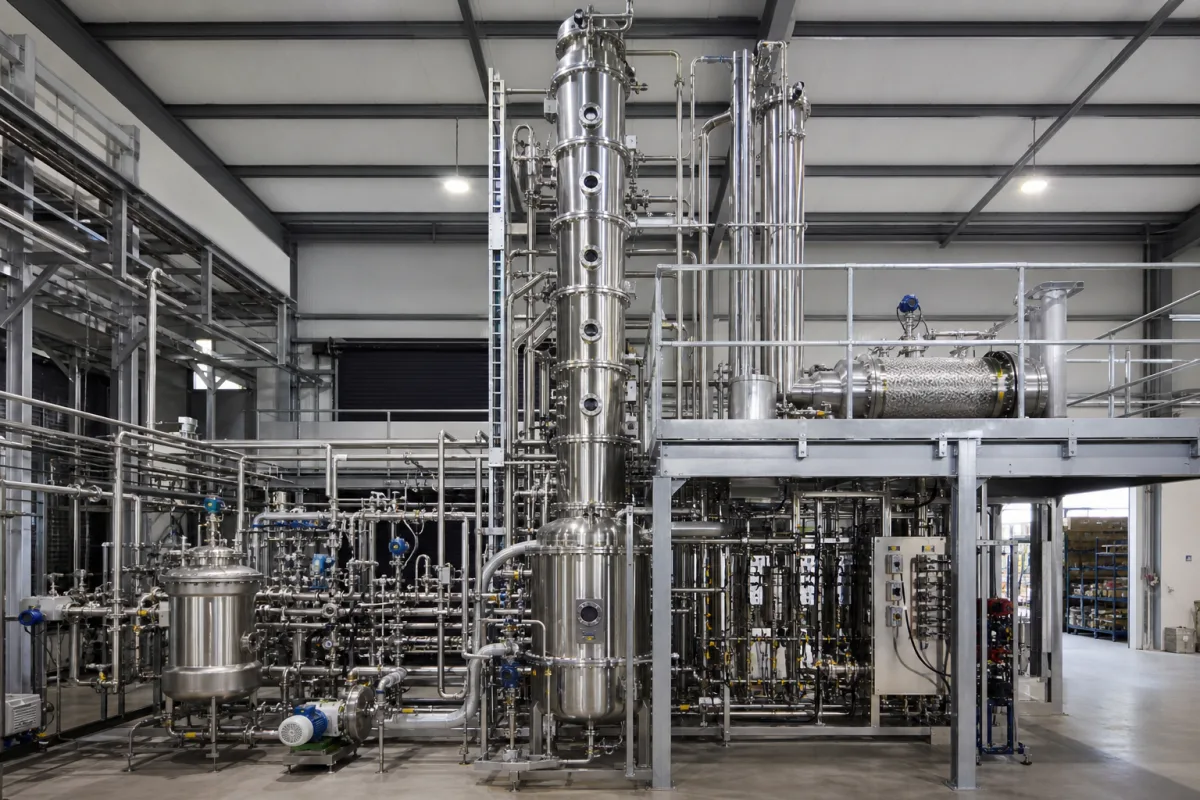
Modular Distillation Column System

Based on aggregated insights from multiple verified factory profiles within the CNFX directory, the standard Modular Distillation Column System used in the Chemical Manufacturing sector typically supports operational capacities ranging from standard industrial configurations to heavy-duty production requirements.

Technical Definition & Core Assembly

A canonical Modular Distillation Column System is characterized by the integration of Distillation Column and Reboiler. In industrial production environments, manufacturers listed on CNFX commonly emphasize stainless steel 316L construction to support stable, high-cycle operation across diverse manufacturing scenarios.

Pre-engineered modular system for continuous separation of chemical mixtures via distillation.
Product Specifications

Technical details and manufacturing context for Modular Distillation Column System

Definition
A standardized, skid-mounted distillation system designed for continuous separation of liquid mixtures based on boiling point differences. It features modular construction for rapid deployment and scalability, with integrated controls, safety systems, and utility connections. The system is engineered for chemical manufacturing processes requiring high-purity separation, such as solvent recovery, monomer purification, or intermediate product isolation. Its pre-fabricated design reduces on-site installation time and costs compared to traditional field-erected columns.
Working Principle
Liquid mixture is heated to vaporize components; vapors rise through packing/trays, condense at different temperatures, and are collected as separate fractions based on volatility.
Common Materials
stainless steel 316L, borosilicate glass, PTFE gaskets, ceramic packing
Technical Parameters
  • Maximum feed flow rate (L/h) Customizable
  • Number of equilibrium stages (theoretical plates) Customizable
Components / BOM
  • Distillation Column
    Primary separation vessel with internals
    Material: Stainless steel 316L
  • Reboiler
    Vaporizes bottom liquid
    Material: Stainless steel 316L
  • Condenser
    Cools and condenses overhead vapor
    Material: Stainless steel 316L
  • Control System
    Automated process monitoring and control
    Material: Electronics/enclosure
  • Feed Preheater Optional
    Pre-heats incoming feed stream
    Material: Stainless steel 316L
Engineering Reasoning
0.1-10 bar absolute pressure, 20-400°C temperature, 0.5-50 m³/h liquid flow rate
Column pressure exceeds 12 bar causing flange gasket blowout, tray flooding at 55 m³/h liquid flow, temperature gradient >50°C/m causing thermal stress cracking
Design Rationale: Exceeding 12 bar pressure differential across column sections causes gasket material (PTFE) extrusion failure; Liquid entrainment exceeding 0.1 m/s vapor velocity causes tray flooding via the Fair correlation; Thermal expansion mismatch between 316L stainless steel (17.3 μm/m·K) and insulation creates >250 MPa stress at welds
Risk Mitigation (FMEA)
Trigger Two-phase flow maldistribution causing 70% liquid load on one tray section
Mode: Tray weeping leading to 40% efficiency drop and methanol-water azeotrope formation
Strategy: Install perforated distributor plates with 5 mm holes at 15 mm pitch and dual liquid level sensors with ±2 mm accuracy
Trigger Reboiler heat flux exceeding 45 kW/m² creating 7°C/mm thermal gradient
Mode: 304L stainless steel reboiler tubes undergo chloride stress corrosion cracking at 65°C
Strategy: Replace with duplex 2205 stainless steel (PREN 35) and implement cascade control maintaining ΔT<3°C/mm

Industry Taxonomies & Aliases

Commonly used trade names and technical identifiers for Modular Distillation Column System.

Industrial Ecosystem & Supply Chain DNA

Complementary Systems
Downstream Applications
Specialized Tooling

Application Fit & Sizing Matrix

Operational Limits
pressure: Vacuum to 10 bar
flow rate: Up to 50 m³/h
temperature: -20°C to 300°C
slurry concentration: Up to 20% solids by weight
Media Compatibility
✓ Petroleum fractions ✓ Organic solvents ✓ Aqueous solutions
Unsuitable: Highly corrosive media (e.g., concentrated acids, strong oxidizers)
Sizing Data Required
  • Feed composition and purity requirements
  • Required separation efficiency (theoretical plates)
  • Operating pressure and temperature profile

Reliability & Engineering Risk Analysis

Failure Mode & Root Cause
Corrosion-induced pitting and cracking
Cause: Exposure to corrosive process fluids (e.g., acidic or caustic streams), chloride stress corrosion cracking in stainless steel components, or improper material selection for specific chemical service leading to localized material degradation.
Thermal fatigue and distortion
Cause: Cyclic thermal stresses from repeated heating/cooling cycles during startups, shutdowns, or process upsets, causing cracking at welds, flange connections, or support structures, and potential misalignment of internal trays/packings.
Maintenance Indicators
  • Unusual vibration or audible knocking from column shell or internals during operation, indicating loose trays, damaged packing, or flow-induced vibration issues.
  • Visible weeping or dripping of process fluid from flange connections, manways, or instrument nozzles, suggesting gasket failure, bolt relaxation, or corrosion under insulation.
Engineering Tips
  • Implement a comprehensive corrosion monitoring program using ultrasonic thickness testing, corrosion coupons, and inline probes at critical locations (e.g., bottom section, feed points) to track material loss rates and schedule proactive replacements.
  • Establish controlled startup and shutdown procedures with defined heating/cooling rates to minimize thermal stresses, and conduct regular infrared thermography surveys to identify hot spots or cold spots indicating insulation damage or internal flow maldistribution.

Compliance & Manufacturing Standards

Reference Standards
ISO 9001:2015 - Quality Management Systems ASME BPE-2022 - Bioprocessing Equipment EN 13445-5:2021 - Unfired pressure vessels - Part 5: Inspection and testing
Manufacturing Precision
  • Column vertical alignment: +/- 1.5mm per 10m height
  • Flange face flatness: 0.05mm across any 150mm diameter
Quality Inspection
  • Helium leak test for vacuum/pressure integrity
  • Material certification verification (ASTM/EN standards)

Factories Producing Modular Distillation Column System

Verified manufacturers with capability to produce this product in China

✓ 92% Supplier Capability Match Found

P Procurement Specialist from United States Jan 15, 2026
★★★★★
"Reliable performance in harsh Chemical Manufacturing environments. No issues with the Modular Distillation Column System so far."
Technical Specifications Verified
T Technical Director from United Arab Emirates Jan 12, 2026
★★★★★
"Testing the Modular Distillation Column System now; the Column Diameter (mm) results are within 1% of the laboratory datasheet."
Technical Specifications Verified
P Project Engineer from Australia Jan 09, 2026
★★★★★
"Impressive build quality. Especially the Column Diameter (mm) is very stable during long-term operation."
Technical Specifications Verified
Verification Protocol

“Feedback is collected from verified sourcing managers during RFQ (Request for Quote) and factory evaluation processes on CNFX. These reports represent historical performance data and technical audit summaries from our B2B manufacturing network.”

8 sourcing managers are analyzing this specification now. Last inquiry for Modular Distillation Column System from Brazil (13m ago).

Supply Chain Commonly Integrated Components

Reaction Module

A modular unit within a continuous flow pharmaceutical reactor where chemical reactions occur under controlled conditions.

Explore Specs →
Temperature Control Unit

A precision thermal management component that regulates and maintains specific temperature conditions within a continuous flow pharmaceutical reactor system.

Explore Specs →
Process Analytics

Real-time monitoring and analysis system for pharmaceutical manufacturing processes

Explore Specs →
Dust Containment System

A safety and environmental control system designed to capture, contain, and prevent the escape of airborne pharmaceutical powder particles during blending operations.

Explore Specs →

Frequently Asked Questions

What materials are used in the modular distillation column system?

The system is constructed with stainless steel 316L, borosilicate glass for visibility, PTFE gaskets for sealing, and ceramic packing for efficient separation.

What are the key components included in the BOM?

The bill of materials includes a condenser, control system, distillation column, feed preheater, and reboiler for complete operation.

What specifications should I consider for my application?

Key specs include column diameter (mm), material compatibility, operating pressure (bar), and temperature range (°C) to ensure suitability for your chemical process.

Can I contact factories directly on CNFX?

CNFX is an open directory, not a transaction platform. Each factory profile provides direct contact information and production details to help you initiate direct inquiries with Chinese suppliers.

Get Quote for Modular Distillation Column System

Request technical pricing, lead times, or customized specifications for Modular Distillation Column System directly from verified manufacturing units.

Your business information is encrypted and only shared with verified Modular Distillation Column System suppliers.

Thank you! Your message has been sent. We'll respond within 1–3 business days.

Need to Manufacture Modular Distillation Column System?

Connect with verified factories specializing in this product category

Add Your Factory Contact Us
Previous Product
Mixing Vessel
Next Product
Modular Urea Granulation and Prilling System