Filter press plates: recessed, CGR and membrane plates rated by pressure class, polymer temperature limit and sealing edge
The plates themselves, bought new or as replacements for a plate pack · pressure class of the plate web, the polymer's temperature ceiling, how the sealing edge and filtrate path are made, and when a membrane plate goes in
A filter press is only as tight and as strong as its plates. Each plate is a molded slab with a recessed face that forms half a chamber, a drainage surface that supports the cloth, ports that carry feed and filtrate, and a sealing rim that meets the next plate when the hydraulic ram closes the pack. Buying plates, whether for a new pack or to replace cracked ones, comes down to four choices: the plate type, the pressure the plate web is rated for, the polymer and its temperature limit, and the way the edge seals and the filtrate leaves the chamber.
Individual filter press plates as a component: recessed chamber plates (non-gasketed and caulked-gasketed CGR), membrane (diaphragm) plates with fixed or replaceable membranes, and plate-and-frame plates, in polypropylene, PVDF and nylon, with their pressure class, temperature limit, drainage surface, ports and sealing edge. Selecting the whole press, feed pressure and cycle time are covered on the Industrial filter press page; packaged small presses with feed pump and manifold are covered on the Compact filter press skid for small chemical batches page. Filter cloths, hydraulic closures and plate shifters are outside this page.
CNFX editorial research · Sources checked October 13, 2026 · 5 sources
Plate web rated for 7, 15, 16 or 20 bar, and a 95 °C ceiling for polypropylene against 130 °C for PVDF or nylon
The pressure class and the polymer are fixed when the plate is molded, so a plate that is too weak for the feed pump or too hot for its polymer cannot be fixed later by press settings. Two plate makers state their classes this way:
EnviroTech writes that a recessed chamber plate is a stronger design than flush plates and frames, which is why it can run at higher temperatures and pressures; it also notes that cake permeability falls as the chamber fills, so the feed pressure rises through the cycle. [1] The plate class therefore has to cover the end of the fill, when the pump reaches its highest pressure, not the start.
Editorial calculation: 7 bar is about 100 psi and 20 bar about 290 psi; Micronics rounds the 20 bar class to 300 psi in its own conversion. [3] A replacement plate rated 7 bar placed in a pack run at 15 bar would be loaded to more than twice its class.
Stay bosses support the plate against flexing while slurry is fed under pressure [3]
Give the maximum feed pump pressure, the slurry temperature at the press inlet, the plate size and press type (sidebar or overhead), and the chemicals in the slurry; ask for the plate's pressure class and polymer in writing.
02
Machined non-gasketed rim or caulked-gasketed CGR groove, pipped drainage, and open or closed filtrate ports
The rim decides whether filtrate drips from the pack, and the drainage surface and ports decide where it goes once it passes the cloth.
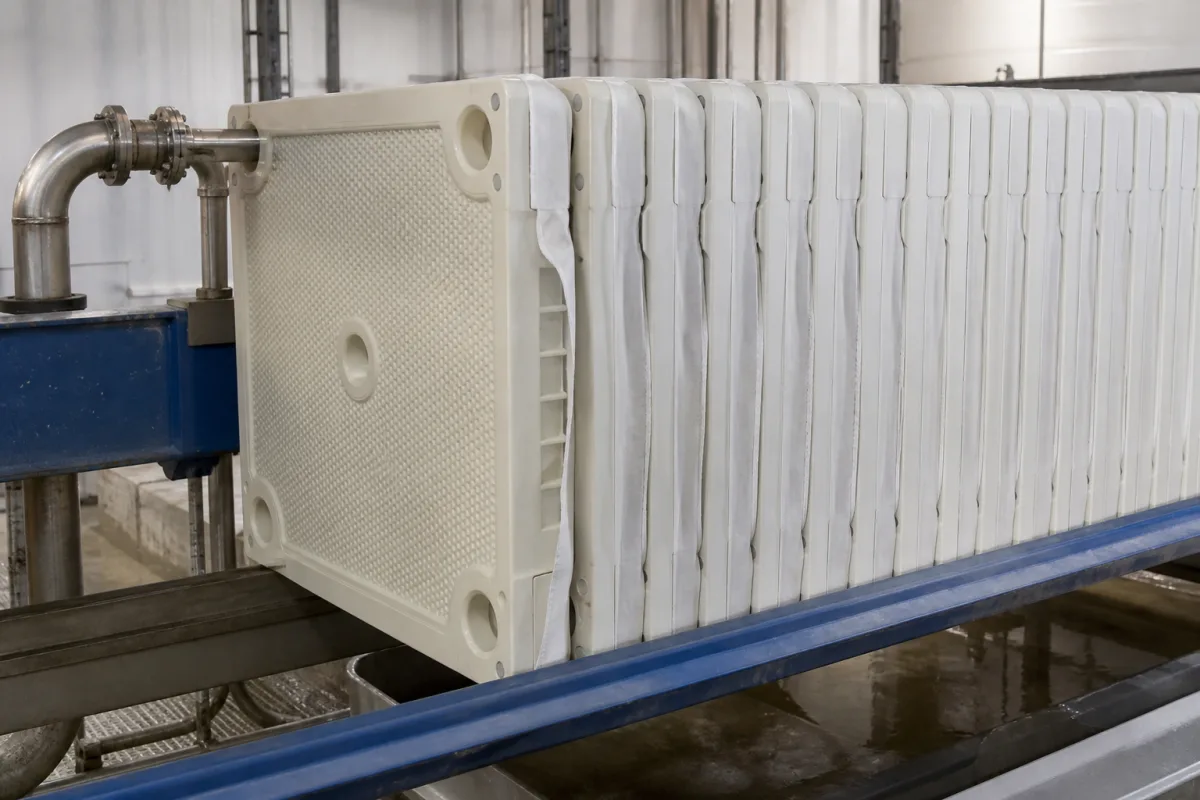
The image above shows plates with a pipped face, a feed eye and corner ports, and cloths draped over the plate tops. When buying replacements, the new plate has to repeat the port positions, the rim type and the hanger of the plates already in the pack; a CGR plate will not seal against a non-gasketed neighbour in the way its gasket was designed for.
Feature
Options
What the maker says
Sealing edge
Non-gasketed (NG), machined faces
Micronics supplies recessed plates with machined non-gasket sealing surfaces as standard [3]; EnviroTech machines the seal surfaces parallel to improve sealing between plates [1]. Kanadevia says NG plates are more sensitive to clamping conditions and cloth condition [5]
Sealing edge
Caulked, gasketed and recessed (CGR)
The cloth is set into grooves and an O-ring around the sealing edge and filtrate holes seals the closed pack, to stop cloth wicking and leaks [3]; Kanadevia adds that gaskets need periodic inspection and replacement [5]
Drainage surface
Pipped, elongated pip or grooved
Micronics writes that the higher pressures of recessed and membrane plates make a pipped surface more desirable, and that grooved drainage is “more common on plate & frame installations” [3]; EnviroTech uses a short-rib drainage surface [1]
Filtrate discharge
Open or closed
Open plates discharge each chamber to a bib or holes under the plate, so a holed cloth shows at once; closed plates collect filtrate through corner holes into a manifold at the feed end [3]
Feed eye
Corner, center or off-center
EnviroTech offers all three, with washing and non-washing discharge [1]; Kanadevia uses a double top-corner feed for even cake formation and washing [5]
Send a drawing or photo of an existing plate showing port positions, feed eye, rim and hangers, and say whether filtrate leaves open or through a manifold.
03
Membrane plates: 7 bar feed, 15 or 16 bar squeeze, and a cake at least one third of the chamber before squeezing
A membrane plate is a recessed plate whose faces can be inflated after filling to squeeze the cake. Two makers give the operating envelope:
Micronics writes that a fixed, welded membrane has no joints, which it presents as an advantage in food applications where joints could trap contamination. [4] Kanadevia, for corrosive slurries, offers a metal-free wetted path of polypropylene plates with a natural rubber diaphragm sheet. [5]
Editorial calculation: with EnviroTech's one-third rule, a 50 mm chamber needs at least about 17 mm of cake before the membrane is inflated, and a 30 mm chamber about 10 mm. [2][1] Kanadevia's laboratory press uses 25, 30 and 40 mm chambers on a 350 mm single chamber with 0.117 m² of filtration area, so a slurry can be tried at different chamber depths before plates are ordered; the 40 mm chamber holds 1.6 times the cake depth of the 25 mm one (40 ÷ 25). [5]
Item
Micronics
EnviroTech
Feed and squeeze pressure
Micronics says membrane plates “usually operate” at up to 7 bar feed and up to 15 bar squeeze; special plates can take more [4]
Fixed membranes, which Micronics says “are most commonly 100% polypropylene”, heat-welded to the core; or replaceable rubber membranes on a machined PP core [4]
PP core with two elastomer membranes (EPDM, Buna-N, Viton or TPE), replaceable without taking the plate out of the press [2]
Pack arrangement
Mixed pack, one recessed plate alternating with one membrane plate; Micronics calls mixed packs “the most common configuration due to the savings in the overall plate pack cost” [4]
State the squeeze medium and pressure, the membrane material needed for the slurry chemistry and temperature, whether the pack is all-membrane or mixed, and the smallest batch the press must handle.
04
Plate data to send with an enquiry
Paste it into your enquiry below or into an email to a maker, then replace every bracket.
Plate type: [recessed NG; CGR; membrane fixed or replaceable; plate and frame]
Size and press: [mm; sidebar or overhead; hanger type]
Pressure: [feed; squeeze]
Polymer and temperature: [PP, PVDF, nylon; slurry temperature]
Chamber: [depth in mm]
Ports: [feed eye position; open or closed filtrate; washing]
Quantity: [new pack or replacements; existing plate drawing]
Explore company information and manufacturing capabilities, then discuss the scope of your project with a relevant supplier.
Share this page
Compiled and source-reviewed by the CNFX editorial team.
Each manufacturer above links to the page on that company's own website where the product is listed, with the date we checked it. How we source and review
· Page last updated 13 October 2026
Buyer questions
What temperature can polypropylene filter plates take?
EnviroTech rates its PP chamber plates up to 95 °C and offers PVDF or nylon plates for up to 130 °C. [1]
What pressure are filter press plates rated for?
EnviroTech offers 7 and 16 bar web options; Micronics designs recessed plates for 7, 15 and 20 bar. [1][3]
What is a CGR filter plate?
A caulked, gasketed and recessed plate: the cloth sits in grooves and an O-ring around the edge and filtrate holes seals the closed pack. Kanadevia notes the gaskets need periodic inspection and replacement. [3][5]
How full must a membrane plate chamber be before squeezing?
EnviroTech requires a cake of at least one third of the initial chamber thickness before squeeze. [2]
Sources and what still needs a direct check
Sources checked 2026-10-13. Four pages from three plate and press makers: EnviroTech's chamber-plate and membrane-plate pages, Micronics's recessed and membrane plate pages, and Kanadevia's guide to filter press types.