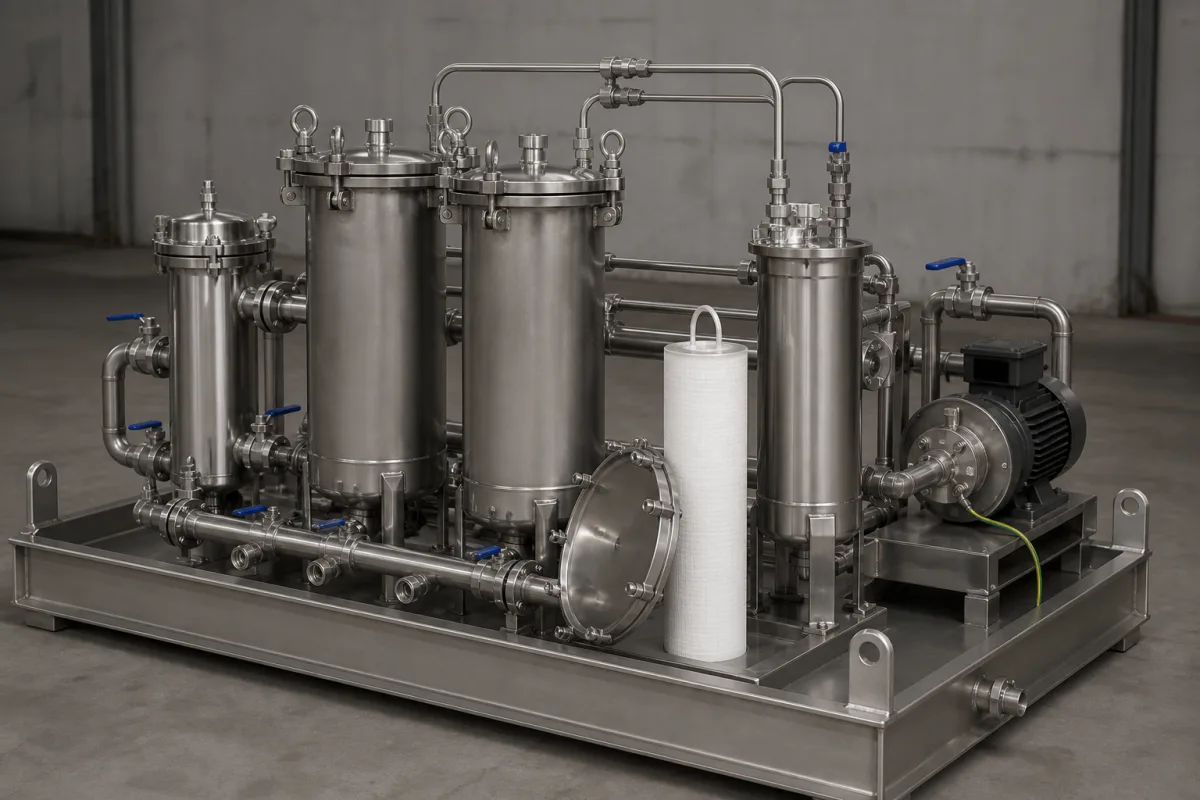
Solvent filtration skid for solvent recovery (cartridge and basket filter system)
Solvent recovery filtration · Cartridge and basket filter skids: solvent flash-point category, PTFE membrane limits and housing choice
A solvent filtration skid is the filtering stage of a solvent recovery module: stainless steel cartridge or basket filter housings, a transfer pump, valves, gauges and piping on one frame, which take solids out of used or distilled solvent before it is stored or reused. Ask three things first: which flammable-liquid category the solvent falls into, which filter medium and seals it can tolerate at the working temperature, and how fine the filtration must be.
Skid-mounted filtration systems for solvents in solvent recovery and chemical processing: cartridge filter housings with membrane or depth cartridges, single- and multi-barrel basket filters, transfer pumps and the frame, valves and gauges that join them. Pressure vessels for granular media and activated carbon filtration in water treatment are covered on the Pressure filter vessels for media filtration page. Lubricating oil purifiers, membrane (TFF and ceramic) systems, polymer melt filters and drinking-water filters are outside this page.
CNFX editorial research · Sources checked October 12, 2026 · 4 sources
Classify the solvent by flash point before choosing the skid
OSHA's 29 CFR 1910.106 sorts flammable liquids into four categories by flash point and boiling point: Category 1 below 23 °C (73.4 °F) flash point with boiling point at or below 35 °C (95 °F); Category 2 below 23 °C flash point with boiling point above 35 °C; Category 3 from 23 °C to 60 °C (140 °F); and Category 4 above 60 °C up to 93 °C (199.4 °F). [1]
Heating changes the category that applies. A Category 3 liquid with a flash point at or above 37.8 °C (100 °F) that is heated to within 16.7 °C (30 °F) of its flash point must be handled as a Category 3 liquid below 37.8 °C, and a Category 4 liquid heated to within 16.7 °C of its flash point must be handled as a Category 3 liquid at or above 37.8 °C. In its tank storage provisions the regulation lists ignition sources to be eliminated or controlled where flammable vapours may be present, including open flames, hot surfaces, frictional heat and static, electrical and mechanical sparks. [1]
Editorial note: solvent leaving a recovery still can be warm, so check the category at the filtration temperature, not at room temperature, and give the supplier both the solvent and the temperature so the pump motor, wiring and grounding of the skid can be specified for that category. [1]
Give the supplier the solvent or solvent mixture, its flash point and category, the temperature at the filter, the flow rate and operating pressure, the solids load and the particle size to be removed, the cartridge or basket type wanted, the seal material, the housing material and connections, the pump and motor requirements for the area, and the space for the frame.
02
Check the PTFE membrane cartridge's temperature, pressure and area limits
Hangzhou Darlly lists its PTB series cartridges with a hydrophobic PTFE membrane for chemical compatibility with aggressive solvents, oxidisers and corrosive fluids, naming solvents, strong acids and bases among the applications. The cartridges have a 69 mm (2.72 in) outer diameter in lengths of 5, 10, 20, 30 and 40 in, polypropylene support layer, cage, core and end caps, and silicone, EPDM or FKM seal options. [2]
Darlly gives a maximum operating temperature of 80 °C and a maximum operating differential pressure of 4 bar at 20 °C and 2 bar at 80 °C, a filtration area of 0.68 m² per 10 in cartridge, and pore sizes of 0.22 µm for liquids and 0.01 µm for gas, with each cartridge integrity tested. [2]
Editorial calculation: if area scales with length, a 30 in cartridge gives about 3 × 0.68 = 2.04 m². The halving of allowed differential pressure from 4 bar to 2 bar between 20 °C and 80 °C means a warm solvent stream must be changed out at a lower pressure drop; set the change-out point from the cartridge maker's curve at your temperature. The support layer, cage, core and end caps are polypropylene, so ask for the solvent compatibility of those parts and the chosen seal as well as of the membrane. [2]
03
Choose cartridge housings or cleanable basket filters for the frame
Cartridge housings hold the membrane or depth cartridges. Darlly lists sanitary cartridge housings in 304 or 316 stainless steel with polished, crevice-free surfaces and TC-type fittings for 2.5 to 3 in OD cartridges, depth-stack housings for 8, 12 and 16 in diameter modules up to four modules high, Y-strainer housings for pipelines carrying aqueous solutions, oils and gases, and 304 stainless housings for 4 to 4.5 in OD cartridges. [3]
For coarser solids ahead of the cartridges, Beijing VP lists single- and triple-barrel basket filters with metal filter screens that can be cleaned and reused instead of replaced, mesh numbers from 10 to 2000, a removable support column with magnetic bar, butterfly nuts for opening and deformation-resistant screens and baskets. [4]
Editorial note: a basket stage with a reusable screen ahead of a 0.22 µm membrane stage keeps coarse solids off the cartridges; ask the supplier how the stages are arranged and whether a standby housing lets one stage be opened while the other runs. [4][2]
12 companies list this product among what they make. Company figures are quoted from each
company's own website; every card states where the relationship came from.
Hangzhou Darlly Filtration Equipment Co., Ltd.
Manufacturing site to be confirmed for the order
Lists filtration systems, stainless cartridge filter housings and PTFE membrane cartridges for solvents.
Explore company information and manufacturing capabilities, then discuss the scope of your project with a relevant supplier.
Share this page
Compiled and source-reviewed by the CNFX editorial team.
Each manufacturer above links to the page on that company's own website where the product is listed, with the date we checked it. How we source and review
· Page last updated 13 October 2026
Buyer questions
Which OSHA category is a solvent with a 15 °C flash point?
Under 29 CFR 1910.106, a flash point below 23 °C is Category 1 if the boiling point is at or below 35 °C and Category 2 if it is above 35 °C. [1]
How hot can a PTFE cartridge run in solvent?
Darlly lists its PTB PTFE cartridges at 80 °C maximum, with allowed differential pressure falling from 4 bar at 20 °C to 2 bar at 80 °C. [2]
Can basket filters in a solvent skid be reused?
Beijing VP lists single- and triple-barrel basket filters with metal screens that are cleaned and reused, in mesh numbers from 10 to 2000. [4]
Sources and what still needs a direct check
Sources checked 2026-10-12. 29 CFR 1910.106 is a US Department of Labor (OSHA) regulation; Hangzhou Darlly and Beijing VP describe their own cartridges, housings and filters.