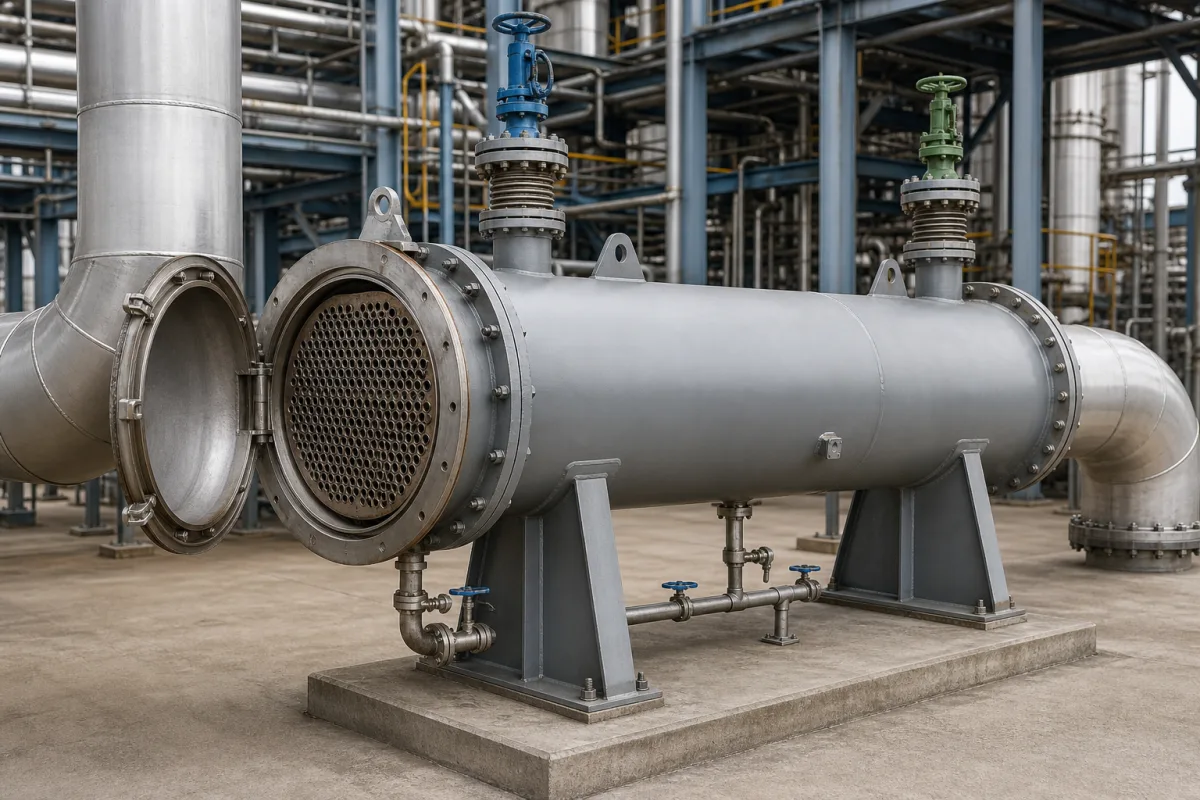
CO2 gas cooler for transcritical refrigeration and heat pump systems
High-pressure heat rejection in CO2 (R744) refrigeration, chillers and heat pumps · why it cools a supercritical gas instead of condensing, 120 to 140 bar design pressure, water-cooled shell-and-tube or air-cooled coil
A CO2 gas cooler is the high-pressure heat exchanger of a transcritical R744 refrigeration, chiller or heat pump system: it takes hot, compressed CO2 from the compressor and cools it against air or water without the refrigerant ever condensing, because the high side runs above CO2's critical pressure. That changes what a buyer has to specify compared with a condenser. Fix three things first: the refrigerant-side design pressure, the gas outlet temperature the system's pressure controller will aim for, and whether the heat goes to outdoor air or into water that can be reused.
Gas coolers for carbon dioxide (R744) refrigerant in transcritical commercial and industrial refrigeration, chillers and heat pumps: water-cooled shell-and-tube units with CO2 in the tubes, and air-cooled finned coils with fans, including their use as heat recovery exchangers or as condensers in subcritical operation. Plate, shell-and-tube, spiral and finned-tube heat exchangers for other duties are covered on the Heat exchanger page, and gasketed plate units on the Gasketed plate-and-frame heat exchanger page. Compressed-air aftercoolers are covered on the Compressed air aftercoolers page, and coolers that raise steam from hot process gas on the Waste heat boiler page. Shell-and-tube condensers for HFC refrigerants, with refrigerant on the shell side and AHRI 450 ratings, are on the Water-cooled shell-and-tube refrigerant condenser for chillers and refrigeration plants page.
CNFX editorial research · Sources checked October 12, 2026 · 4 sources
Above 73.8 bar and 31 °C: cooling CO2 without condensing it
The NIST Chemistry WebBook lists the critical temperature of carbon dioxide as 304.18 K and its critical pressure as 73.80 bar (Suehiro, Nakajima et al., 1996), with other measurements between 304.1 and 304.35 K and 73.40 to 73.825 bar. [1] Editorial calculation: 304.18 K − 273.15 = 31.03 °C.
Bitzer's refrigerant report explains the consequence for the heat exchanger: in transcritical operation, heat rejection on the high-pressure side is isobaric but not isothermal, so the CO2 is cooled with a temperature glide instead of being condensed, and the exchanger is therefore called a gas cooler. As long as the system stays above the critical pressure, which Bitzer gives as 74 bar, only dense vapour leaves it; condensation happens only after expansion to a lower pressure. [3]
The same report says the high-side pressure has to be held at an "optimum pressure" that depends on the gas cooler outlet temperature, balancing the largest enthalpy difference against the least compression work, and set by a modulating controller. When the heat sink is cold enough, a system designed for transcritical operation can run subcritically, and the gas cooler then works as a condenser. [3]
Carrier rates its Soprano air-cooled gas coolers at an air temperature of 32 °C and a gas cooler outlet temperature of 34 °C. [4] Editorial calculation: that rating point has a 2 K approach between leaving gas and entering air, and the 32 °C air is already above the 31.03 °C critical temperature, so at this point the unit cannot work as a condenser.
Editorial note: because the outlet temperature sets the pressure the controller chooses, ask the supplier for capacity at your design ambient or water inlet temperature and at the high-side pressure your controller will hold, not only at a catalogue point.
Give the supplier the refrigerant (R744), the system type (booster rack, chiller, heat pump), heat rejected in kW, CO2 inlet temperature and mass flow, target gas outlet temperature, the high-side pressure range, and the design air or water inlet temperature.
02
Water-cooled shell-and-tube gas cooler: CO2 in the tubes at 140 bar, water in the shell at 16 bar
Bitzer's GK series puts the CO2 on the tube side because of its high design pressure and water or anti-freeze mixtures on the shell side, in counterflow. Design pressure is −1/140 bar on the tube side and −1/16 bar on the shell side, with design temperature −10/150 °C on both. [2]
Bitzer lists tubes in CuFe2P, tube sheets, refrigerant end covers and shell in P265GH carbon steel, plastic polymer baffles, CE marking under the Pressure Equipment Directive 2014/68/EU, and marine approvals on request. The series covers 30 to 1,200 kW as gas coolers in 7 shell diameters and 14 standard lengths, with baffle arrangements chosen on the water side. [2]
Refrigerant-side volume matters for the CO2 charge. In the largest standard shell, the 273 mm GK2745K at 4,946 mm long, Bitzer gives between 41.8 and 76.4 dm³ on the refrigerant side and between 201.9 and 158.0 dm³ on the water side, depending on the model identification number, with volumes quoted for the version with the fewest baffles. [2]
The same shell can serve as the main gas cooler, as a heat recovery exchanger making hot water upstream of an air-cooled gas cooler, or as a condenser in subcritical operation. Bitzer says GK coolers let CO2 heat pumps deliver water at up to 120 °C, uses large water flow sections to limit scaling, and points to the 16 bar water-side pressure for district heating. [2]
Editorial calculation: the 140 bar tube-side design pressure is 140 ÷ 73.80 ≈ 1.9 times CO2's critical pressure. [2][1]
Air-cooled CO2 gas coolers: 120 bar coils, EC fans and outdoor installation
Carrier's Soprano CO2 gas coolers are air-cooled units for outdoor installation, offered in single- or double-row designs with vertical or horizontal airflow, EC fans and motors with Modbus fan control, a design pressure (PS) of 120 bar and a cooling capacity range of 7 to 300 kW. [4]
Editorial calculation: the Soprano's 120 bar design pressure is 20 bar below the GK series' 140 bar tube-side rating, and its 300 kW upper capacity is a quarter of the 1,200 kW Bitzer quotes for one GK shell. [4][2] Bitzer presents one GK shell as a way to go beyond 1,000 kW without two or three coolers installed in parallel. [2]
Bitzer's report notes that, for supermarket systems, transcritical installations are preferred where the annual ambient temperature allows long running hours in subcritical operation, and lists parallel compression, ejectors or expanders as measures that improve the efficiency of transcritical systems. [3] Editorial note: for an air-cooled unit, the design ambient sets how many hours it spends as a gas cooler and how many as a condenser; give the supplier the site's design dry-bulb temperature and the hours above 31 °C if known.
04
Send the CO2 side, the heat sink and the pressure rating together
Paste it into your enquiry below or into an email to a maker, then replace every bracket.
System: [booster rack, chiller or heat pump; transcritical or subcritical hours]
CO2 side: [heat rejected kW; mass flow; inlet temperature; target outlet temperature; high-side pressure range]
Design pressure: [refrigerant side bar; water side bar]
Heat sink: [air: design dry-bulb °C, airflow direction, fan type | water or glycol: inlet/outlet °C, flow]
Use: [main gas cooler, heat recovery, condenser]
Construction: [tube and shell materials; connection sizes; refrigerant-side volume]
Approvals: [PED / other pressure-vessel code; marine]
1 company lists this product among what they make. Company figures are quoted from each
company's own website; every card states where the relationship came from.
Shanghai Shenglin M&E Technology Co., Ltd.
Manufacturing site to be confirmed for the order
CO² Gas Coolers page lists air-cooled CO2 gas coolers in flat-bed or V-block layouts, with 7 or 12.7 mm OD copper tube, a range of fin materials and coatings, AC or EC fans, and a stated max design pressure of 80 bar.
Explore company information and manufacturing capabilities, then discuss the scope of your project with a relevant supplier.
Share this page
Compiled and source-reviewed by the CNFX editorial team.
Each manufacturer above links to the page on that company's own website where the product is listed, with the date we checked it. How we source and review
· Page last updated 13 October 2026
Buyer questions
Why is it called a gas cooler and not a condenser?
Above CO2's critical pressure (73.80 bar per NIST, 74 bar in Bitzer's report) the refrigerant is cooled with a temperature glide and does not condense, so the high-side exchanger cools a gas. [1][3]
What design pressure does a CO2 gas cooler need?
The units reviewed are rated 140 bar on the CO2 side for Bitzer's water-cooled GK series and 120 bar for Carrier's air-cooled Soprano. [2][4]
Can the same gas cooler work as a condenser?
Yes; Bitzer says a transcritical system can run subcritically when the heat sink is cold enough, and its GK shells are listed for gas cooler, heat recovery and condenser duty. [3][2]
How hot can water from a CO2 heat pump gas cooler be?
Bitzer states GK coolers let CO2 heat pumps operate at water temperatures of up to 120 °C. [2]
Sources and what still needs a direct check
Sources checked 2026-10-12. NIST supplies the critical-point data. Bitzer's GK data sheet and refrigerant report, and Carrier's Soprano page, describe their own products and their makers' account of transcritical operation.