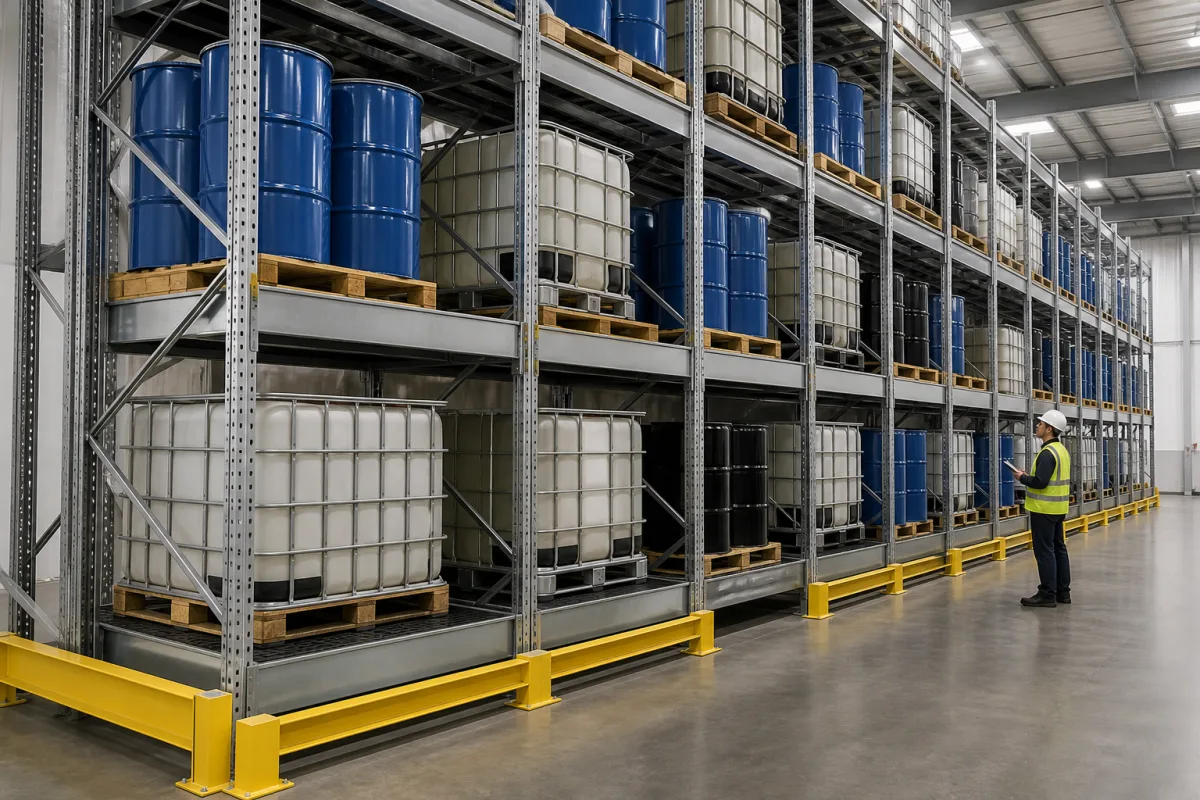
Racking is a lightweight structure carrying heavy loads next to moving trucks. Choose the system for your handling, have the designer set safe loads and display them, fix it to a floor that can carry it, and inspect it so damage is found and acted on before it fails.
Steel storage racking for pallets, drums and containers: adjustable pallet, drive-in and drive-through, push-back, live (flow), mobile and cantilever racking, including racking within automated stores. Shelving, display stands and furniture racks are outside this page.
CNFX editorial research · Sources checked October 11, 2026 · 6 sources
HSE's Warehousing and storage guide (HSG76) describes these racking systems: adjustable pallet racking gives individual access to every pallet position; mobile racking runs on rails; cantilever racking uses arms; live storage feeds goods by gravity or conveyor from a loading face to a picking face for first-in-first-out; push-back loads and picks from one face for first-in-last-out; drive-in and drive-through racking store pallets two or more deep on beam rails. [1]
HSG76 adds that the pallet type and orientation must suit the racking, especially in drive-in racking and where mixed systems are used in one warehouse. [1]
Give the supplier the load units (pallet size, weight, overhang; drums or containers), the trucks and aisle widths, the building height and floor specification, and how many positions you need.
02
Have safe loads set and displayed
HSG76 says safe working loads, heights, widths and tolerances should be set by the system designer and manufacturer, and that racking should carry a clear notice stating the maximum load and any specified load configurations. Load weights should be established before storing, unless the racking is designed for the heaviest load in the operation. [1]
It warns that racking should never be altered, for example by welding, nor components removed without consulting the manufacturer; before moving adjustable components, the design limits of the new configuration should be established and the load notice amended where necessary, and HSG76 states that "Adjusting the position of the first or second beam from the bottom is normally the most critical alteration, which always requires a check on the rated carrying capacity of the rack." Beam connector locks should secure every beam end against uplift by trucks. [1]
03
Fix the racking to a floor that can carry it
HSG76 says racking should stand on sound, level floors able to take the point load at each base plate. Free-standing racks should not be used where lift trucks operate. Uprights next to aisles and gangways should be floor-fixed where the height-to-depth ratio is up to 6:1; all uprights where it exceeds 6:1 up to 10:1; above 10:1 the manufacturer should give specific guidance. [1]
Editorial calculation: a single run 6 m to the top beam with 1.1 m deep frames has a ratio of about 5.5:1; the same run as back-to-back frames with a 0.3 m run spacer is about 6 / (1.1 + 1.1 + 0.3) ≈ 2.4:1, as HSG76 allows the combined depth where spacers are at no more than 2.5 m centres. [1]
04
Plan inspection and act on damage levels
HSG76 notes that racking is made from relatively light materials and any damage reduces capacity. It recommends a nominated person responsible for racking safety, immediate reporting of damage, visual inspections weekly or at other risk-based intervals with written records, and an expert inspection at least every 12 months. [1]
It classifies damage as green (surveillance only), amber (remedial work as soon as possible; once offloaded, do not reload until repaired, and treat as red if not repaired within four weeks) and red (offload and isolate immediately until repaired; HSG76 adds "Such repair work would usually be by replacement of the damaged component."). For automated and high-bay systems it suggests expert inspection of at least 20% of the installation each year so that all of it is covered within five years. [1]
05
Check clearances and depth limits for high-density racking
Racking maker Mecalux publishes sizing rules for its high-density systems. For drive-in racking, uprights are slotted every 50 mm; each storage level is the pallet height plus 150 mm with GP rails or plus 200 mm with C rails; lane depth is the sum of the pallet depths plus at least 25 mm per unit load; and forklifts working inside the lanes need clearance, for example at least 75 mm between each side of the truck and the uprights. Its example lane of 11 pallets deep and 3 high holds 33 pallets, matching one trailer load. [4]
Mecalux states that push-back racking loads and unloads from one aisle on a last-in, first-out basis, while pallet flow channels slope at about 4% so pallets slide from the loading aisle to a separate picking aisle. [5][6] Editorial calculation: assuming 1.2 m deep pallets, a 30-deep flow channel is about 36 m long and at a 4% slope drops about 1.44 m from entry to exit, height that is lost to storage — the loss in height Mecalux warns deep channels can cause. [6]
These are one maker's rules for its own systems; HSG76's requirements on load notices, floor fixing and inspection apply to all of them. [1]
System (Mecalux)
Published sizing values
Drive-in
Level = pallet + 150 mm (GP rails) or + 200 mm (C rails); ≥ 25 mm clearance per pallet in lane depth; ≥ 75 mm each side of forklift. [4]
Push-back
Carts 2–4 pallets deep, rollers for 4 or more; maximum height 7.5 m; carts rated −30 °C to 40 °C. [5]
Pallet flow (live)
Up to 30 pallets deep per channel; slope about 4%; beam length = pallet front + 160 mm (80 mm each side). [6]
06
Selective, shuttle, drive-in and flow racking from the linked racking makers
A-Plus and Kingmore both sell shuttle racking next to pallet racking, and Kingmore adds miniload AS/RS. [2][3]
A-Plus lists selective, double-deep, very narrow aisle, mobile, shuttle, drive-in, push-back and pallet flow racking; Kingmore lists heavy-duty pallet racking, radio shuttle and miniload AS/RS; Jracking lists teardrop and heavy-duty pallet racking and cantilever racks; Heda lists drive-in, shuttle, cantilever and carton flow racks; Deli lists warehouse racking with AS/RS handling robots; OKE lists pallet racking. Ask each for design calculations, load notices and installation by trained installers. [2][3]
07
Uprights, beam locks, base plates, run spacers and the load notice
Bay loads, levels, coating, system height and base-plate loads for a racking order
HSG76 leaves bay loads and tolerances to the system designer, so those rows ask for the designer's figures; the only dimension rule here is Mecalux's pallet front + 160 mm for flow-rack beams.
12 companies list this product among what they make. Company figures are quoted from each
company's own website; every card states where the relationship came from.
Explore company information and manufacturing capabilities, then discuss the scope of your project with a relevant supplier.
Share this page
Compiled and source-reviewed by the CNFX editorial team.
Each manufacturer above links to the page on that company's own website where the product is listed, with the date we checked it. How we source and review
· Page last updated 13 October 2026
Buyer questions
How often should pallet racking be inspected?
HSE guidance recommends visual inspections weekly or at risk-based intervals and an expert inspection at least every 12 months, with written records. [1]
What do red, amber and green racking damage mean?
Green needs surveillance only; amber needs repair as soon as possible and must not be reloaded once emptied; red means offload and isolate immediately until repaired. [1]
Does racking need to be bolted to the floor?
HSE says free-standing racks should not be used where lift trucks operate, and sets floor fixing by height-to-depth ratio. [1]
How deep can pallet flow and push-back racking go?
Mecalux lists up to 30 pallets deep for pallet flow channels sloped at about 4%, and 2–4 pallets deep for push-back on carts, with rollers beyond 4. [6][5]
Sources and what still needs a direct check
Sources checked 2026-10-11. HSE's Warehousing and storage: a guide to health and safety (HSG76, second edition, 2007) is the UK regulator's guidance, drawing on SEMA terms. Racking maker Mecalux's technical pages give its own sizing rules for drive-in, push-back and pallet flow racking. SEMA's own codes and EN standards were not read for this page. Supplier pages describe their own offers.