Industry-Verified Manufacturing Data (2026)

Stirring Mechanism (Impeller or Gas Purging)

Based on aggregated insights from multiple verified factory profiles within the CNFX directory, the standard Stirring Mechanism (Impeller or Gas Purging) used in the Chemical Manufacturing sector typically supports operational capacities ranging from standard industrial configurations to heavy-duty production requirements.

Technical Definition & Core Assembly

A canonical Stirring Mechanism (Impeller or Gas Purging) is characterized by the integration of Impeller and Drive Shaft. In industrial production environments, manufacturers listed on CNFX commonly emphasize Stainless steel (e.g., 316L) construction to support stable, high-cycle operation across diverse manufacturing scenarios.

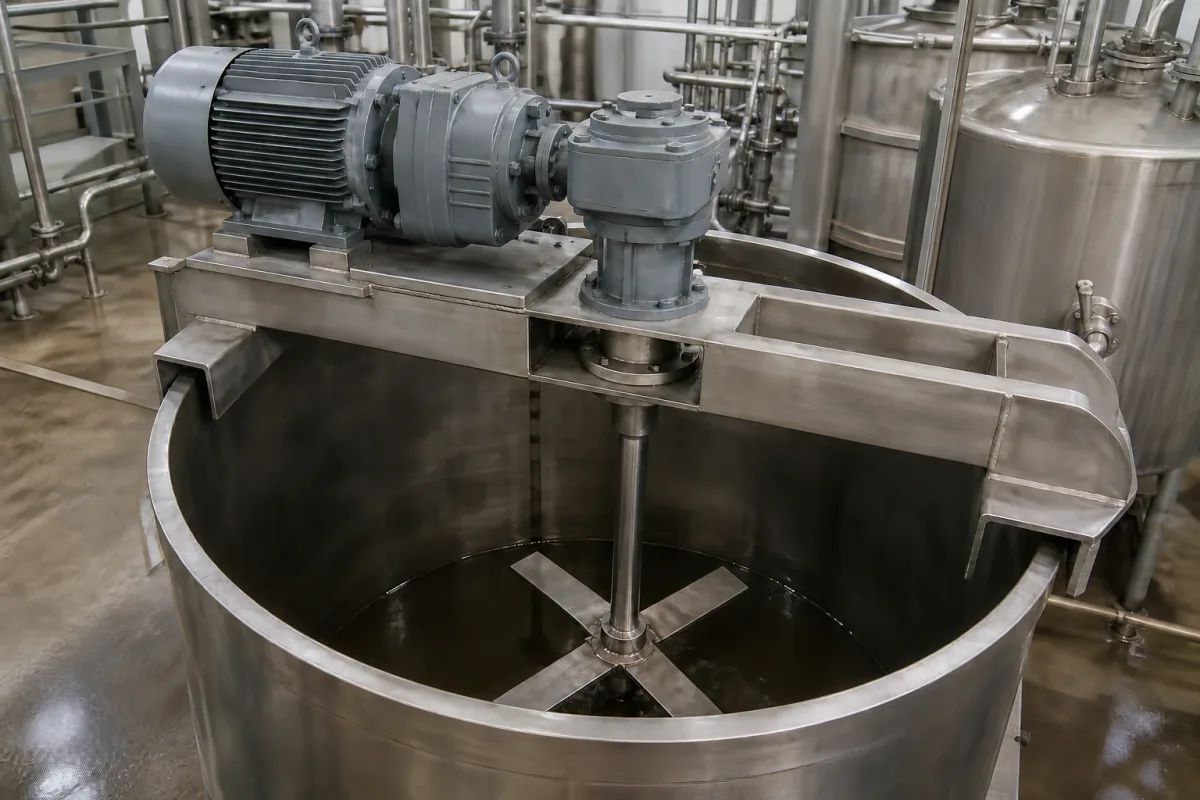
A mechanism within a desulfurization reactor that ensures uniform mixing of reactants through mechanical impellers or gas purging.
Product Specifications

Technical details and manufacturing context for Stirring Mechanism (Impeller or Gas Purging)

Definition
The stirring mechanism is a critical component of a desulfurization reactor responsible for creating and maintaining a homogeneous mixture of the gas stream (containing sulfur compounds) and the liquid or solid absorbent/adsorbent. It enhances mass transfer and reaction efficiency by promoting contact between phases, either through the rotational action of an impeller (mechanical stirring) or the introduction of an inert gas stream (gas purging/bubbling).
Working Principle
For impeller-based systems: A motor-driven shaft rotates an impeller (e.g., turbine, propeller) within the reactor vessel, creating fluid motion and shear forces that mix the contents. For gas purging systems: Compressed gas (e.g., nitrogen, air) is injected through spargers or nozzles at the reactor bottom, forming bubbles that rise and induce convective mixing and turbulence.
Common Materials
Stainless steel (e.g., 316L), Nickel alloys, Carbon steel with lining
Technical Parameters
  • Impeller diameter or gas sparger nozzle size (mm) Per Request
Components / BOM
  • Impeller
    Rotates to generate fluid motion and shear for mixing
    Material: Stainless steel
  • Drive Shaft
    Transmits torque from the motor to the impeller
    Material: Forged steel
  • Sparger
    Distributes purge gas as fine bubbles into the reactor medium
    Material: Perforated stainless steel
Engineering Reasoning
0.5-3.0 m/s impeller tip speed, 0.1-0.8 bar gas purging pressure
Impeller tip speed >3.5 m/s causes cavitation, gas pressure >1.2 bar causes bubble coalescence
Design Rationale: Cavitation at Reynolds number >10^5 for impellers, Kelvin-Helmholtz instability at gas-liquid interface for purging
Risk Mitigation (FMEA)
Trigger Bearing lubrication failure at <0.1 μm oil film thickness
Mode: Impeller shaft seizure at >150°C bearing temperature
Strategy: Hydrodynamic bearing design with 0.2-0.3 μm minimum oil film thickness
Trigger Gas distributor clogging at >15% solid particle concentration
Mode: Non-uniform bubble distribution with >30% size variation
Strategy: Self-cleaning sintered metal distributors with 50 μm pore size

Industry Taxonomies & Aliases

Commonly used trade names and technical identifiers for Stirring Mechanism (Impeller or Gas Purging).

Applied To / Applications

This component is essential for the following industrial systems and equipment:

Industrial Ecosystem & Supply Chain DNA

Complementary Systems
Downstream Applications
Specialized Tooling

Application Fit & Sizing Matrix

Operational Limits
pressure: 0-10 bar (gauge)
flow rate: 0.5-50 m³/h (gas purging), 100-5000 rpm (impeller)
temperature: 50-200°C
slurry concentration: Up to 40% solids by weight
Media Compatibility
✓ Limestone slurry (CaCO3) ✓ Seawater (for marine scrubbers) ✓ Flue gas with SO2 (acidic environment)
Unsuitable: Hydrofluoric acid (HF) or highly abrasive slurries with >40% solids
Sizing Data Required
  • Reactor volume (m³)
  • Required mixing intensity (kW/m³)
  • Gas-to-liquid ratio (for gas purging) or impeller diameter-to-tank ratio (for mechanical impellers)

Reliability & Engineering Risk Analysis

Failure Mode & Root Cause
Fatigue cracking
Cause: Cyclic loading from turbulent flow, resonance, or misalignment leading to stress concentration at welds or shaft connections
Corrosion-erosion
Cause: Chemical attack combined with fluid shear forces, especially in aggressive media or with galvanic couples between dissimilar materials
Maintenance Indicators
  • Unusual vibration patterns or audible knocking during operation indicating imbalance or mechanical looseness
  • Visible shaft wobble or excessive seal leakage suggesting bearing wear or misalignment
Engineering Tips
  • Implement predictive maintenance with vibration analysis and thermography to detect early-stage mechanical degradation
  • Optimize material selection and apply protective coatings (e.g., hard-facing on impeller edges) based on process media corrosivity and abrasiveness

Compliance & Manufacturing Standards

Reference Standards
ISO 2858:2012 (Centrifugal pumps - Design and testing) ANSI/ASME B73.1-2012 (Specification for horizontal end suction centrifugal pumps for chemical process) DIN 24256 (Agitators; definitions, main dimensions, nominal powers)
Manufacturing Precision
  • Impeller diameter: +/-0.5% of nominal diameter
  • Shaft runout: 0.05mm maximum at coupling
Quality Inspection
  • Dynamic balancing test (ISO 1940-1 Grade G6.3)
  • Material composition verification (spectrometric analysis)

Factories Producing Stirring Mechanism (Impeller or Gas Purging)

Verified manufacturers with capability to produce this product in China

✓ 92% Supplier Capability Match Found

T Technical Director from United States Feb 03, 2026
★★★★★
"Testing the Stirring Mechanism (Impeller or Gas Purging) now; the technical reliability results are within 1% of the laboratory datasheet."
Technical Specifications Verified
P Project Engineer from United Arab Emirates Jan 31, 2026
★★★★☆
"Impressive build quality. Especially the technical reliability is very stable during long-term operation. (Delivery took slightly longer than expected, but technical support was excellent.)"
Technical Specifications Verified
S Sourcing Manager from Australia Jan 28, 2026
★★★★★
"As a professional in the Chemical Manufacturing sector, I confirm this Stirring Mechanism (Impeller or Gas Purging) meets all ISO standards."
Technical Specifications Verified
Verification Protocol

“Feedback is collected from verified sourcing managers during RFQ (Request for Quote) and factory evaluation processes on CNFX. These reports represent historical performance data and technical audit summaries from our B2B manufacturing network.”

19 sourcing managers are analyzing this specification now. Last inquiry for Stirring Mechanism (Impeller or Gas Purging) from Vietnam (1h ago).

Supply Chain Compatible Machinery & Devices

Automated Batch Crystallization System

Automated system for controlled crystallization of chemical compounds in batch processes.

Explore Specs →
Automated pH Monitoring and Dosing System

Automated system for continuous pH monitoring and chemical dosing in process streams.

Explore Specs →
Automated Powder Dispensing and Blending System

Automated system for precise dispensing and homogeneous blending of powdered chemicals.

Explore Specs →
Automated Solvent Recovery and Purification System

Automated system for recovering and purifying industrial solvents.

Explore Specs →

Frequently Asked Questions

What are the main differences between impeller and gas purging stirring mechanisms?

Impeller mechanisms use mechanical blades to create fluid movement, ideal for viscous mixtures. Gas purging injects inert gases to create turbulence, better for sensitive reactions where mechanical contact should be minimized.

Which material is best for corrosive chemical environments in desulfurization?

316L stainless steel offers excellent corrosion resistance for most applications. For highly corrosive environments, nickel alloys like Hastelloy provide superior durability against sulfur compounds and acidic conditions.

How does the stirring mechanism improve desulfurization efficiency?

Uniform mixing ensures optimal contact between reactants and catalysts, preventing dead zones and improving reaction kinetics. This leads to higher sulfur removal rates, reduced byproducts, and consistent product quality.

Can I contact factories directly on CNFX?

CNFX is an open directory, not a transaction platform. Each factory profile provides direct contact information and production details to help you initiate direct inquiries with Chinese suppliers.

Get Quote for Stirring Mechanism (Impeller or Gas Purging)

Request technical pricing, lead times, or customized specifications for Stirring Mechanism (Impeller or Gas Purging) directly from verified manufacturing units.

Your business information is encrypted and only shared with verified Stirring Mechanism (Impeller or Gas Purging) suppliers.

Thank you! Your message has been sent. We'll respond within 1–3 business days.

Need to Manufacture Stirring Mechanism (Impeller or Gas Purging)?

Connect with verified factories specializing in this product category

Add Your Factory Contact Us
Previous Product
Static Mixer Element
Next Product
Storage Racking Structure