Industry-Verified Manufacturing Data (2026)

Tube Bundle / Plate Pack

Based on aggregated insights from multiple verified factory profiles within the CNFX directory, the standard Tube Bundle / Plate Pack used in the Chemical Manufacturing sector typically supports operational capacities ranging from standard industrial configurations to heavy-duty production requirements.

Technical Definition & Core Assembly

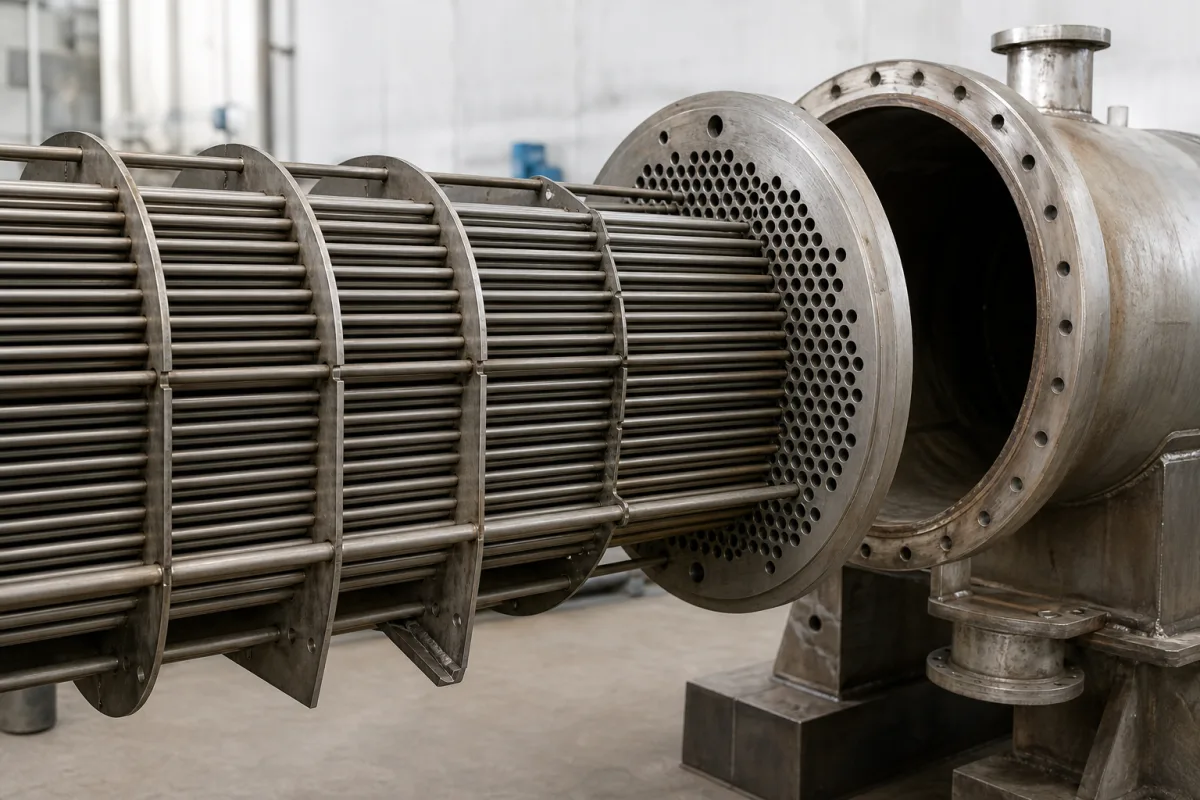
A canonical Tube Bundle / Plate Pack is characterized by the integration of Heat Transfer Tubes / Plates and Tube Sheets / Headers. In industrial production environments, manufacturers listed on CNFX commonly emphasize Stainless Steel (e.g., 304, 316L) construction to support stable, high-cycle operation across diverse manufacturing scenarios.

Heat transfer core component of a Tail Gas Heater

Product Specifications

Technical details and manufacturing context for Tube Bundle / Plate Pack

Definition
A tube bundle or plate pack is the primary heat exchange element within a Tail Gas Heater, consisting of an array of tubes or plates arranged to maximize surface area for efficient thermal energy transfer from hot flue gases to the process gas stream.
Working Principle
Hot tail gas flows over the external surfaces of the tubes or plates, transferring heat through conduction and convection. The cooler process gas flows inside the tubes or through channels between plates, absorbing this heat. The arrangement (bundle or pack) is designed to create turbulent flow and optimal thermal contact.
Common Materials
Stainless Steel (e.g., 304, 316L), Carbon Steel, Nickel Alloys (e.g., Inconel)
Technical Parameters
  • Tube outer diameter or plate thickness; critical for mechanical strength and heat transfer efficiency. (mm) Standard Spec
Components / BOM
  • Heat Transfer Tubes / Plates
    Primary surface for conductive and convective heat transfer between gas streams.
    Material: Stainless Steel
  • Tube Sheets / Headers
    Secures the ends of the tube bundle, distributes and collects the process gas flow.
    Material: Carbon Steel or Stainless Steel
  • Baffles / Spacers
    Supports the tubes/plates, maintains alignment, and directs flue gas flow across the bundle for optimal heat transfer.
    Material: Stainless Steel
Engineering Reasoning
0-25 bar differential pressure, 200-650°C gas temperature, 0.5-3.0 m/s gas velocity
Material yield strength exceeded at 275 MPa stress, tube wall thinning below 1.2 mm minimum thickness, thermal gradient exceeding 150°C/cm across tube wall
Design Rationale: Creep rupture at 650°C+ due to grain boundary sliding in austenitic stainless steel, stress corrosion cracking from chloride ions above 50 ppm at 300°C, thermal fatigue from cyclic temperature differentials exceeding 200°C
Risk Mitigation (FMEA)
Trigger Sulfur dew point corrosion from H2S condensation below 150°C
Mode: Localized pitting corrosion at tube-to-header joints reaching 2 mm/year penetration rate
Strategy: Maintain inlet gas temperature above 180°C with preheater bypass system, apply 316L stainless steel with 2.5% molybdenum content
Trigger Flow-induced vibration at gas velocities exceeding 3.5 m/s
Mode: Fatigue cracking at tube support baffles after 10^7 stress cycles at 25 Hz natural frequency
Strategy: Install anti-vibration bars at 300 mm intervals, implement gas velocity control below 2.8 m/s through variable speed ID fan

Industry Taxonomies & Aliases

Commonly used trade names and technical identifiers for Tube Bundle / Plate Pack.

Applied To / Applications

This component is essential for the following industrial systems and equipment:

Industrial Ecosystem & Supply Chain DNA

Complementary Systems
Downstream Applications
Specialized Tooling

Application Fit & Sizing Matrix

Operational Limits
pressure: Up to 150 bar (design dependent)
flow rate: 0.5-50 m/s (tube side), 1-30 m/s (shell side)
temperature: -50°C to 650°C
slurry concentration: Up to 30% solids by weight (with erosion considerations)
Media Compatibility
✓ Natural gas / tail gas streams ✓ Steam / condensate systems ✓ Thermal oil / heat transfer fluids
Unsuitable: Chloride-containing environments above 60°C (risk of stress corrosion cracking)
Sizing Data Required
  • Heat duty (kW or BTU/hr)
  • Inlet/outlet temperatures for both streams
  • Allowable pressure drop (both sides)

Reliability & Engineering Risk Analysis

Failure Mode & Root Cause
Fouling and scaling
Cause: Accumulation of deposits (e.g., minerals, biological growth, particulates) on heat transfer surfaces, reducing thermal efficiency and increasing pressure drop due to inadequate water treatment, poor filtration, or improper flow velocities.
Corrosion and pitting
Cause: Material degradation from chemical attack, galvanic action, or microbiologically influenced corrosion (MIC), often exacerbated by aggressive process fluids, improper material selection, or inadequate protective coatings.
Maintenance Indicators
  • Significant drop in heat transfer efficiency (e.g., outlet temperature deviation >5% from design)
  • Abnormal increase in pressure drop across the bundle (>10-15% above baseline) indicating flow restriction
Engineering Tips
  • Implement regular chemical cleaning or mechanical brushing protocols based on fouling rates, and optimize water treatment (e.g., pH control, biocide addition) to minimize scale and biological growth.
  • Select corrosion-resistant materials (e.g., titanium, duplex stainless steels) matched to fluid chemistry, and apply cathodic protection or protective coatings where feasible, especially in chloride-rich or acidic environments.

Compliance & Manufacturing Standards

Reference Standards
ISO 9001:2015 - Quality management systems ASME BPVC Section VIII - Pressure vessel standards EN 13445 - Unfired pressure vessels
Manufacturing Precision
  • Tube bundle pitch: +/- 0.5mm
  • Plate pack flatness: 0.2mm per meter
Quality Inspection
  • Hydrostatic pressure test
  • Dimensional verification with CMM

Factories Producing Tube Bundle / Plate Pack

Verified manufacturers with capability to produce this product in China

✓ 97% Supplier Capability Match Found

T Technical Director from Canada Jan 02, 2026
★★★★★
"Great transparency on the Tube Bundle / Plate Pack components. Essential for our Chemical Manufacturing supply chain."
Technical Specifications Verified
P Project Engineer from United States Dec 30, 2025
★★★★☆
"The Tube Bundle / Plate Pack we sourced perfectly fits our Chemical Manufacturing production line requirements. (Delivery took slightly longer than expected, but technical support was excellent.)"
Technical Specifications Verified
S Sourcing Manager from United Arab Emirates Dec 27, 2025
★★★★★
"Found 48+ suppliers for Tube Bundle / Plate Pack on CNFX, but this spec remains the most cost-effective."
Technical Specifications Verified
Verification Protocol

“Feedback is collected from verified sourcing managers during RFQ (Request for Quote) and factory evaluation processes on CNFX. These reports represent historical performance data and technical audit summaries from our B2B manufacturing network.”

9 sourcing managers are analyzing this specification now. Last inquiry for Tube Bundle / Plate Pack from Mexico (39m ago).

Supply Chain Compatible Machinery & Devices

Modular Distillation Column System

Pre-engineered modular system for continuous separation of chemical mixtures via distillation.

Explore Specs →
Automated Batch Crystallization System

Automated system for controlled crystallization of chemical compounds in batch processes.

Explore Specs →
Automated pH Monitoring and Dosing System

Automated system for continuous pH monitoring and chemical dosing in process streams.

Explore Specs →
Automated Powder Dispensing and Blending System

Automated system for precise dispensing and homogeneous blending of powdered chemicals.

Explore Specs →

Frequently Asked Questions

What materials are recommended for tube bundles in corrosive chemical applications?

For corrosive environments in chemical manufacturing, we recommend stainless steel grades like 316L for general corrosion resistance or nickel alloys like Inconel for extreme conditions involving high temperatures and aggressive chemicals.

How do baffles and spacers improve heat transfer efficiency in tube bundles?

Baffles and spacers direct fluid flow across tube surfaces, increasing turbulence and heat transfer rates while preventing vibration damage. Proper spacing ensures optimal thermal performance and extends equipment lifespan in tail gas heaters.

What specifications should I provide when ordering custom tube bundles for chemical processing?

Provide operating temperatures, pressure ratings, fluid composition (including corrosive elements), dimensional constraints, material preferences (304/316L stainless, carbon steel, or nickel alloys), and existing equipment specifications for accurate custom fabrication.

Can I contact factories directly on CNFX?

CNFX is an open directory, not a transaction platform. Each factory profile provides direct contact information and production details to help you initiate direct inquiries with Chinese suppliers.

Get Quote for Tube Bundle / Plate Pack

Request technical pricing, lead times, or customized specifications for Tube Bundle / Plate Pack directly from verified manufacturing units.

Your business information is encrypted and only shared with verified Tube Bundle / Plate Pack suppliers.

Thank you! Your message has been sent. We'll respond within 1–3 business days.

Need to Manufacture Tube Bundle / Plate Pack?

Connect with verified factories specializing in this product category

Add Your Factory Contact Us
Previous Product
Trays (e.g., Sieve, Valve)
Next Product
Twin-Screw Polymer Compounding Extruder