Industry-Verified Manufacturing Data (2026)

Analog Output Stage

Based on aggregated insights from multiple verified factory profiles within the CNFX directory, the standard Analog Output Stage used in the Computer, Electronic and Optical Product Manufacturing sector typically supports operational capacities ranging from standard industrial configurations to heavy-duty production requirements.

Technical Definition & Core Assembly

A canonical Analog Output Stage is characterized by the integration of Operational Amplifier (Op-Amp) and Feedback Resistor Network. In industrial production environments, manufacturers listed on CNFX commonly emphasize Semiconductor (Silicon) construction to support stable, high-cycle operation across diverse manufacturing scenarios.

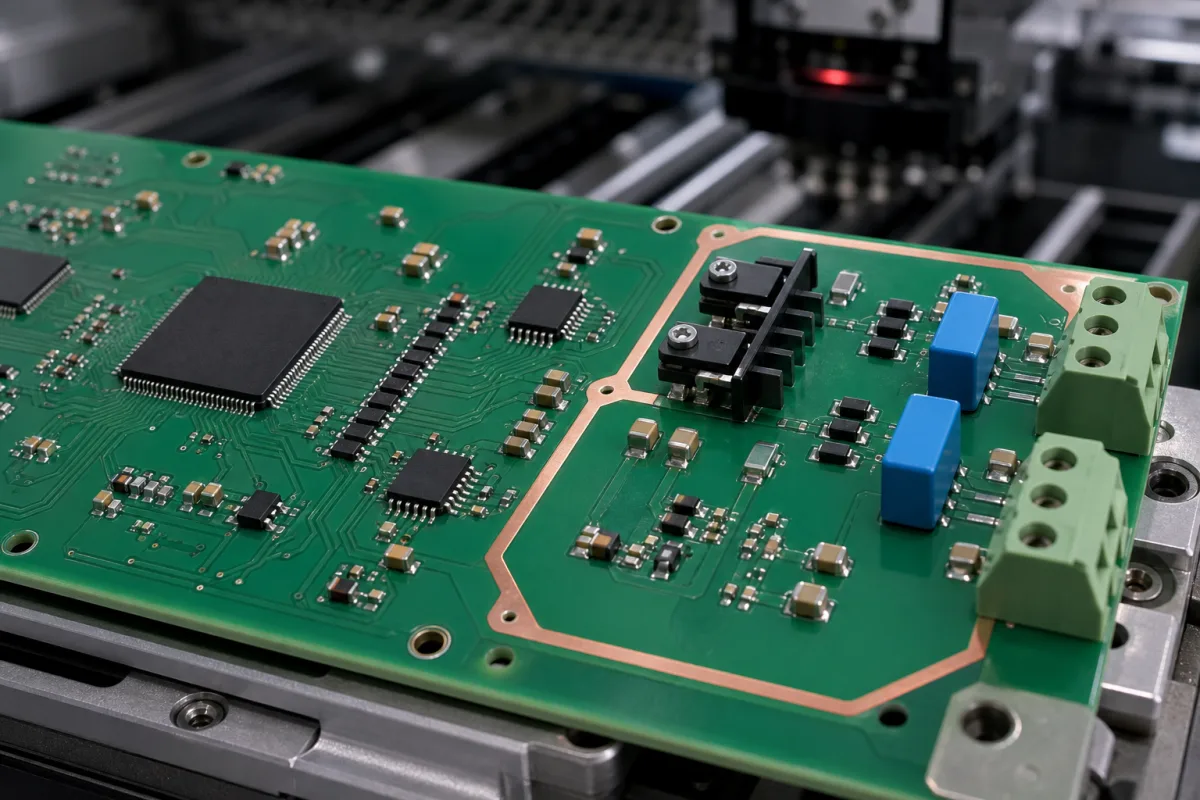
The final stage in a Digital-to-Analog Converter (DAC) that converts processed electrical signals into continuous analog output signals suitable for driving external loads.
Product Specifications

Technical details and manufacturing context for Analog Output Stage

Definition
The analog output stage is a critical component within a Digital-to-Analog Converter (DAC) responsible for taking the intermediate analog signal (often a current or voltage) from the DAC's core conversion circuitry and conditioning it for practical use. Its primary role is to provide sufficient drive capability, maintain signal integrity, and often perform functions such as amplification, filtering, buffering, and impedance matching to deliver a clean, stable, and powerful analog signal to external devices like speakers, actuators, or measurement equipment.
Working Principle
The stage typically receives a low-power analog voltage or current from the DAC's internal circuitry (e.g., from a resistor ladder or current-steering network). It then uses operational amplifiers (op-amps), transistors, or specialized amplifier ICs in configurations like voltage followers, inverting/non-inverting amplifiers, or differential amplifiers. These components buffer the signal to prevent loading of the DAC core, amplify it to the required voltage/current levels, and may incorporate low-pass filtering to remove high-frequency noise or sampling artifacts (images) from the conversion process. The output is designed to have low output impedance and high current sourcing/sinking capability.
Common Materials
Semiconductor (Silicon), Copper, FR-4 (PCB Substrate), Solder, Plastic/Epoxy (Encapsulation)
Technical Parameters
  • Output Voltage Swing or Output Current Capability - Defines the maximum analog signal amplitude the stage can deliver to a specified load. (V or mA) Per Request
Components / BOM
  • Operational Amplifier (Op-Amp)
    Core amplification element; provides gain, high input impedance, and low output impedance.
    Material: Semiconductor (Silicon)
  • Feedback Resistor Network
    Sets the closed-loop gain and stability of the op-amp circuit.
    Material: Thin-Film Resistor (e.g., Nichrome on ceramic)
  • Output Transistors (if discrete)
    Provide high current drive capability for the output signal.
    Material: Semiconductor (Silicon, e.g., BJT or MOSFET)
  • Decoupling Capacitors
    Filter power supply noise and provide local energy storage for transient current demands.
    Material: Ceramic or Tantalum
  • Output Filter (optional)
    Low-pass filter to attenuate high-frequency noise and DAC sampling images.
    Material: Resistors, Capacitors, Inductors
Engineering Reasoning
0-20 mA current loop, 0-10 V voltage range, -40°C to +85°C ambient temperature
Output current exceeds 25 mA continuous, output voltage exceeds 12 V, junction temperature exceeds 150°C
Design Rationale: Thermal runaway due to excessive power dissipation (P = I²R + V*I), semiconductor junction breakdown at 150°C, output transistor saturation beyond safe operating area
Risk Mitigation (FMEA)
Trigger Load impedance drops below 250 Ω causing current surge
Mode: Output transistor thermal destruction, bond wire melting at 600°C
Strategy: Current limiting circuit with foldback protection, thermal shutdown at 125°C junction temperature
Trigger Power supply voltage transient exceeding 15 V for >10 μs
Mode: Output stage MOSFET gate oxide breakdown at 20 V, latch-up in CMOS output drivers
Strategy: TVS diodes clamping at 13.5 V, ferrite beads with 100 Ω impedance at 100 MHz, decoupling capacitors with 10 μF bulk + 100 nF ceramic

Industry Taxonomies & Aliases

Commonly used trade names and technical identifiers for Analog Output Stage.

Applied To / Applications

This component is essential for the following industrial systems and equipment:

Industrial Ecosystem & Supply Chain DNA

Complementary Systems
Downstream Applications
Specialized Tooling

Application Fit & Sizing Matrix

Operational Limits
pressure: N/A (electronic component, not fluidic)
other spec: Output voltage range: ±10V, ±5V, 0-10V, 0-5V; Output current: 4-20mA, 0-20mA; Load impedance: 100Ω to 1kΩ typical; Power supply: ±12V to ±15V DC
temperature: -40°C to +85°C (industrial grade), -55°C to +125°C (military/aerospace)
Media Compatibility
✓ Industrial control systems (PLCs, DCS) ✓ Test and measurement equipment ✓ Audio/video signal processing systems
Unsuitable: High-voltage or high-power RF transmission environments (due to electromagnetic interference and signal integrity risks)
Sizing Data Required
  • Required output voltage/current range
  • Load impedance and drive capability
  • Signal bandwidth and settling time requirements

Reliability & Engineering Risk Analysis

Failure Mode & Root Cause
Signal Drift
Cause: Component aging (resistors, capacitors), temperature variations affecting semiconductor characteristics, or power supply instability leading to gradual deviation from calibrated output values.
Output Saturation or Clipping
Cause: Overvoltage events damaging output transistors/op-amps, improper biasing causing rail-to-rail limitations, or feedback loop failure (open/short) preventing proper signal regulation.
Maintenance Indicators
  • Erratic or unstable readings on connected indicators/controllers despite stable input conditions
  • Audible humming/buzzing from the stage or excessive heat emission indicating component stress
Engineering Tips
  • Implement regular calibration checks using precision multimeters/simulators to detect early drift, and maintain stable environmental conditions (temperature/humidity control) to reduce thermal stress on components.
  • Install transient voltage suppression (TVS) diodes on output lines and ensure proper power supply filtering/regulation to protect against electrical surges and noise-induced failures.

Compliance & Manufacturing Standards

Reference Standards
IEC 61000-6-2 (Electromagnetic compatibility - Generic standards - Immunity for industrial environments) IEC 60529 (Degrees of protection provided by enclosures - IP Code) IEC 61131-2 (Programmable controllers - Equipment requirements and tests)
Manufacturing Precision
  • Output voltage accuracy: +/-0.1% of full scale
  • Linearity error: +/-0.05% of full scale
Quality Inspection
  • Signal integrity test (frequency response, distortion analysis)
  • Environmental stress screening (temperature cycling, vibration testing)

Factories Producing Analog Output Stage

Verified manufacturers with capability to produce this product in China

✓ 94% Supplier Capability Match Found

P Procurement Specialist from United Arab Emirates Feb 24, 2026
★★★★★
"Testing the Analog Output Stage now; the technical reliability results are within 1% of the laboratory datasheet."
Technical Specifications Verified
T Technical Director from Australia Feb 21, 2026
★★★★★
"Impressive build quality. Especially the technical reliability is very stable during long-term operation."
Technical Specifications Verified
P Project Engineer from Singapore Feb 18, 2026
★★★★★
"As a professional in the Computer, Electronic and Optical Product Manufacturing sector, I confirm this Analog Output Stage meets all ISO standards."
Technical Specifications Verified
Verification Protocol

“Feedback is collected from verified sourcing managers during RFQ (Request for Quote) and factory evaluation processes on CNFX. These reports represent historical performance data and technical audit summaries from our B2B manufacturing network.”

13 sourcing managers are analyzing this specification now. Last inquiry for Analog Output Stage from Brazil (1h ago).

Supply Chain Compatible Machinery & Devices

Industrial Smart Camera Module

Embedded vision system for industrial automation and quality inspection.

Explore Specs →
Industrial Wireless Power Transfer Module

Wireless power transfer module for industrial equipment applications

Explore Specs →
Industrial Smart Sensor Module

Modular industrial sensor with embedded processing and wireless connectivity

Explore Specs →
Surface Mount Resistor

Passive electronic component for current limiting and voltage division in circuits

Explore Specs →

Frequently Asked Questions

What is the primary function of an analog output stage in a DAC system?

The analog output stage serves as the final processing component in a Digital-to-Analog Converter, converting the processed electrical signals into continuous, stable analog output signals capable of driving external loads such as speakers, motors, or other analog devices.

What materials are typically used in manufacturing analog output stages?

Common materials include Silicon semiconductors for integrated circuits, Copper for conductive traces and components, FR-4 as the PCB substrate, Solder for electrical connections, and Plastic/Epoxy for encapsulation and protection of sensitive components.

What are the key components in an analog output stage Bill of Materials (BOM)?

Essential BOM components include Decoupling Capacitors for power stability, Feedback Resistor Networks for gain control, Operational Amplifiers (Op-Amps) for signal amplification, optional Output Filters for noise reduction, and Output Transistors for discrete designs requiring higher current handling.

Can I contact factories directly on CNFX?

CNFX is an open directory, not a transaction platform. Each factory profile provides direct contact information and production details to help you initiate direct inquiries with Chinese suppliers.

Get Quote for Analog Output Stage

Request technical pricing, lead times, or customized specifications for Analog Output Stage directly from verified manufacturing units.

Your business information is encrypted and only shared with verified Analog Output Stage suppliers.

Thank you! Your message has been sent. We'll respond within 1–3 business days.

Need to Manufacture Analog Output Stage?

Connect with verified factories specializing in this product category

Add Your Factory Contact Us
Previous Product
Analog Output Amplifier / Buffer
Next Product
Analog-to-Digital Converter