Editorial Technical Reference

Analog-to-Digital Converter

This page explains how Analog-to-Digital Converter is classified within Computer, Electronic and Optical Product Manufacturing. Technical values and manufacturer relationships are research references; confirm the current specification and supplier evidence for each order.

Technical Definition & Core Assembly

Electronic circuit that converts continuous analog audio signals into discrete digital values for processing.

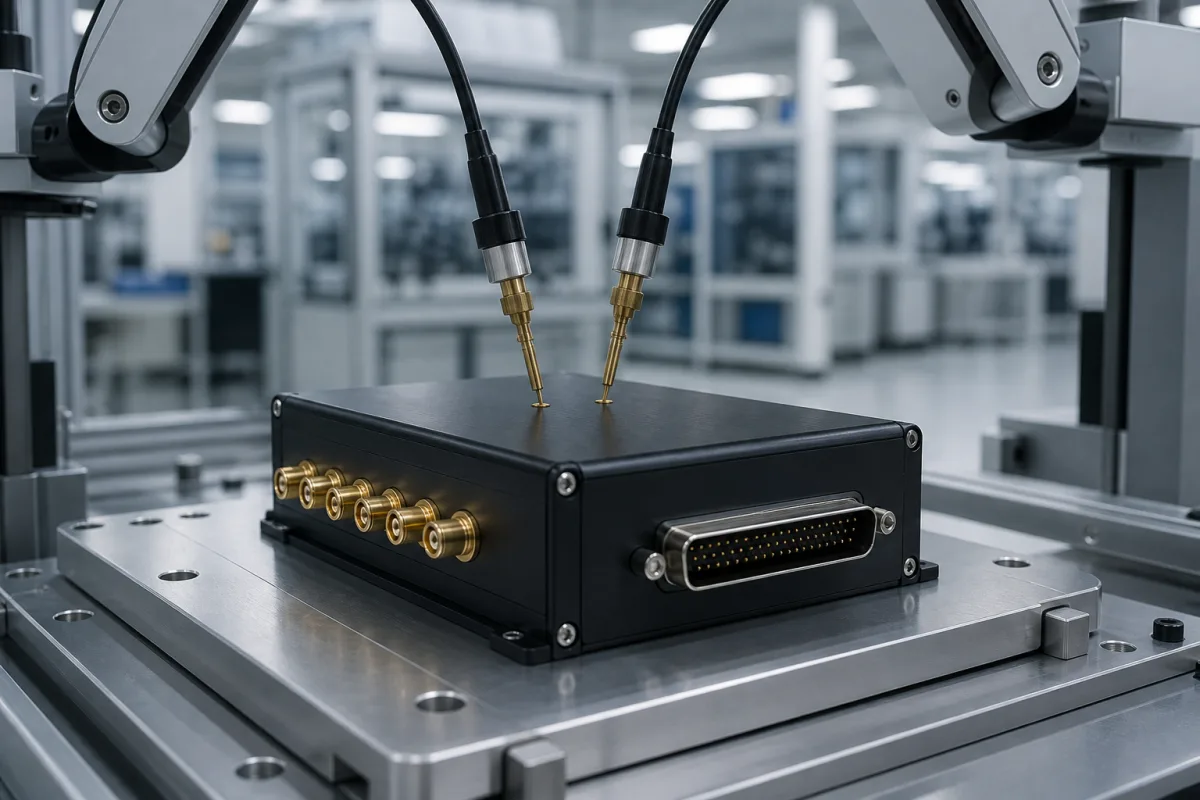
Representative product image. Confirm appearance and specifications with the manufacturer.

Product Specifications

Technical details and manufacturing context for Analog-to-Digital Converter

Definition
An analog-to-digital converter (ADC) is a component used in digital audio signal processing modules. It samples analog audio waveforms at a defined sampling rate, quantizes the amplitude of each sample, and encodes the resulting values into binary digital data. This conversion enables subsequent digital signal processing, storage, and transmission. The ADC operates by sampling the input signal at regular intervals, measuring the amplitude of each sample, and converting the continuous value into a discrete digital number through quantization and encoding. Common techniques include successive approximation, delta-sigma modulation, and flash conversion. Key parameters to consider when selecting an ADC include resolution (12–24 bits), sampling rate (10–1000 kSPS), input voltage range (0–5 V), signal-to-noise ratio (70–100 dB), integral nonlinearity (±0.5–±2 LSB), differential nonlinearity (±0.5–±1 LSB), supply voltage (2.7–5.5 V), power consumption (0.5–100 mW), operating temperature range (-40 to 85 °C), input impedance (10–100 MΩ), package type (SOIC-8 to TQFP-64), and interface (SPI, I2C, or parallel). The device is typically fabricated on silicon semiconductor with copper interconnects and housed in ceramic packaging. For a specific application, verify model-specific values and standards with the legal manufacturer or supplier, as the ranges provided are directory references and not guarantees of performance. The ADC is a critical component in audio systems, enabling high-fidelity digital audio capture and processing. Its performance directly affects the quality of the digitized audio, making careful selection essential for meeting design requirements.
Working Principle
The ADC samples the analog audio signal at a fixed sampling rate, capturing the amplitude at each instant. Each sample is then quantized to the nearest discrete level determined by the resolution (e.g., 12–24 bits). The quantized value is encoded into binary form using techniques such as successive approximation, delta-sigma modulation, or flash conversion. The digital output is transmitted via SPI, I2C, or parallel interface. The sampling rate must be at least twice the highest input frequency to avoid aliasing. The input impedance is high (10–100 MΩ) to minimize loading of the source. The conversion process introduces quantization error, reflected in the integral and differential nonlinearity specifications. The device operates within a supply voltage range of 2.7–5.5 V and consumes 0.5–100 mW, depending on speed and resolution.
Common Materials
Silicon semiconductor, Copper interconnects, Ceramic packaging
Technical Parameters
ParameterTypical rangeNotes & selection driver
Resolution12–24 bitHigher resolution for finer quantization
Sampling Rate10–1000 kSPSDetermines maximum input frequency
Input Voltage Range0–5 VUnipolar or bipolar options
Signal-to-Noise Ratio70–100 dBHigher is better for audio quality
Integral Nonlinearity±0.5–±2 LSBDeviation from ideal transfer function
Differential Nonlinearity±0.5–±1 LSBMonotonicity guarantee
Supply Voltage2.7–5.5 VSingle or dual supply options
Power Consumption0.5–100 mWCritical for battery-powered devices
Operating Temperature Range-40–85 °CIndustrial grade
Input Impedance10–100 High impedance to avoid loading source
Package TypeSOIC-8–TQFP-64Surface mount options
InterfaceSPI/I2C/ParallelDigital output protocol

Ranges are indicative industry figures for RFQ preparation, not a supplier commitment. Confirm every value and standard with the legal manufacturer before ordering.

Components / BOM
  • Sample-and-Hold Circuit Part
    Captures and maintains instantaneous analog voltage for conversion
    Material: Silicon semiconductor
  • Quantizer Part
    Maps continuous amplitude values to discrete digital levels
    Material: Silicon semiconductor
  • Encoder Part
    Converts quantized values into binary digital output
    Material: Silicon semiconductor
  • Reference Voltage Source
    Provides stable voltage reference for accurate conversion
    Material: Silicon semiconductor with precision resistors

Applied To / Applications

This component is essential for the following industrial systems and equipment:

Industrial Ecosystem & Supply Chain Structure

Complementary Systems
Downstream Applications
Specialized Tooling

Application Fit & Sizing Matrix

Operational Limits
resolution: 8-bit to 24-bit (varies by model)
temperature: -40°C to +85°C (industrial grade), -55°C to +125°C (military grade)
sampling rate: 1 kSPS to 10 MSPS (varies by model)
voltage range: 2.7V to 5.5V (typical supply), ±0.1V to ±10V (input signal range)
power consumption: 1 mW to 500 mW (depends on speed and resolution)
Media Compatibility
✓ Audio signal processing systems ✓ Industrial sensor interfaces ✓ Medical instrumentation
Unsuitable: High-voltage power line monitoring (requires specialized isolation and protection)
Sizing Data Required
  • Required resolution (bits)
  • Sampling frequency (Hz)
  • Input voltage range (V)

Reliability & Engineering Risk Analysis

Failure Mode & Root Cause
Signal distortion
Cause: Electromagnetic interference from nearby equipment or poor grounding, leading to inaccurate digital output.
Component degradation
Cause: Thermal stress from continuous operation or voltage spikes, causing drift in conversion accuracy or complete failure.
Maintenance Indicators
  • Erratic or inconsistent digital readings compared to known analog inputs
  • Unusual heat emission or audible buzzing from the converter unit
Engineering Tips
  • Implement proper shielding and grounding to minimize electromagnetic interference and ensure signal integrity.
  • Install thermal management solutions, such as heat sinks or cooling fans, and use surge protection to prevent voltage spikes.

Indicative industry ranges for design and RFQ preparation. Confirm the exact figures and applicable standard with the manufacturer before specifying.

Compliance & Manufacturing Standards

Applicable Standards
ISO/IEC 60747-14-1:2020 - Semiconductor devices - Part 14-1: Analog-to-digital converters ANSI/ISA-61010-1 - Electrical equipment for measurement, control, and laboratory use DIN EN 55032:2017 - Electromagnetic compatibility of multimedia equipment

Quoted from the published standard.

Manufacturing Precision
  • Linearity error: +/-0.5 LSB (Least Significant Bit)
  • Gain error: +/-0.1% of full-scale range
Quality Inspection
  • Dynamic performance test (SINAD, THD, SNR)
  • Power supply rejection ratio (PSRR) measurement

Manufacturers of Analog-to-Digital Converter

1 company lists this product among what they make. Company figures are quoted from each company's own website; every card states where the relationship came from.

Silergy
Shanghai, CN
Listed on the company's own website · profile compiled by CNFX from public sources

Manufacturer listings support early research and capability understanding. They are not certification, ranking, or transaction guarantees.

Technical documentation
Request current drawings, revision history, and a signed specification sheet.
Manufacturing capability
Verify equipment lists, process limits, capacity, and representative production evidence.
Inspection readiness
Confirm test methods, calibrated equipment, sampling plans, and traceable reports.
Supplier transparency
Check the legal entity, factory address, ownership, certifications, and direct contacts.

CNFX does not score or rank suppliers. Buyers must verify all claims and documents with the legal manufacturer before ordering.

Supply Chain Compatible Machinery & Devices

Industrial IoT Gateway

The Industrial IoT Gateway is a ruggedized edge computing device designed for industrial environments.

Explore Specs →
Modular Industrial Edge Computing Device

This modular industrial edge computing device is a ruggedized system designed for deployment in harsh industrial environments to perform real-time data processing, analytics, and control functions at the network edge.

Explore Specs →
Industrial Smart Camera Module

The Industrial Smart Camera Module is a compact, self-contained vision processing unit designed for integration into industrial machinery and production lines.

Explore Specs →
Surface Mount Resistor

Passive electronic component for current limiting and voltage division in circuits

Explore Specs →

Frequently Asked Questions

What is the typical resolution range for this ADC?

The resolution range is 12 to 24 bits, which determines the fineness of quantization. Higher resolution provides finer amplitude steps, improving audio fidelity.

What sampling rates are supported?

The sampling rate range is 10 to 1000 kSPS. The required rate depends on the maximum input frequency; it should be at least twice that frequency to avoid aliasing.

What interfaces are available for digital output?

The ADC supports SPI, I2C, and parallel interfaces. The choice depends on the host processor and system architecture.

How should I verify the performance for my application?

Consult the legal manufacturer or supplier for the specific model's datasheet and confirm parameters such as resolution, sampling rate, nonlinearity, and operating temperature range, as the listed values are directory references.

Data Basis

Editorial classification, named public sources where available, and source-reviewed manufacturer records.

Preliminary Technical Classification
This page supports structured research, RFQ preparation, and supplier evaluation. It does not replace buyer-led supplier qualification, standards review, or technical approval.
Buyer enquiry

Request manufacturing insight for Analog-to-Digital Converter

Ask for use case, specification boundaries, supplier type, and RFQ preparation information for this product.

Where it goes
Straight to the CNFX editorial desk, and to the manufacturer if this product is linked to a claimed profile. Nothing is broadcast to a supplier list.
Your details stay here
We do not sell or rent enquiry data, and we do not add you to a mailing list. Used only to answer this request.
No commission, no middleman
CNFX is a directory. We take no cut of any order and never negotiate on a supplier's behalf.
What we don't claim
A listing is not an endorsement. Qualify every supplier and verify every figure yourself before ordering.

Your business information is used only to process this request.

Thank you! Your message has been sent. We'll respond within 1–3 business days.
Sorry, we couldn't send your message. Please try again, or email us at contact@cnfx.com.

Need to Manufacture Analog-to-Digital Converter?

Compare manufacturer profiles with relevant product and process capability.

Previous Product
XY Positioning Stage
Last Product
Get QuotesChat