Industry-Verified Manufacturing Data (2026)

Automated Assembly Station

Based on aggregated insights from multiple verified factory profiles within the CNFX directory, the standard Automated Assembly Station used in the Computer, Electronic and Optical Product Manufacturing sector typically supports operational capacities ranging from standard industrial configurations to heavy-duty production requirements.

Technical Definition & Core Assembly

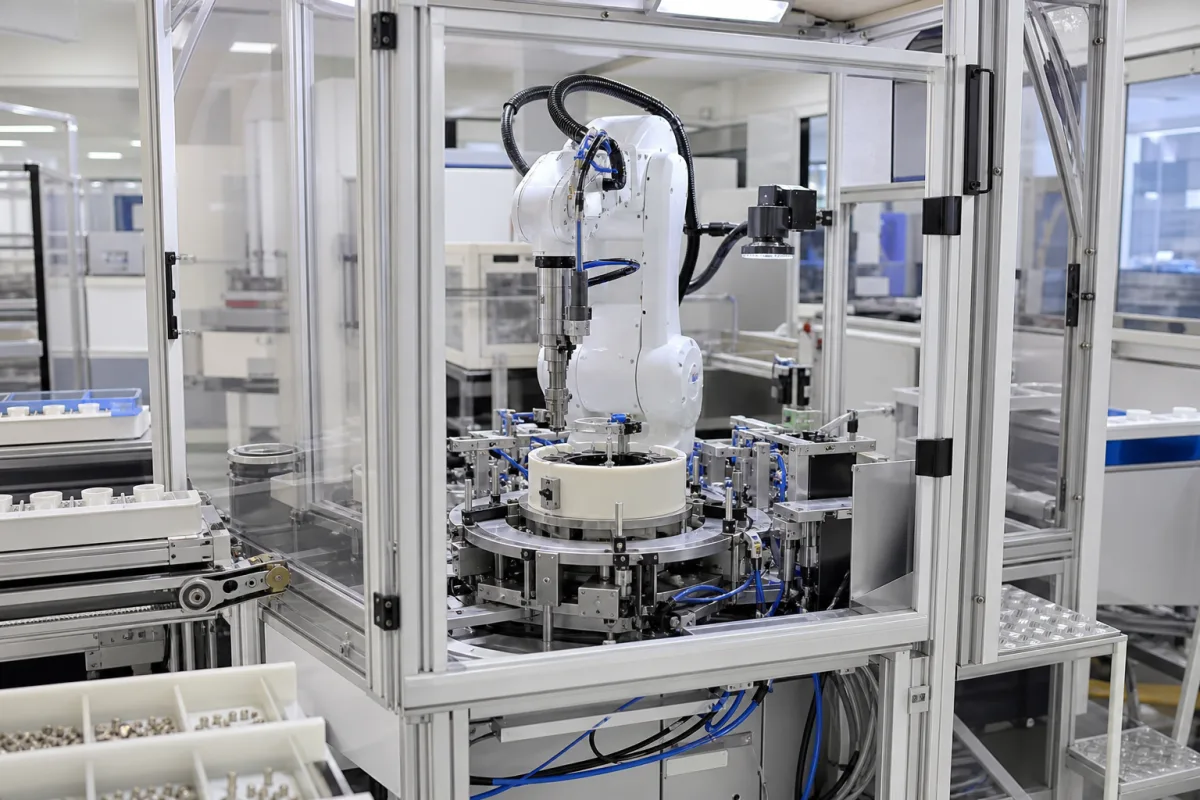
A canonical Automated Assembly Station is characterized by the integration of Robotic Manipulator Arm and Vision Guidance System. In industrial production environments, manufacturers listed on CNFX commonly emphasize Aluminum alloy frame construction to support stable, high-cycle operation across diverse manufacturing scenarios.

A specialized workstation within a production line that performs automated assembly operations for medical imaging system components.
Product Specifications

Technical details and manufacturing context for Automated Assembly Station

Definition
An Automated Assembly Station is a critical component of the Integrated Medical Imaging System Production Line, responsible for the precise, automated assembly of various sub-components into functional medical imaging system modules. It operates as part of a coordinated manufacturing process, ensuring consistent quality, high throughput, and reduced human error in the assembly of sensitive medical equipment.
Working Principle
The station receives pre-processed components via a conveyor or robotic transfer system. It uses programmable robotic arms, precision fixtures, and automated tools (e.g., screwdrivers, dispensers) guided by vision systems and sensors to pick, place, fasten, and connect parts according to a predefined assembly sequence and tolerances. It interfaces with the production line's central control system for synchronization and data logging.
Common Materials
Aluminum alloy frame, Stainless steel fixtures, Industrial-grade plastics, Electrical wiring and connectors
Technical Parameters
  • Positioning accuracy of the robotic arm or assembly head. (mm) Customizable
Components / BOM
  • Robotic Manipulator Arm
    Performs precise picking, placing, and fastening of components.
    Material: Aluminum alloy, steel gears
  • Vision Guidance System
    Cameras and sensors for part recognition, alignment verification, and quality inspection.
    Material: Optical lenses, electronic sensors
  • Tool Changer & End Effectors
    Holds and automatically switches between different assembly tools (screwdrivers, grippers, dispensers).
    Material: Steel, carbide, engineered polymers
  • Control Cabinet & HMI
    Houses the PLC, drives, and safety controllers; Human-Machine Interface for operation and monitoring.
    Material: Steel enclosure, electronic components, touchscreen
Engineering Reasoning
0.8-1.2 m/s linear actuator speed, 0.05-0.15 mm positioning accuracy, 40-80 N gripping force
Actuator speed exceeds 1.5 m/s causing overshoot >0.25 mm, gripper force drops below 20 N or exceeds 100 N, positioning error >0.3 mm
Design Rationale: Servo motor cogging torque variation exceeding 0.15 N·m at low speeds, ball screw backlash accumulation >0.08 mm, pneumatic gripper seal friction coefficient change from 0.12 to 0.25 due to particulate contamination
Risk Mitigation (FMEA)
Trigger Servo drive current ripple exceeding 15% of nominal 5A rating
Mode: Stepper motor missed steps causing 0.18 mm positional drift per cycle
Strategy: Implement 3-phase sinusoidal commutation with 0.5° encoder resolution and 2 kHz PWM frequency
Trigger ISO Class 7 cleanroom particulate contamination >1000 particles/m³ of 0.5μm size
Mode: Vacuum gripper adhesion force reduction from 60 N to <25 N within 72 hours
Strategy: Install HEPA filtration maintaining ISO Class 5 (≤3520 particles/m³ of 0.5μm) with 0.3 m/s laminar airflow

Industry Taxonomies & Aliases

Commonly used trade names and technical identifiers for Automated Assembly Station.

Industrial Ecosystem & Supply Chain DNA

Complementary Systems
Downstream Applications
Specialized Tooling

Application Fit & Sizing Matrix

Operational Limits
pressure: Atmospheric (no pressure rating required)
other spec: Cleanroom Class ISO 7 or better, Max Component Weight: 25 kg (55 lbs), Cycle Time: 30-120 seconds per assembly
temperature: 15-30°C (59-86°F)
Media Compatibility
✓ Medical-grade plastics (PEEK, polycarbonate) ✓ Stainless steel components (316L grade) ✓ Precision optical elements (lenses, mirrors)
Unsuitable: Corrosive chemical environments or explosive atmospheres
Sizing Data Required
  • Maximum component dimensions (LxWxH)
  • Required production throughput (units/hour)
  • Available floor space and utility connections

Reliability & Engineering Risk Analysis

Failure Mode & Root Cause
Misalignment of robotic arm joints
Cause: Wear in harmonic drive components or improper calibration due to thermal expansion and vibration over time
Conveyor belt tracking failure
Cause: Uneven tension distribution from worn idler rollers or debris accumulation on tracking sensors
Maintenance Indicators
  • Inconsistent cycle times or jerky motion in robotic actuators
  • Unusual high-frequency vibration or grinding noises from linear guides
Engineering Tips
  • Implement laser alignment checks on robotic arm axes quarterly and after any major component replacement
  • Establish a preventive lubrication schedule for linear guides and ball screws using manufacturer-specified greases, with contamination control procedures

Compliance & Manufacturing Standards

Reference Standards
ISO 9001:2015 - Quality Management Systems ANSI/ASME B5.54 - Machine Tool Performance Evaluation CE Marking - Machinery Directive 2006/42/EC
Manufacturing Precision
  • Positional Accuracy: +/-0.05mm
  • Repeatability: +/-0.02mm
Quality Inspection
  • Cycle Time Verification Test
  • Force/Torque Calibration Check

Factories Producing Automated Assembly Station

Verified manufacturers with capability to produce this product in China

✓ 98% Supplier Capability Match Found

T Technical Director from Singapore Jan 06, 2026
★★★★★
"Reliable performance in harsh Computer, Electronic and Optical Product Manufacturing environments. No issues with the Automated Assembly Station so far."
Technical Specifications Verified
P Project Engineer from Germany Jan 03, 2026
★★★★☆
"Testing the Automated Assembly Station now; the technical reliability results are within 1% of the laboratory datasheet. (Delivery took slightly longer than expected, but technical support was excellent.)"
Technical Specifications Verified
S Sourcing Manager from Brazil Dec 31, 2025
★★★★★
"Impressive build quality. Especially the technical reliability is very stable during long-term operation."
Technical Specifications Verified
Verification Protocol

“Feedback is collected from verified sourcing managers during RFQ (Request for Quote) and factory evaluation processes on CNFX. These reports represent historical performance data and technical audit summaries from our B2B manufacturing network.”

7 sourcing managers are analyzing this specification now. Last inquiry for Automated Assembly Station from India (58m ago).

Supply Chain Compatible Machinery & Devices

Industrial IoT Gateway

Edge computing device connecting industrial equipment to cloud platforms.

Explore Specs →
Modular Industrial Edge Computing Device

Rugged computing platform for industrial data processing at the network edge

Explore Specs →
Industrial Smart Camera Module

Embedded vision system for industrial automation and quality inspection.

Explore Specs →
Industrial Wireless Power Transfer Module

Wireless power transfer module for industrial equipment applications

Explore Specs →

Frequently Asked Questions

What types of medical imaging components can this automated assembly station handle?

This station is designed for assembling precision components used in CT scanners, MRI machines, ultrasound devices, and other medical imaging systems, including optical elements, electronic boards, and mechanical assemblies.

How does the vision guidance system improve assembly accuracy?

The integrated vision system uses high-resolution cameras and machine vision algorithms to verify component positioning, detect defects, and guide robotic arms with micron-level precision, ensuring consistent quality in medical device manufacturing.

What maintenance requirements does this automated assembly station have?

Regular maintenance includes lubrication of robotic joints, calibration of vision systems, inspection of end effectors, and software updates. The aluminum and stainless steel construction minimizes corrosion, while industrial-grade components ensure long service life with proper maintenance schedules.

Can I contact factories directly on CNFX?

CNFX is an open directory, not a transaction platform. Each factory profile provides direct contact information and production details to help you initiate direct inquiries with Chinese suppliers.

Get Quote for Automated Assembly Station

Request technical pricing, lead times, or customized specifications for Automated Assembly Station directly from verified manufacturing units.

Your business information is encrypted and only shared with verified Automated Assembly Station suppliers.

Thank you! Your message has been sent. We'll respond within 1–3 business days.

Need to Manufacture Automated Assembly Station?

Connect with verified factories specializing in this product category

Add Your Factory Contact Us
Previous Product
Authorization Rule Engine
Next Product
Automated Component Feeder