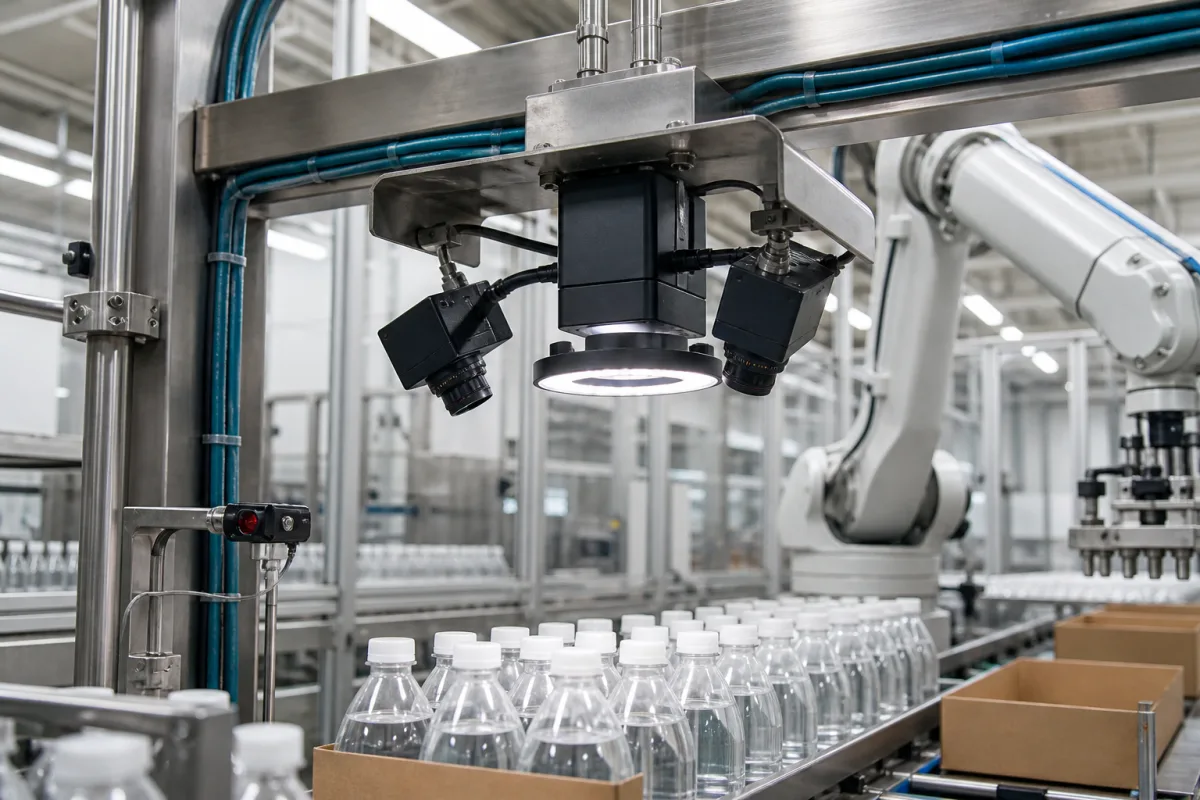
Conveyor-tracking vision guidance for robot picking of bottles and containers: an overhead 2D camera, an encoder-latched trigger and a belt-calibrated robot
Bottling and packing lines · an overhead camera that photographs containers on a moving belt, tags each picture with an encoder count, and hands the positions to a robot that picks on the move
When bottles arrive on a belt in no fixed pattern, the robot that picks them needs to know where each one is at the moment its gripper arrives, not where it was when the camera saw it. A conveyor-tracking vision system solves this in three parts: a camera above the belt that finds the containers, an encoder on the conveyor whose count is latched at the instant of each picture, and a calibration that ties camera pixels, belt travel and robot coordinates together. The pick precision then depends on belt speed, belt acceleration and how well each of those three is set up.
2D vision guidance with conveyor tracking for robots that pick bottles, cans and other containers from a moving belt into cases, trays or another conveyor: the overhead camera and its trigger, the conveyor encoder and its latch, the transfer of positions to the robot, load sharing between robots on one belt, and the camera-to-belt-to-robot calibration. Fixed 3D cameras that find the pose of car bodies and closures are covered on the 3D vision guidance for robot cells on car bodies page; palletizing of beverage packs on the Automated beverage container palletizing system page; robot arms sealed for wet beverage and food areas on the Robotic arm assembly for wet beverage and food packing areas page. Inspection systems, smart cameras, vision processing units and ring, bar and dome lights have their own pages, as do component centering on SMT pick-and-place robots and vision-guided flexible part feeders.
CNFX editorial research · Sources checked October 13, 2026 · 3 sources
Taking a picture every set distance of belt travel, and latching the encoder count with it
Stäubli's VALtrack description sets out the two ways a robot can learn where objects are on a belt, and why vision is the one that copes with containers in no fixed pattern.
In Stäubli's arrangement the encoder interface is a 5 V incremental encoder with differential A, B and Z signals on an EtherCAT encoder module, one digital output of the coupler fires the camera, and the library handles up to four conveyors at once. [1] Editorial point from the same description: because the trigger is driven by belt distance, not by time, the pictures stay spaced along the belt when its speed changes, and the spacing x has to be set no longer than the camera's field of view along the belt so that no container falls between two pictures.
Yaskawa's MotoSight 2D setup guide adds a wiring rule for the conveyor reference signal: it should be connected directly to the robot controller to avoid dispersion from sequence scan time, and the controller quadruples every encoder pulse count. [3] Where one belt feeds two or more robots, Stäubli's library passes work downstream by bypass (every n-th object), overflow (objects that have passed out of reach), area distribution (one robot per part of the belt width) or object ID. [1]
Detection method
How the position is captured
What the objects must do
Sensor tracking
A simple on/off sensor triggers the latch of the encoder value on the encoder module [1]
Every x mm of conveyor motion (configurable) the controller triggers the camera and latches the encoder value; object data go to the controller over TCP/IP [1]
State how containers arrive (single file, random, in a pattern), the belt width and speed, how many robots share the belt, and whether different container types must go to different robots.
02
How far off the pick lands: ±0.5 mm at constant speed, and what belt speed and ramps add
Two robot makers publish tracking figures measured on their own systems; they come from different robots and test set-ups and are not a like-for-like comparison.
ABB states that its figures were measured under real conditions with an IRB 360-1/1130 and PickMaster and may vary with the robot's actual speed and acceleration in the application. [2] Editorial calculation from the Stäubli table: reaching 500 mm/s at 300 mm/s² takes about 1.7 s, and at 150 mm/s² about 3.3 s, so a belt that starts and stops repeatedly spends a measurable share of its time in the phase where the error is up to 2 mm rather than ±0.5 mm. [1]
For bottle picking the tolerance that matters is the gap between the gripper element and the container neck or shoulder. The figures above, set against that gap at the planned belt speed, show whether the belt can run continuously, or should be slowed or indexed while the robot picks.
Published tracking figure
Belt condition
Value
Stäubli VALtrack, pick and place precision
Constant speed, 50 to 500 mm/s, with correct robot/conveyor calibration and encoder scale
Give the supplier the container diameter and the clearance of the gripper around the neck or body, the belt speed and its start/stop behaviour, and ask for the tracking figure measured at that speed with the offered robot.
03
Calibrating encoder scale, conveyor frame and camera grid so the robot meets the bottle
Yaskawa's MotoSight 2D setup guide lays out the calibration chain in the order it has to be done.
The conveyor position resolution comes first. The guide has the installer zero the encoder, trip the trigger with a part, jog the conveyor at least 1 m and at most 21 m, measure the distance L from the trigger to the part's leading edge, and calculate the resolution as L × 1,000,000 divided by the encoder pulse count. [3] If the resolution is wrong, the robot leads or lags the part by a distance that grows the farther the conveyor travels; the guide states that this setting has a direct impact on application accuracy. [3] Editorial calculation: jogging over the 21 m maximum instead of the 1 m minimum spreads a 1 mm error in measuring L over 21 times the travel, so the resolution error from that measurement falls by the same factor.
The robot tool centre point is taught from five points, with the guide recommending no more than 30° of tilt from the pointer, and the tool weight and centre of gravity are entered because they set the robot's acceleration and deceleration. [3] A user frame is taught along the conveyor edge so that its X axis follows the belt direction. [3] The camera is then calibrated with a printed grid laid on the conveyor, X along the belt, after checking that the printed squares have the intended size, for example 10 mm; a further user frame ties the robot to that grid. [3]
Ask the integrator how the encoder resolution was measured and over what distance, how the camera grid and robot frames were taught, and what check is run after a camera, lens or conveyor belt is changed.
04
Data for a conveyor-tracking vision enquiry
Paste it into your enquiry below or into an email to a maker, then replace every bracket.
Containers: [types; diameters; cap or neck colour; how they arrive on the belt]
Conveyor: [width; speed; continuous, start/stop or indexing; encoder fitted or not]
Robots: [number on the belt; type; gripper and clearance around the container]
Rate: [containers per minute; cases or trays per minute]
Camera position: [height available above the belt; field of view along the belt]
Load sharing: [by count, overflow, belt zone or container type]
Calibration: [who sets encoder scale, conveyor frame and camera grid; check after changeover]
Explore company information and manufacturing capabilities, then discuss the scope of your project with a relevant supplier.
Share this page
Compiled and source-reviewed by the CNFX editorial team.
Each manufacturer above links to the page on that company's own website where the product is listed, with the date we checked it. How we source and review
· Page last updated 13 October 2026
Buyer questions
How does the camera know where a container will be when the robot reaches it?
In Stäubli's VALtrack the controller triggers the camera every set distance of belt travel and latches the encoder value at the same instant, so each object position is tied to a belt position. [1]
How precise is picking from a moving belt?
Stäubli gives ±0.5 mm at constant speeds from 50 to 500 mm/s with correct calibration; ABB gives 1.0 mm at 200 mm/s, 1.5 mm at 350–750 mm/s and 5.0 mm at 800–1,400 mm/s for an IRB 360 with PickMaster. [1][2]
What happens to pick precision when the belt speeds up or slows down?
Stäubli lists errors of up to 2 mm at 300 mm/s² and up to 1.5 mm at 150 mm/s² on a 500 mm/s belt; ABB lists 3.5 mm for a 500 mm/s belt that starts and stops in 0.2 s. [1][2]
How is the conveyor encoder scaled?
Yaskawa's guide jogs the conveyor 1 to 21 m, measures the travel L and sets the position resolution to L × 1,000,000 divided by the encoder pulse count. [3]
Sources and what still needs a direct check
Sources checked 2026-10-13. Stäubli's VALtrack flyer describes encoder-latched camera triggering and gives pick precision at constant and changing belt speeds; ABB's IRB 360 data sheet gives conveyor-tracking repeatability measured with PickMaster; Yaskawa's MotoSight 2D guide gives the encoder, frame and camera calibration steps.