Industry-Verified Manufacturing Data (2026)

Balancing Controller IC

Based on aggregated insights from multiple verified factory profiles within the CNFX directory, the standard Balancing Controller IC used in the Computer, Electronic and Optical Product Manufacturing sector typically supports operational capacities ranging from standard industrial configurations to heavy-duty production requirements.

Technical Definition & Core Assembly

A canonical Balancing Controller IC is characterized by the integration of Voltage Reference and ADC (Analog-to-Digital Converter). In industrial production environments, manufacturers listed on CNFX commonly emphasize Silicon construction to support stable, high-cycle operation across diverse manufacturing scenarios.

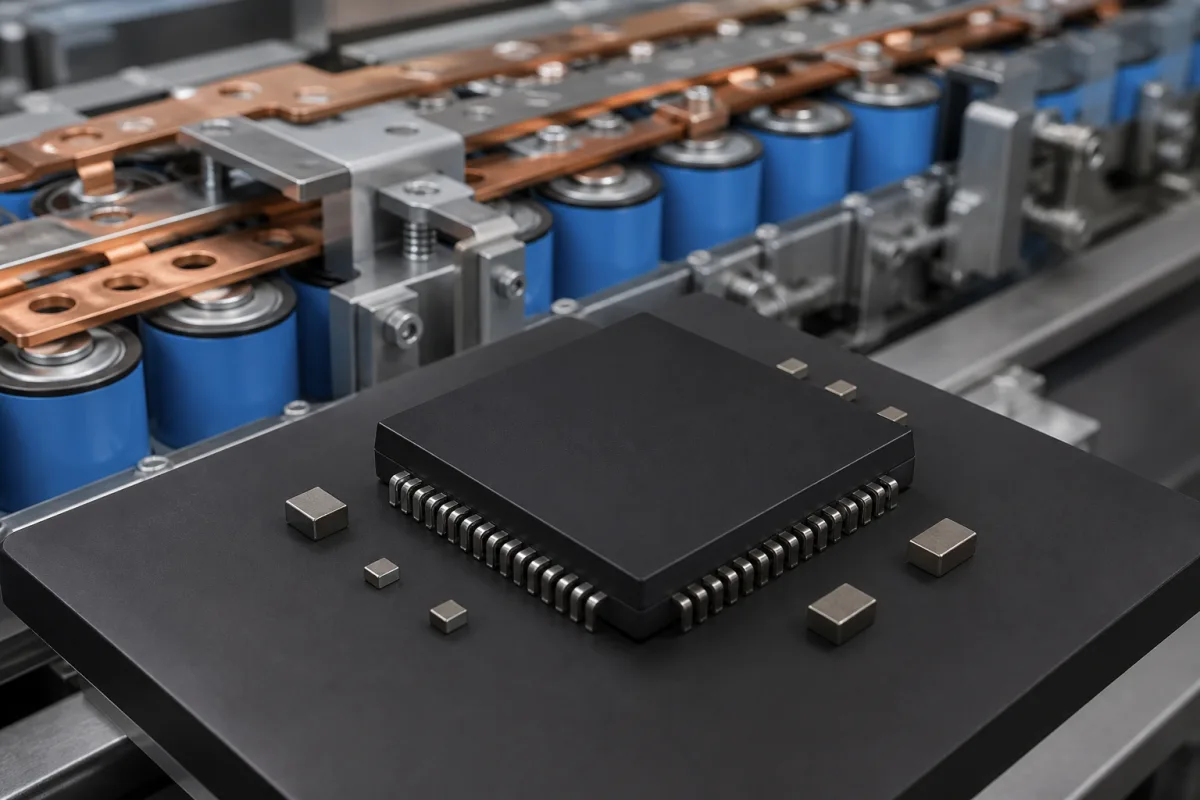
Integrated circuit that manages voltage equalization across individual cells in a battery pack
Product Specifications

Technical details and manufacturing context for Balancing Controller IC

Definition
A specialized integrated circuit that monitors and controls the voltage levels of individual battery cells within a series-connected pack, ensuring balanced charging and discharging to prevent overcharging, undercharging, and capacity degradation
Working Principle
The IC continuously monitors cell voltages through precision voltage sensing circuits. When voltage imbalances exceed predetermined thresholds, it activates balancing mechanisms (typically passive dissipation through resistors or active charge redistribution) to equalize cell voltages, optimizing battery performance and lifespan
Common Materials
Silicon, Copper, Plastic encapsulation
Technical Parameters
  • Operating voltage range and cell voltage monitoring accuracy (V) Standard Spec
Components / BOM
  • Voltage Reference
    Provides stable reference voltage for accurate cell voltage measurements
    Material: Silicon
  • ADC (Analog-to-Digital Converter)
    Converts analog cell voltage signals to digital values for processing
    Material: Silicon
  • Balancing MOSFETs
    Switching transistors that control current flow during balancing operations
    Material: Silicon
  • Communication Interface
    Enables data exchange with external microcontroller or BMS
    Material: Copper/Silicon
Engineering Reasoning
2.5-4.5 V per cell, -40 to 125 °C ambient temperature
Cell voltage differential exceeding 150 mV sustained for >60 seconds
Design Rationale: Thermal runaway in MOSFET switches due to joule heating (P=I²R) when balancing current exceeds 2A continuously, causing semiconductor junction temperatures to exceed 175°C
Risk Mitigation (FMEA)
Trigger Electromigration in aluminum interconnects at current densities >1×10⁶ A/cm²
Mode: Open circuit in balancing path, causing 300+ mV cell voltage divergence
Strategy: Copper redistribution layer with 0.18 μm design rules and current density limit of 5×10⁵ A/cm²
Trigger Latch-up from substrate injection during 100 V/μs voltage transients
Mode: Short circuit across balancing MOSFETs, drawing 5A+ quiescent current
Strategy: Guard rings with 10 μm spacing and 50 Ω series resistors on all I/O pins

Industry Taxonomies & Aliases

Commonly used trade names and technical identifiers for Balancing Controller IC.

Applied To / Applications

This component is essential for the following industrial systems and equipment:

Industrial Ecosystem & Supply Chain DNA

Complementary Systems
Downstream Applications
Specialized Tooling

Application Fit & Sizing Matrix

Operational Limits
temperature: -40°C to +125°C (operating), -55°C to +150°C (storage)
voltage range: 2.5V to 5.5V (supply), up to 5V per cell (balancing)
current handling: Up to 300mA per cell channel (typical)
communication interface: I2C, SPI, or proprietary serial
Media Compatibility
✓ Lithium-ion battery packs (Li-ion, LiPo) ✓ Lithium iron phosphate (LiFePO4) cells ✓ Nickel-metal hydride (NiMH) battery arrays
Unsuitable: High-voltage AC systems or environments with strong electromagnetic interference (EMI) without proper shielding
Sizing Data Required
  • Number of series cells in battery pack
  • Maximum balancing current required per cell
  • Communication protocol and interface requirements

Reliability & Engineering Risk Analysis

Failure Mode & Root Cause
Overheating and thermal degradation
Cause: Inadequate heat dissipation due to poor thermal design, excessive ambient temperature, or blocked cooling pathways leading to semiconductor junction failure.
Electrostatic discharge (ESD) damage
Cause: Improper handling during installation or maintenance without ESD protection, causing latent or immediate failure of sensitive IC components.
Maintenance Indicators
  • Audible high-frequency whine or buzzing from the controller indicating unstable switching or impending thermal runaway
  • Visible discoloration, bulging, or charring on the IC package or surrounding PCB indicating overheating
Engineering Tips
  • Implement strict ESD protocols during all handling and maintenance activities, including use of grounded workstations and wrist straps
  • Ensure optimal thermal management through proper heatsinking, airflow design, and periodic cleaning of cooling surfaces

Compliance & Manufacturing Standards

Reference Standards
ISO 9001:2015 Quality Management Systems IEC 60747-1:2006 Semiconductor devices - General EN 55032:2015 Electromagnetic compatibility of multimedia equipment
Manufacturing Precision
  • Voltage Regulation: +/-1% of nominal output
  • Operating Temperature Range: -40°C to +125°C
Quality Inspection
  • Electrical Performance Testing (e.g., load regulation, line regulation)
  • Environmental Stress Screening (ESS) including thermal cycling and vibration testing

Factories Producing Balancing Controller IC

Verified manufacturers with capability to produce this product in China

✓ 96% Supplier Capability Match Found

S Sourcing Manager from Australia Jan 20, 2026
★★★★★
"Great transparency on the Balancing Controller IC components. Essential for our Computer, Electronic and Optical Product Manufacturing supply chain."
Technical Specifications Verified
P Procurement Specialist from Singapore Jan 17, 2026
★★★★☆
"The Balancing Controller IC we sourced perfectly fits our Computer, Electronic and Optical Product Manufacturing production line requirements. (Delivery took slightly longer than expected, but technical support was excellent.)"
Technical Specifications Verified
T Technical Director from Germany Jan 14, 2026
★★★★★
"Found 40+ suppliers for Balancing Controller IC on CNFX, but this spec remains the most cost-effective."
Technical Specifications Verified
Verification Protocol

“Feedback is collected from verified sourcing managers during RFQ (Request for Quote) and factory evaluation processes on CNFX. These reports represent historical performance data and technical audit summaries from our B2B manufacturing network.”

18 sourcing managers are analyzing this specification now. Last inquiry for Balancing Controller IC from Poland (1h ago).

Supply Chain Compatible Machinery & Devices

Modular Industrial Edge Computing Device

Rugged computing platform for industrial data processing at the network edge

Explore Specs →
Industrial Smart Camera Module

Embedded vision system for industrial automation and quality inspection.

Explore Specs →
Industrial Wireless Power Transfer Module

Wireless power transfer module for industrial equipment applications

Explore Specs →
Industrial Smart Sensor Module

Modular industrial sensor with embedded processing and wireless connectivity

Explore Specs →

Frequently Asked Questions

What is the primary function of a Balancing Controller IC?

The Balancing Controller IC actively monitors and equalizes voltage across individual cells in a battery pack to prevent overcharging or deep discharging, ensuring optimal performance, safety, and extended battery life.

How does the Balancing Controller IC communicate with the battery management system?

It typically uses standard communication interfaces like I2C, SPI, or SMBus to relay cell voltage data and receive balancing commands from the main BMS controller, enabling precise control and system integration.

What are the key components in the BOM for this IC?

The Bill of Materials includes a voltage reference for accuracy, an ADC for voltage measurement, balancing MOSFETs to shunt current, and a communication interface for system integration, all built on silicon with copper interconnects and plastic encapsulation.

Can I contact factories directly on CNFX?

CNFX is an open directory, not a transaction platform. Each factory profile provides direct contact information and production details to help you initiate direct inquiries with Chinese suppliers.

Get Quote for Balancing Controller IC

Request technical pricing, lead times, or customized specifications for Balancing Controller IC directly from verified manufacturing units.

Your business information is encrypted and only shared with verified Balancing Controller IC suppliers.

Thank you! Your message has been sent. We'll respond within 1–3 business days.

Need to Manufacture Balancing Controller IC?

Connect with verified factories specializing in this product category

Add Your Factory Contact Us
Previous Product
Backup Power Interface
Next Product
Balun Transformer