Industry-Verified Manufacturing Data (2026)

Cell Monitoring Circuit

Based on aggregated insights from multiple verified factory profiles within the CNFX directory, the standard Cell Monitoring Circuit used in the Computer, Electronic and Optical Product Manufacturing sector typically supports operational capacities ranging from standard industrial configurations to heavy-duty production requirements.

Technical Definition & Core Assembly

A canonical Cell Monitoring Circuit is characterized by the integration of Analog Front End (AFE) and Multiplexer. In industrial production environments, manufacturers listed on CNFX commonly emphasize Silicon (for integrated circuits) construction to support stable, high-cycle operation across diverse manufacturing scenarios.

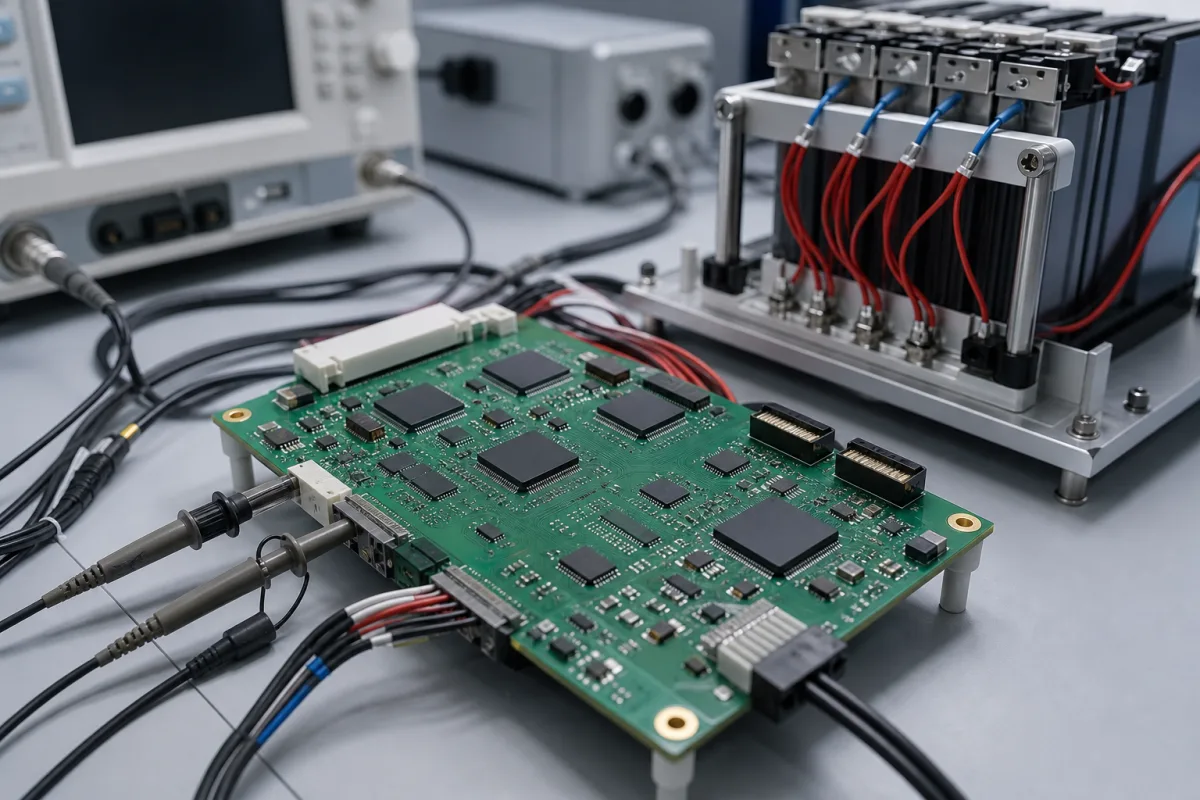
Electronic circuit that monitors individual battery cell voltage, temperature, and other critical parameters in a battery pack.
Product Specifications

Technical details and manufacturing context for Cell Monitoring Circuit

Definition
A specialized electronic circuit within a Battery Management System (BMS) responsible for continuously monitoring the voltage, temperature, and sometimes internal resistance of individual battery cells in a series or parallel configuration. It ensures cell balancing, prevents overcharging/over-discharging, and provides critical data for battery health assessment and safety protection.
Working Principle
The circuit uses precision analog-to-digital converters (ADCs) and voltage reference circuits to measure each cell's voltage relative to a common ground or through differential measurement techniques. Temperature sensors (typically thermistors) are integrated or connected to monitor cell temperature. The collected data is digitized and transmitted via communication interfaces (like SPI, I2C, or CAN) to the BMS microcontroller for processing, balancing control, and safety decisions.
Common Materials
Silicon (for integrated circuits), Copper (for PCB traces), FR-4 (PCB substrate), Electronic components (resistors, capacitors, ICs)
Technical Parameters
  • Measurement accuracy for cell voltage, typically in millivolt range (e.g., ±5mV) (V) Customizable
Components / BOM
  • Analog Front End (AFE)
    Conditions and measures analog signals from battery cells
    Material: Silicon IC
  • Multiplexer
    Switches between different cell connections for sequential measurement
    Material: Silicon IC
  • ADC (Analog-to-Digital Converter)
    Converts analog voltage measurements to digital values
    Material: Silicon IC
  • Voltage Reference
    Provides stable reference voltage for accurate measurements
    Material: Silicon IC
  • Communication Interface Circuit
    Handles data transmission to BMS controller
    Material: Silicon IC with supporting components
  • PCB (Printed Circuit Board)
    Provides physical mounting and electrical connections for all components
    Material: FR-4 with copper traces
Engineering Reasoning
2.5-4.2 V cell voltage, -40°C to +85°C ambient temperature, 0-100% relative humidity (non-condensing)
Cell voltage <2.0 V or >4.5 V for >100 ms, temperature >125°C at IC junction, >95% relative humidity with condensation
Design Rationale: Electrolyte decomposition above 4.5 V causing gas generation and pressure buildup; silicon junction thermal runaway at >150°C; moisture ingress leading to dendritic growth and internal short circuits
Risk Mitigation (FMEA)
Trigger Electromagnetic interference from adjacent power electronics exceeding 100 V/m field strength
Mode: ADC sampling corruption causing ±500 mV measurement error
Strategy: Shielded twisted-pair wiring with ferrite chokes, differential signaling with 2.5 kV isolation barrier
Trigger Thermal cycling between -40°C and +125°C at 10 cycles/hour
Mode: Solder joint fatigue fracture increasing contact resistance by >100 mΩ
Strategy: Copper-invar-copper PCB substrate with CTE 6 ppm/°C, SAC305 solder with 0.5 mm standoff height

Industry Taxonomies & Aliases

Commonly used trade names and technical identifiers for Cell Monitoring Circuit.

Applied To / Applications

This component is essential for the following industrial systems and equipment:

Industrial Ecosystem & Supply Chain DNA

Complementary Systems
Downstream Applications
Specialized Tooling

Application Fit & Sizing Matrix

Operational Limits
pressure: Atmospheric (0.5 to 1.2 atm typical)
other spec: Voltage Range: 0-5V per cell, Measurement Accuracy: ±0.5%
temperature: -40°C to +85°C (operational), -55°C to +125°C (storage)
Media Compatibility
✓ Lithium-ion battery cells ✓ Lithium-polymer battery cells ✓ Nickel-metal hydride battery cells
Unsuitable: High-voltage arc welding environments (due to EMI interference)
Sizing Data Required
  • Number of cells in battery pack
  • Maximum cell voltage rating
  • Required measurement sampling rate

Reliability & Engineering Risk Analysis

Failure Mode & Root Cause
Sensor Drift/Calibration Loss
Cause: Environmental exposure (temperature/humidity cycling), component aging, or contamination affecting measurement accuracy
Circuit Board Degradation
Cause: Thermal cycling stress, vibration-induced solder joint fatigue, or moisture ingress causing corrosion/short circuits
Maintenance Indicators
  • Inconsistent/fluctuating readings compared to reference measurements
  • Audible buzzing/humming from the monitoring unit or visible corrosion/overheating on components
Engineering Tips
  • Implement periodic calibration checks against known standards and maintain environmental control (stable temperature/humidity)
  • Use vibration-damping mounts, conformal coating on circuit boards, and ensure proper sealing against moisture ingress

Compliance & Manufacturing Standards

Reference Standards
IEC 61508: Functional Safety of Electrical/Electronic/Programmable Electronic Safety-related Systems ISO 9001: Quality Management Systems UL 1642: Standard for Lithium Batteries
Manufacturing Precision
  • Voltage Measurement Accuracy: +/- 0.5% of full scale
  • Temperature Sensing Tolerance: +/- 1°C
Quality Inspection
  • Functional Safety Verification Test (IEC 61508)
  • Environmental Stress Screening (ESS) for Thermal Cycling

Factories Producing Cell Monitoring Circuit

Verified manufacturers with capability to produce this product in China

✓ 96% Supplier Capability Match Found

P Procurement Specialist from Australia Jan 27, 2026
★★★★★
"The Cell Monitoring Circuit we sourced perfectly fits our Computer, Electronic and Optical Product Manufacturing production line requirements."
Technical Specifications Verified
T Technical Director from Singapore Jan 24, 2026
★★★★★
"Found 33+ suppliers for Cell Monitoring Circuit on CNFX, but this spec remains the most cost-effective."
Technical Specifications Verified
P Project Engineer from Germany Jan 21, 2026
★★★★★
"The technical documentation for this Cell Monitoring Circuit is very thorough, especially regarding technical reliability."
Technical Specifications Verified
Verification Protocol

“Feedback is collected from verified sourcing managers during RFQ (Request for Quote) and factory evaluation processes on CNFX. These reports represent historical performance data and technical audit summaries from our B2B manufacturing network.”

11 sourcing managers are analyzing this specification now. Last inquiry for Cell Monitoring Circuit from UAE (1h ago).

Supply Chain Compatible Machinery & Devices

Industrial IoT Gateway

Edge computing device connecting industrial equipment to cloud platforms.

Explore Specs →
Modular Industrial Edge Computing Device

Rugged computing platform for industrial data processing at the network edge

Explore Specs →
Industrial Smart Camera Module

Embedded vision system for industrial automation and quality inspection.

Explore Specs →
Industrial Wireless Power Transfer Module

Wireless power transfer module for industrial equipment applications

Explore Specs →

Frequently Asked Questions

What is the primary function of a cell monitoring circuit in battery packs?

The cell monitoring circuit continuously measures individual cell voltage and temperature within a battery pack to prevent overcharging, overheating, and cell imbalance, ensuring safety and extending battery life.

How does the communication interface in cell monitoring circuits work?

The communication interface (typically using protocols like I2C, SPI, or CAN) transmits real-time cell data to the battery management system (BMS) controller, enabling system-level monitoring, diagnostics, and control actions.

What are the key components in a cell monitoring circuit BOM?

Essential components include an Analog Front End (AFE) for signal conditioning, a multiplexer to switch between cells, an ADC for digital conversion, a voltage reference for accuracy, and a communication interface circuit, all mounted on a PCB with FR-4 substrate.

Can I contact factories directly on CNFX?

CNFX is an open directory, not a transaction platform. Each factory profile provides direct contact information and production details to help you initiate direct inquiries with Chinese suppliers.

Get Quote for Cell Monitoring Circuit

Request technical pricing, lead times, or customized specifications for Cell Monitoring Circuit directly from verified manufacturing units.

Your business information is encrypted and only shared with verified Cell Monitoring Circuit suppliers.

Thank you! Your message has been sent. We'll respond within 1–3 business days.

Need to Manufacture Cell Monitoring Circuit?

Connect with verified factories specializing in this product category

Add Your Factory Contact Us
Previous Product
Cell Housing Assembly
Next Product
Cell Monitoring Unit (CMU)