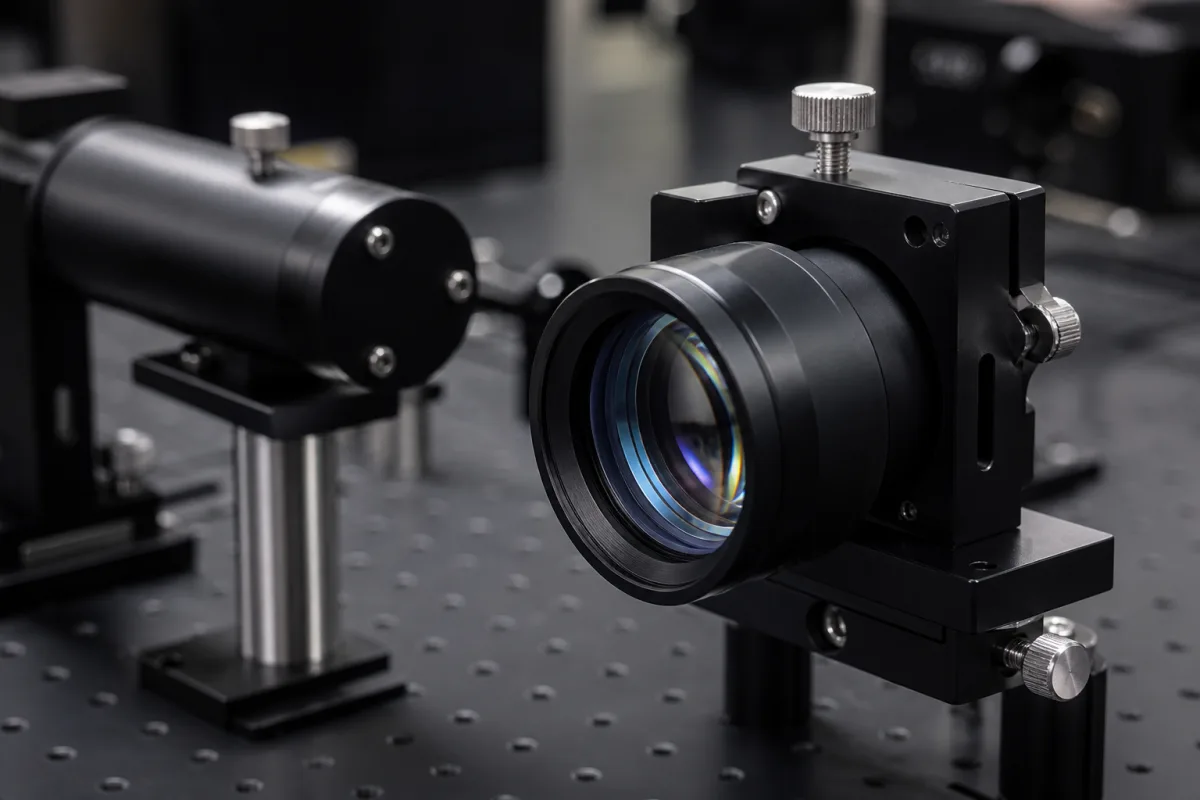
Collimating lens for laser diodes and fiber lasers
Laser optics · Focal length vs beam size and divergence, numerical aperture for diode output, fast- and slow-axis collimators, coating and wavelength
A collimating lens turns the diverging light from a laser diode, optical fiber or other small source into a nearly parallel beam. Ask three things first: what collimated beam size and residual divergence the application needs, since both follow from the focal length; whether the lens's numerical aperture captures the source's full divergence (including the fast axis of an edge-emitting diode); and which wavelength, coating and mount the lens must have.
Collimating lenses for laser diodes, diode bars and fiber outputs, including aspheric collimators, fast-axis (FAC) and slow-axis (SAC) cylindrical collimators, and collimating lenses in fiber laser processing heads. Beam expanders, focusing and F-theta lenses, and complete laser modules are outside this page.
CNFX editorial research · Sources checked October 11, 2026 · 5 sources
RP Photonics explains that a diverging beam is collimated by a lens whose focal length makes the curved wavefronts flat, with the lens one focal length from a tight focus; the longer the focal length, the larger the collimated beam. Within the paraxial approximation the collimated beam radius is the divergence half-angle times that distance, w = θ·f, and for a Gaussian beam the half-angle is λ / (π w₀). [1]
RP Photonics notes that a beam stays collimated over distances short compared with its Rayleigh length, which scales with the square of the waist radius; its example is a 1064 nm beam of 1 mm radius with a Rayleigh length of about 3 m. It also states that the product of waist radius and divergence (beam parameter product) is unchanged by an aberration-free optical system. [1][2] Residual divergence can be fine-adjusted by moving the lens along the beam. [1]
Editorial calculation: INGENERIC's fast-axis collimator table pairs effective focal length with a divergence value (D, mrad) — for example 0.15 mm with 4.60 mrad, 0.60 mm with 1.20 mrad, 1.00 mm with 0.70 mrad and 2.80 mm with 0.26 mrad. The product of the two stays near 0.7 across the range, so doubling the focal length roughly halves that divergence, at the cost of a larger beam. [3]
Give the supplier the source (laser diode, diode bar, fiber; wavelength; power), its divergence in each axis (FWHM or 1/e²) or fiber NA and core, required collimated beam size and residual divergence, working distance, mounting (barrel, holder, bonded), coating band, power or damage threshold, environment, and test data required.
02
Match the lens NA to the source and treat each diode axis
RP Photonics notes that a full width at half-maximum (FWHM) divergence angle "is common e.g. in data sheets of laser diodes and light-emitting diodes"; for a Gaussian beam that full angle is 1.18 times the 1/e² half-angle, so a 30° FWHM fast axis corresponds to a 25.4° (0.44 rad) half-angle, and collimating it without truncation needs a lens of fairly high numerical aperture, for example 0.6, designed to avoid spherical aberration. [2] RP Photonics says edge-emitting laser diodes "emit strongly diverging beams, and are therefore often equipped with collimation optics — at least with a fast axis collimator", and that "Collimating astigmatic beams usually requires a separate treatment in both transverse directions", for example with two different cylindrical lenses. [1]
INGENERIC describes its acylindrical glass fast-axis collimators as the key beam-shaping component of high-power diode lasers, with NA up to 0.8, diffraction-limited collimation and transmission up to 99%, and lists standard parts from 0.15 to 2.8 mm effective focal length with back focal lengths of 0.03 to 0.18 mm for 19 of the 20 standard parts listed (the FAC07-2500 is listed at 1.124 mm, as listed by INGENERIC; confirm against the drawing). Its slow-axis collimators are cylindrical lens arrays at emitter pitches of 200 to 1,000 µm, or single lenses of 3.7 to 37 mm focal length, with standard AR coating for 780–1020 nm. [3][4]
Editorial calculation: for the 0.44 rad half-angle above, a 0.6 mm focal-length FAC gives a collimated 1/e² radius of about 0.6 × tan 25.4° ≈ 0.28 mm, a beam about 0.57 mm high; the very short back focal lengths in INGENERIC's table mean the lens sits a fraction of a millimetre from the emitter, so ask how it is aligned and fixed. [2][3]
03
Diode collimators, FAC/SAC lenses and fiber-laser head lenses listed by Hitronics and Startnow
Listings include laser diode collimator lenses with fiber receptacles, FAC and SAC lenses for diode bars, and replacement collimating lenses for fiber laser cutting and welding heads; ask each for focal length, NA, wavelength and coating, and damage threshold.
04
Lens element, AR coating, mount and fiber receptacle
The mount matters as much as the glass: it holds the lens one focal length from the source, and moving the lens along the beam is how residual divergence is fine-adjusted. [1]
Focal length, NA, clear aperture, back focal length and coating band for a collimator order
INGENERIC's FAC and SAC tables supply the focal length, NA, clear aperture, transmittance, coating band and back focal length values below; flatness, surface quality, temperature ranges, weight and outer diameter have to come from the supplier. [3][4]
3 companies list this product among what they make. Company figures are quoted from each
company's own website; every card states where the relationship came from.
Hitronics
Manufacturing site to be confirmed for the order
Lists laser diode collimator lenses and FAC and SAC lenses for diode bars.
Explore company information and manufacturing capabilities, then discuss the scope of your project with a relevant supplier.
Share this page
Compiled and source-reviewed by the CNFX editorial team.
Each manufacturer above links to the page on that company's own website where the product is listed, with the date we checked it. How we source and review
· Page last updated 13 October 2026
Buyer questions
How do I choose a collimating lens focal length?
Per RP Photonics, the collimated beam radius is the divergence half-angle times the focal length, so a longer focal length gives a larger, less divergent beam. [1]
What NA does a laser diode collimator need?
RP Photonics notes a 30° FWHM fast axis is a 0.44 rad half-angle and needs a lens of fairly high NA, for example 0.6. [2]
What are FAC and SAC lenses?
INGENERIC's fast-axis collimators are acylindrical lenses with NA up to 0.8; slow-axis collimators are cylindrical lens arrays or single lenses for diode bars and emitters. [3][4]
Sources and what still needs a direct check
Sources checked 2026-10-11. RP Photonics is a technical encyclopedia on laser physics; INGENERIC and Hitronics describe their own lenses.