Editorial Technical Reference

Laser Diode Assembly

This page explains how Laser Diode Assembly is classified within Computer, Electronic and Optical Product Manufacturing. Technical values and manufacturer relationships are research references; confirm the current specification and supplier evidence for each order.

Technical Definition & Core Assembly

A precision optical assembly containing a laser diode and associated components for generating and directing coherent light.
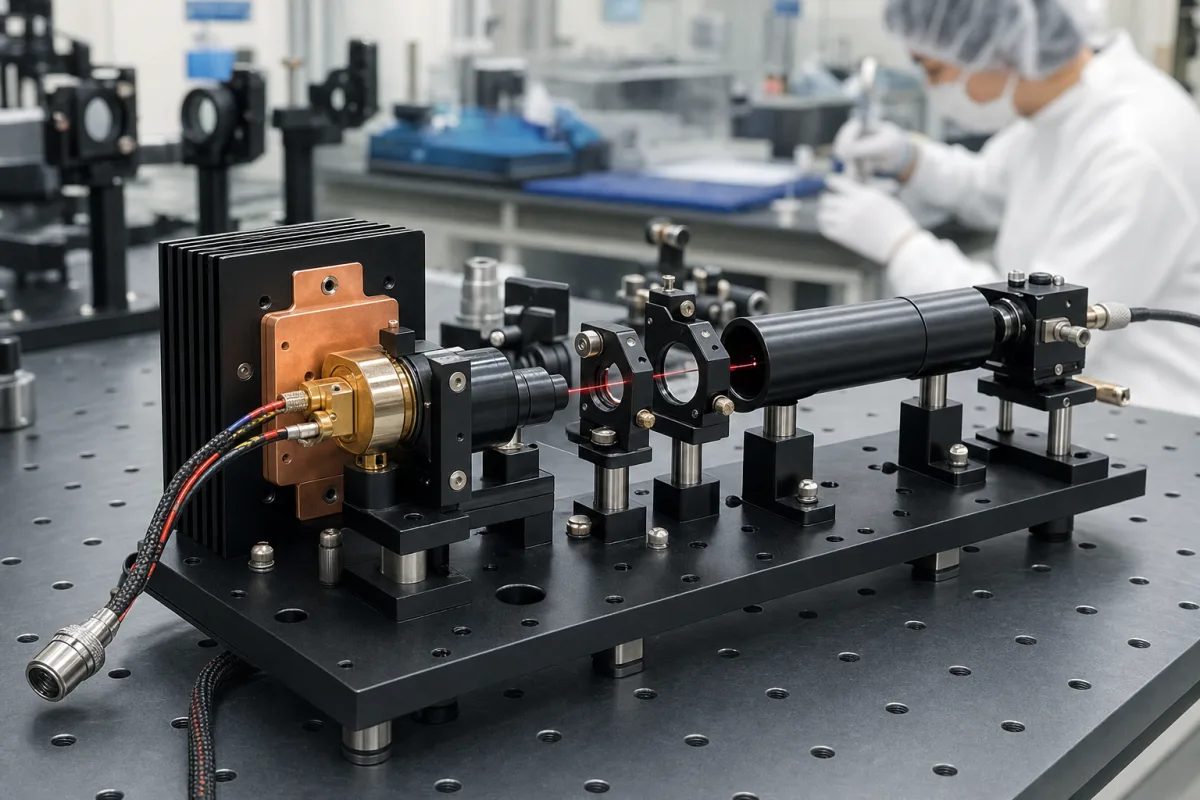
Representative product image. Confirm appearance and specifications with the manufacturer.

Product Specifications

Technical details and manufacturing context for Laser Diode Assembly

Definition
The Laser Diode Assembly is a critical sub-component of the Laser Alignment Module, responsible for generating a stable, coherent laser beam used for precise alignment and measurement applications. It integrates the laser diode chip with thermal management, optical collimation, and electrical interface elements to ensure reliable operation within the larger system. The assembly typically includes a semiconductor laser diode (e.g., GaAs or InP), a copper heat sink, glass or quartz collimating optics, and an aluminum housing. It is designed to operate over a range of output powers from 1 to 500 mW, wavelengths from 405 to 1550 nm, and operating voltages from 1.8 to 5.5 V DC, with corresponding currents from 20 to 2000 mA. Beam divergence ranges from 0.1 to 2.0 mrad, and beam diameter from 1 to 10 mm. The assembly is rated for operating temperatures from -40 to 85 °C and storage from -40 to 100 °C, with relative humidity up to 95% non-condensing. Ingress protection ratings from IP54 to IP67 are available, and laser safety class may range from 1 to 4 per IEC 60825-1. Weight varies from 10 to 500 g. These values are reference ranges; actual specifications must be confirmed with the manufacturer for the specific model and application. The assembly is intended for integration into alignment systems, and its performance depends on proper electrical driving, thermal management, and optical alignment. Verification of parameters such as output power, wavelength stability, and beam quality is essential during procurement and commissioning.
Working Principle
Electrical current is applied to the semiconductor laser diode, causing it to emit coherent light through stimulated emission. The assembly's optics (e.g., collimating lens) shape and direct this beam. Integrated heat sinks and drivers manage thermal and electrical conditions to maintain wavelength stability and output power. The laser diode chip is mounted on a heat sink to dissipate heat, and a collimating lens is positioned to produce a low-divergence beam. The electrical interface provides a stable current source, and optional monitoring photodiodes may be included for feedback control. The assembly operates within specified temperature and humidity ranges to ensure reliable performance.
Common Materials
Semiconductor (e.g., GaAs, InP), Copper (heat sink), Glass/Quartz (lens), Aluminum (housing)
Technical Parameters
ParameterTypical rangeNotes & selection driver
Output Power1–500 mWCW or pulsed; higher power requires thermal management
Wavelength405–1550 nmSelect based on application; visible to IR
Operating Voltage1.8–5.5 V DCTypical for laser diode driver
Operating Current20–2000 mADepends on output power and efficiency
Beam Divergence0.1–2.0 mradFull angle; lower for collimated beams
Beam Diameter1–10 mmAt exit aperture; affects focusing
Operating Temperature-40–85 °CExtended range may require TEC
Storage Temperature-40–100 °CNon-operating survival range
Relative Humidity5–95 %Non-condensing; higher may cause condensation
Ingress ProtectionIP54–IP67Higher IP for dusty or wet environmentsIEC 60529
Laser Safety Class1–4Class depends on power and enclosureIEC 60825-1
Weight10–500 gIncludes housing and optics

Ranges are indicative industry figures for RFQ preparation, not a supplier commitment. Confirm every value and standard with the legal manufacturer before ordering.

Components / BOM
  • Laser Diode Chip Part
    Semiconductor element that emits coherent light when electrically pumped.
    Material: Gallium Arsenide (GaAs) or similar III-V compound
  • Collimating Lens
    Optical element that shapes the divergent output from the diode into a parallel or focused beam.
    Material: Glass or Quartz
  • Thermal Sink/Heat Spreader Part
    Manages heat generated by the laser diode to maintain stable operating temperature and prevent performance degradation.
    Material: Copper or Aluminum
  • Mounting Housing
    Mechanical structure that aligns and secures all internal components and provides interface to the Laser Alignment Module.
    Material: Aluminum or Stainless Steel
  • Laser Driver
    Supplies the stable drive current that sets output power and holds wavelength steady.
  • Monitoring Photodiode Optional
    Samples output power for closed-loop power control, on assemblies fitted with it.

Applied To / Applications

This component is essential for the following industrial systems and equipment:

Industrial Ecosystem & Supply Chain Structure

Complementary Systems
Downstream Applications
Specialized Tooling

Application Fit & Sizing Matrix

Operational Limits
pressure: Atmospheric to 2 bar (sealed assembly dependent)
other spec: Max optical power: 500 mW, Wavelength tolerance: ±5 nm, Beam divergence: <10 mrad
temperature: -40°C to +85°C (operating), -55°C to +100°C (storage)
Media Compatibility
✓ Clean dry air/nitrogen environments ✓ Optical fiber coupling systems ✓ Vacuum-sealed instrument housings
Unsuitable: High particulate/dust environments without protective window
Sizing Data Required
  • Required optical output power (mW)
  • Target wavelength and spectral width (nm)
  • Beam quality requirements (M² factor/divergence)

Reliability & Engineering Risk Analysis

Failure Mode & Root Cause
Thermal runaway
Cause: Inadequate heat dissipation due to poor thermal interface material, insufficient cooling, or excessive drive current, leading to overheating and catastrophic failure.
Catastrophic optical damage (COD)
Cause: Localized overheating at the laser facet from optical feedback, contamination, or current spikes, causing irreversible damage to the semiconductor material.
Maintenance Indicators
  • Significant, sudden drop in optical output power or efficiency (measured via power meter)
  • Visible dark spots, discoloration, or burn marks on the laser diode facet under magnification
Engineering Tips
  • Implement precise temperature control with active cooling (e.g., thermoelectric coolers) and monitor junction temperature to maintain within specified operating range.
  • Use optical isolators to prevent back reflections and ensure clean, stable power supplies with current limiting to avoid electrical transients.

Indicative industry ranges for design and RFQ preparation. Confirm the exact figures and applicable standard with the manufacturer before specifying.

Compliance & Manufacturing Standards

Applicable Standards
ISO 11145:2018 (Optics and photonics - Lasers and laser-related equipment - Vocabulary and symbols) ANSI Z136.1 (Safe Use of Lasers) DIN EN 60825-1 (Safety of laser products - Part 1: Equipment classification and requirements)

Quoted from the published standard.

Manufacturing Precision
  • Beam Collimation Alignment: +/- 0.05 degrees
  • Mounting Surface Flatness: 0.025 mm
Quality Inspection
  • LIV (Light-Current-Voltage) Testing
  • Beam Profile Analysis (M² measurement)

Manufacturers of Laser Diode Assembly

Manufacturer profiles associated with Laser Diode Assembly.

Sourcing Laser Diode Assembly from China?
Tell us your specification and target quantity — we will match it against manufacturer records and come back with the factories that fit.
Request manufacturers We manufacture this

Manufacturer listings support early research and capability understanding. They are not certification, ranking, or transaction guarantees.

Technical documentation
Request current drawings, revision history, and a signed specification sheet.
Manufacturing capability
Verify equipment lists, process limits, capacity, and representative production evidence.
Inspection readiness
Confirm test methods, calibrated equipment, sampling plans, and traceable reports.
Supplier transparency
Check the legal entity, factory address, ownership, certifications, and direct contacts.

CNFX does not score or rank suppliers. Buyers must verify all claims and documents with the legal manufacturer before ordering.

Supply Chain Compatible Machinery & Devices

Modular Industrial Edge Computing Device

This modular industrial edge computing device is a ruggedized system designed for deployment in harsh industrial environments to perform real-time data processing, analytics, and control functions at the network edge.

Explore Specs →
Industrial Smart Camera Module

The Industrial Smart Camera Module is a compact, self-contained vision processing unit designed for integration into industrial machinery and production lines.

Explore Specs →
Surface Mount Resistor

Passive electronic component for current limiting and voltage division in circuits

Explore Specs →
Surface Mount Capacitor

A surface mount capacitor is a fundamental electronic component used for energy storage, filtering, coupling, and decoupling in electronic circuits.

Explore Specs →

Frequently Asked Questions

What is the typical output power range for this laser diode assembly?

The reference output power range is 1 to 500 mW, depending on the model and application. Higher power levels require enhanced thermal management. Always verify the specific output power rating with the manufacturer for your intended use.

What wavelengths are available?

The assembly can be configured for wavelengths from 405 nm (visible) to 1550 nm (infrared). The exact wavelength depends on the laser diode chip used. Select the wavelength based on your application requirements, and confirm availability with the supplier.

What are the operating temperature limits?

The operating temperature range is -40 to 85 °C, and storage temperature is -40 to 100 °C. Extended temperature operation may require additional thermal control such as a thermoelectric cooler (TEC). Verify the actual limits for your specific model.

What laser safety class does this assembly have?

The laser safety class can range from 1 to 4 per IEC 60825-1, depending on output power and enclosure design. The class is determined by the final product configuration. Always check the safety classification and follow appropriate safety measures.

Data Basis

Editorial classification, named public sources where available, and source-reviewed manufacturer records.

Preliminary Technical Classification
This page supports structured research, RFQ preparation, and supplier evaluation. It does not replace buyer-led supplier qualification, standards review, or technical approval.
Buyer enquiry

Request manufacturing insight for Laser Diode Assembly

Ask for use case, specification boundaries, supplier type, and RFQ preparation information for this product.

Where it goes
Straight to the CNFX editorial desk, and to the manufacturer if this product is linked to a claimed profile. Nothing is broadcast to a supplier list.
Your details stay here
We do not sell or rent enquiry data, and we do not add you to a mailing list. Used only to answer this request.
No commission, no middleman
CNFX is a directory. We take no cut of any order and never negotiate on a supplier's behalf.
What we don't claim
A listing is not an endorsement. Qualify every supplier and verify every figure yourself before ordering.

Your business information is used only to process this request.

Thank you! Your message has been sent. We'll respond within 1–3 business days.
Sorry, we couldn't send your message. Please try again, or email us at contact@cnfx.com.

Need to Manufacture Laser Diode Assembly?

Compare manufacturer profiles with relevant product and process capability.

Previous Product
XY Positioning Stage
Last Product
Get QuotesChat