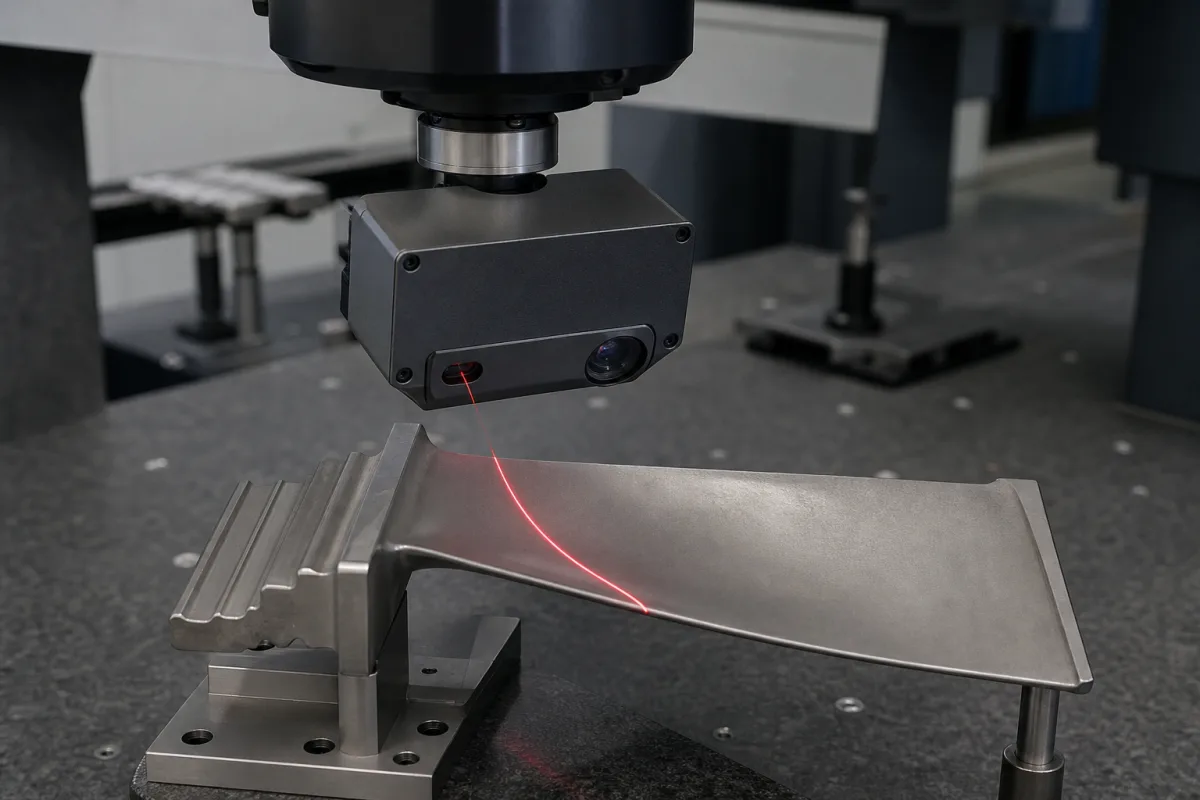
Laser scanner modules (laser line profile scanners)
2D/3D laser line profile scanners for inline inspection and dimensional measurement · measuring range in z and x, points per profile, profile frequency, linearity, laser class and wavelength, interfaces, IP rating, temperature, supply
A laser scanner module — a laser line profile scanner — projects a laser line onto a part and measures its cross-section profile without contact, giving 2D profiles and, with the part or scanner moving, 3D shape data for inline inspection and dimensional measurement. Ask three things first: the measuring range and width the part needs; the resolution, linearity and profile rate for your tolerances and line speed; and the laser class, interfaces and environment at the installation.
2D/3D laser line profile scanners and scanner modules for inline and offline measurement, with controllers and software. Laser safety scanners for area guarding (see laser safety scanner), single-point laser displacement sensors, lidar for mapping, handheld 3D scanners and coordinate measuring machines are outside this page except where compared.
CNFX editorial research · Sources checked October 12, 2026 · 4 sources
Micro-Epsilon's scanCONTROL 30x0 datasheet shows how one product family spans different parts. Its four heads cover z-axis measuring heights of 15 mm (77.5–92.5 mm from the sensor), 40 mm, 140 mm and 220 mm, the larger two with extended ranges ending at 360 mm and 460 mm; the measured line width at mid-range is 25, 50, 100 and 200 mm. Every head gives 2,048 points per profile, and z-axis linearity, referenced to a standard object and averaged across the line, is 1.5 µm, 3 µm, 9 µm and 26 µm respectively (±0.01%, ±0.0075%, ±0.006% and ±0.012% of range). [1]
Editorial calculation: 2,048 points across a 25 mm line width at mid-range gives one point every 25 ÷ 2,048 ≈ 0.012 mm (12 µm), while the same points spread over 200 mm give about 98 µm — so choose the smallest head that still covers the part, since width and resolution trade directly. [1]
Give the supplier the part and feature to measure, required z-range and line width, resolution and linearity, profile rate and line speed, surface (shiny, dark, transparent), laser class allowed and wavelength preference, interface (GigE Vision, digital I/O, encoder), software and evaluation, mounting and working distance, ambient light and temperature, IP rating, and quantity.
02
Check profile rate, laser class, interfaces and environment
The same datasheet gives a profile frequency of up to 10,000 Hz; Ethernet GigE Vision output with digital inputs for mode switching, encoder counting and triggering, plus RS422 and analogue or switching outputs via an output unit; a standard laser of class 2M at 658 nm, with class 3R and a 405 nm blue-laser class 2M variant as options; IP67 protection when connected; 2 g vibration and 15 g shock ratings; operation from 0 to +45 °C and storage from −20 to +70 °C; a weight of 415 g without cable; and supply of 11–30 V DC (24 V nominal, 500 mA) or Power over Ethernet. [1]
Editorial calculation: at 10,000 profiles per second a part moving at 1 m/s is profiled every 0.1 mm along its length; at 0.1 m/s, every 0.01 mm. Check that the profile rate at full resolution and exposure for your surface still meets the spacing you need. [1]
03
Compare ranges, laser colour, class and ruggedness across makers
RIFTEK's RF62x profiler datasheet spans measuring ranges from 10 to 1,010 mm with Z linearity of 0.01% of range, red (660 nm), blue (405 or 450 nm) and infrared (808 nm) lasers, laser safety Class 2M to IEC/EN 60825-1:2014 or Class 3B on request, Gigabit Ethernet with Ethernet/IP, Modbus TCP and UDP, trigger and encoder synchronisation, a web interface, 9–30 V supply, IP67 enclosure, 20 g vibration from 10 to 1,000 Hz, 30 g/6 ms shock, and storage from −20 to +70 °C. Versions within the series range from 640 or 1,280 X points at over 4,000 profiles/s to 1,280 or 2,560 points at 1,000 Hz (16,000 Hz in a region of interest). [2]
RIFTEK's RF631 series, announced in May 2025, lists 4,600 points per profile without interpolation, 1,200 Hz at full field of view and 6,000 Hz in a region of interest, compatible with the RF62x series. [3]
In the United States, 21 CFR 1040.10 requires each laser product to be classified in Class I, IIa, II, IIIa, IIIb or IV by its highest accessible emission; Class IIIb levels are an acute hazard to skin and eyes from direct radiation. Ask for the class under both IEC 60825-1 and the US rule if the scanner will be used in the US. [4][2]
Editorial calculation: 0.01% linearity is 0.1 mm on a 1,010 mm range but 1 µm on a 10 mm range, so linearity in µm depends on the head chosen as much as on the stated percentage. [2]
04
Line-laser 3D cameras on the linked site, and the data to request from any bidder
OPT Machine Vision, the linked maker, lists its LPE2 series of line-laser 3D cameras.
When requesting quotations, ask each supplier for measuring range, points per profile, linearity on your surface, profile rate at full resolution, laser class, interfaces and software.
05
Laser line projector, optics and receiver, processing, interfaces and housing
The optics-and-receiver row fixes z-range, line width and point count, so it is the row chosen by head size: 15, 40, 140 or 220 mm of z-range in the scanCONTROL 30x0 family. [1]
z-range and width, points per profile, linearity, profile rate, laser, supply and environment for a scanner order
The values are scanCONTROL 30x0 figures; RIFTEK's RF62x above gives a second set to compare for range (10–1,010 mm), laser wavelengths and supply (9–30 V). [1][2]
1 company lists this product among what they make. Company figures are quoted from each
company's own website; every card states where the relationship came from.
OPT Machine Vision Tech Co., Ltd.
Manufacturing site to be confirmed for the order
Its website lists the LPE2 series of line-laser 3D cameras.
Explore company information and manufacturing capabilities, then discuss the scope of your project with a relevant supplier.
Share this page
Compiled and source-reviewed by the CNFX editorial team.
Each manufacturer above links to the page on that company's own website where the product is listed, with the date we checked it. How we source and review
· Page last updated 13 October 2026
Buyer questions
How many points does a laser profile scanner measure per line?
Micro-Epsilon's scanCONTROL 30x0 measures 2,048 points per profile. [1]
How fast can profiles be captured?
Up to 10,000 profiles per second on the scanCONTROL 30x0. [1]
What laser class do profile scanners use?
The scanCONTROL 30x0 uses class 2M as standard, with a class 3R option. [1]
Which laser colours do profile scanners use?
RIFTEK's RF62x series offers red (660 nm), blue (405 or 450 nm) and infrared (808 nm) lasers. [2]
Sources and what still needs a direct check
Sources checked 2026-10-12. Micro-Epsilon's scanCONTROL 30x0 datasheet and RIFTEK's RF62x datasheet and RF631 announcement are makers' documents used as examples of profile-scanner specifications; 21 CFR 1040.10 is the US laser product classification rule.