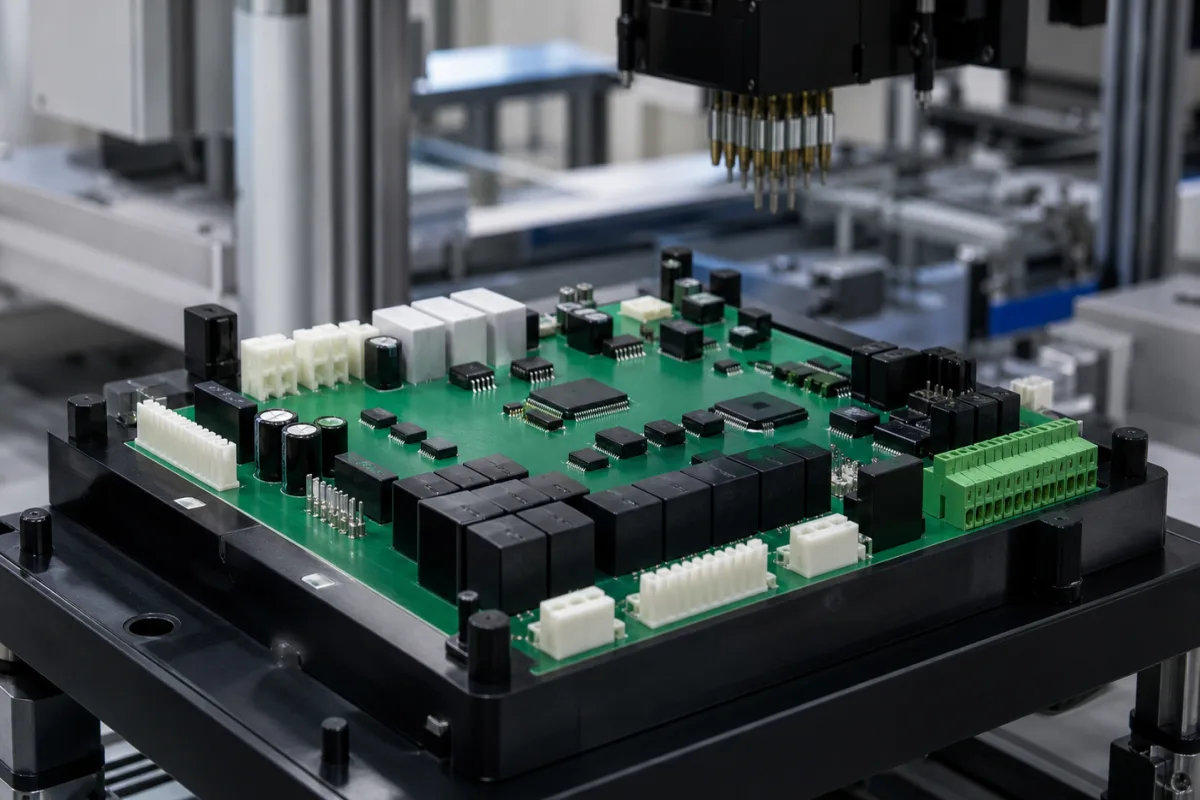
Control PCB of a circuit breaker trip unit: the electronics that measure phase current and trip on long-time, short-time, instantaneous and earth-fault settings
Control boards of electronic circuit breaker trip units · Long-time I²t protection with thermal memory, short-time, instantaneous and earth-fault thresholds, setting dials and keypads, and secondary injection testing
This page covers the control boards inside electronic trip units of low-voltage moulded-case and air circuit breakers: the electronics that read the current sensors, run the long-time (L), short-time (S), instantaneous (I) and earth-fault (G) protection functions set on dials, keypads or software, and fire the breaker's trip actuator. Ask three things first: which protection functions and setting ranges the board implements, what tolerances apply to its pickup and timing, and how the finished trip unit is tested.
Control boards of electronic trip units for low-voltage moulded-case and air circuit breakers, including current measurement, LSIG protection logic, setting interfaces and trip outputs. Contract PCB assembly as a service is covered on the PCB assembly page, and communication interface boards and relay I/O boards on their own pages. Thermal-magnetic trip units, medium-voltage protection relays and bare PCB fabrication are outside this page.
CNFX editorial research · Sources checked October 12, 2026 · 4 sources
Long-time protection: an I²t curve with thermal memory and a 1.05–1.20 Ir trip band
Schneider Electric describes long-time protection on its ComPacT NSX MicroLogic 5, 6 and 7 trip units as I²t inverse definite minimum time protection that incorporates a thermal image, set by the Ir pickup and tr time delay. Ir is preset with a dial and fine-tuned on the keypad, or set by password-protected software or a network command; its default is the maximum dial position, In, and under IEC/EN 60947-2 the long-time tripping range is 1.05–1.20 Ir. On a 250 A trip unit the dial presets start at 100 A. [1]
Schneider's MicroLogic 2 and 4 units set Ir on a multi-position dial whose maximum equals the trip unit rating In; the MicroLogic 4, which adds earth-leakage protection, has a switch that disconnects the trip unit supply from the phases for panel dielectric testing. [2]
Give the supplier the breaker frame and current ratings, the protection functions needed (L, S, I, G, earth leakage, zone selectivity), how settings are entered (dials, keypad, software), the trip actuator interface, communication needs, the applicable standard (IEC/EN 60947-2) and the tests to be run on each board and on the assembled trip unit.
02
LSIG thresholds, delays and tolerances on one trip unit's settings table
ABB's SACE Emax 2 catalogue gives the settings of its Ekip Touch, Ekip Hi-Touch, Ekip G Touch and Ekip G Hi-Touch trip units, showing the range a control board has to resolve and time for each function. [4]
The same table lists optional IEC inverse curves for L (standard, very and extremely inverse), zone selectivity with t2sel of 0.04–0.2 s, current unbalance, and closing-on-short-circuit protection. [4] Editorial calculation: at I1 = 0.4 × In on a 1,000 A sensor, the overload pickup is 400 A and the trip band 420–480 A; the I3 setting at 15 × In is 15,000 A, so the board's current measurement has to span from below 400 A to above 15 kA. [4]
Secondary injection checks the electronics; primary injection checks sensors and wiring too
Schneider's field testing guide for MicroLogic circuit breakers measures long-time delay by applying 300% of the ampere rating and timing to trip, and notes that the UTS3 secondary injection test kit can run the long-time test but does not test the current transformers and connections. Short-time pickup levels are multiples of sensor size times the rating plug multiplier, and the short-time function can be tested with a high-current, low-voltage AC supply; the guide says not to run the contact resistance test before instantaneous primary injection testing, which clears resistive films from the contacts. [3]
Editorial note: for the control board itself, ask the supplier which tests run on the bare assembled board (in-circuit or functional fixtures), which on the finished trip unit by secondary injection, and which need primary current through the breaker's sensors.
04
Send the breaker ratings, protection functions and tests together
Paste it into your enquiry below or into an email to a maker, then replace every bracket.
Explore company information and manufacturing capabilities, then discuss the scope of your project with a relevant supplier.
Share this page
Compiled and source-reviewed by the CNFX editorial team.
Each manufacturer above links to the page on that company's own website where the product is listed, with the date we checked it. How we source and review
· Page last updated 13 October 2026
Buyer questions
What does a trip unit control board do?
It measures phase currents from the breaker's sensors and trips the breaker on long-time, short-time, instantaneous and earth-fault settings, such as ABB's Ekip Touch L, S, I and G functions. [4]
At what current does long-time protection trip?
Schneider gives a long-time tripping range of 1.05–1.20 Ir under IEC/EN 60947-2; ABB's Ekip Touch trips between 1.05 and 1.2 × I1. [1][4]
Does secondary injection test the whole trip system?
No; Schneider notes that secondary injection test kits do not test the current transformers and connections, which need primary injection. [3]
Sources and what still needs a direct check
Sources checked 2026-10-12. Schneider Electric and ABB describe the protection functions, settings and tests of their own trip units.