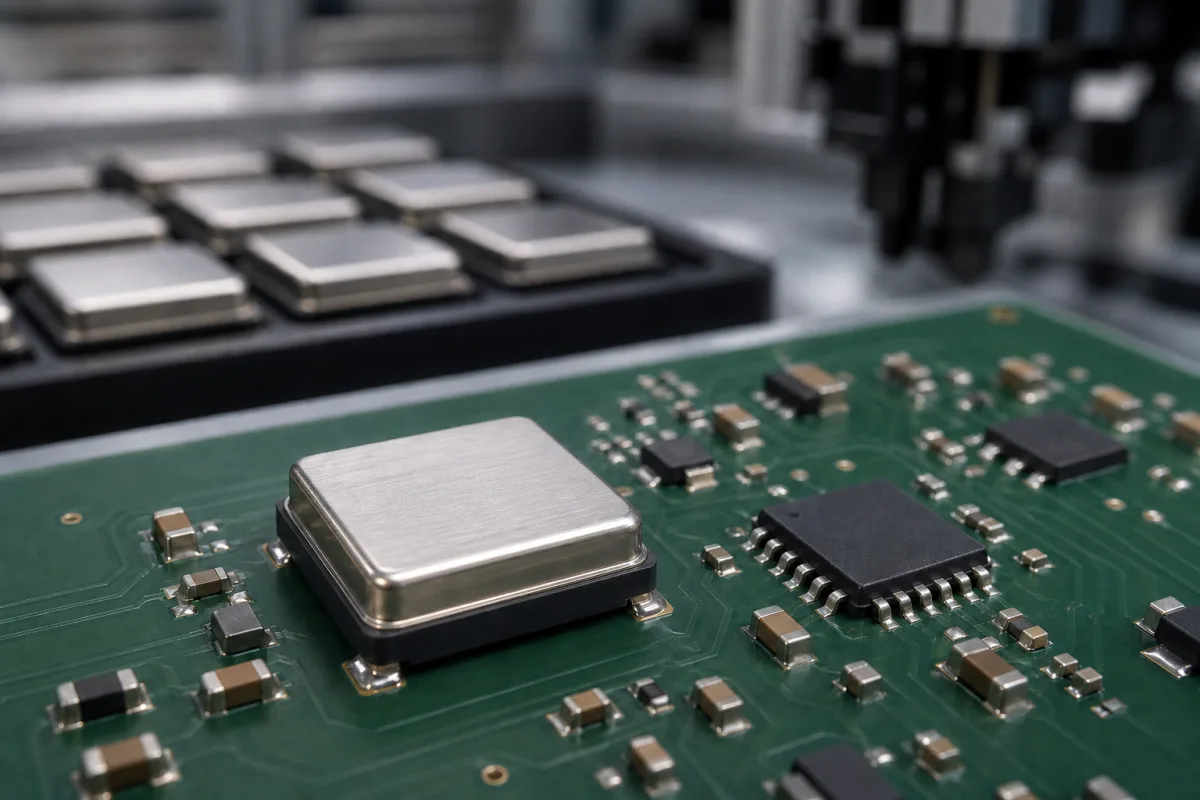
Frequency control · XO, TCXO and OCXO, ppm stability, output type and package
A crystal oscillator combines a quartz crystal with its drive circuit in one package to produce a clock. Ask three things first: how many ppm of error the system tolerates over temperature and lifetime, which output and supply voltage the circuit needs, and what package and frequency.
Packaged quartz crystal oscillators (XO/SPXO, VCXO, TCXO and OCXO). Bare crystal units are noted where suppliers list them; MEMS oscillators, PLL modules and frequency synthesizers are outside this page.
CNFX editorial research · Sources checked October 11, 2026 · 4 sources
Engineers from Morion, an oscillator maker, writing in Microwave Journal, explain that a simple quartz oscillator (XO) relies on the crystal cut alone and can reach ±10 to ±15 ppm from −40 to +85 °C; a TCXO adds a varactor driven by a compensation voltage and can reach ±0.1 to ±0.3 ppm; an OCXO keeps the crystal and circuit in an oven at constant temperature and can reach ±1 to ±5 × 10⁻¹¹ over the same range. [1]
They add that OCXO frequency also changes over time, known as aging, so operating time affects stability. [1] Ask suppliers for aging per day or per year as well as temperature stability.
Bare crystal units, unlike packaged oscillators, are specified with a load capacitance; Jingweite, for example, lists crystals at 6, 7, 9 and 12.5 pF alongside TCXOs. [3]
Give the supplier the frequency, total stability over temperature and life, temperature range, supply voltage, output type and load, start-up time, phase noise or jitter limit, package and any automotive grade.
02
Check the ppm budget and what it includes
SJK's SPXO range, for example, lists 1–220 MHz in packages from 1612 to 7050, CMOS output, 1.8–3.3 V supply (1.8–5.0 V for larger sizes), ±20 ppm stability and −40 to +85 °C; its DIP-8 and DIP-14 parts list ±25 ppm. [2] Ask whether a figure covers initial tolerance, temperature, supply, load and aging, or only some of them.
Editorial calculation: ±20 ppm on a 25 MHz clock is 25,000,000 × 20 ÷ 1,000,000 = ±500 Hz. As a timekeeping error, 20 ppm × 86,400 s per day ≈ 1.7 s per day; at the ±0.2 ppm a TCXO can reach, it is about 0.017 s per day. [2][1]
If the system budget is tighter than an XO reaches over temperature, a TCXO or OCXO is needed. [1]
03
Compare what suppliers offer
Suppliers linked to this page list crystal oscillators alongside crystals and other frequency-control parts. [2][3]
SJK lists SPXO, automotive, differential, spread-spectrum, VCXO and TCXO oscillators and MEMS oscillators; Jingweite lists TCXOs and crystals; Huixun lists crystals, oscillators, TCXOs and OCXOs; Hangjing lists crystals, oscillators, filters, TCXOs and VCXOs; A-Crystal lists TCXO, VCXO, VC-TCXO and oven-controlled oscillators; XtalTQ lists TCXO, OCXO, VCXO and PLL modules; WTL lists CMOS, differential, VCXO, TCXO and OCXO parts; Eshine and GNS list crystal oscillators among distributed components. [2][3]
04
Set long-term stability targets against NIST's quartz limits
NIST's Time and Frequency Division, in its Time and Frequency from A to Z glossary, gives a Q of 10⁴ to 10⁶ as typical for a quartz oscillator, estimates the maximum Q for a high-stability quartz oscillator as 1.6 × 10⁷ divided by the resonance frequency in megahertz, and lists approximate Q values of 10⁴ for a quartz wristwatch, 10⁶ for an OCXO and 10⁷ for rubidium. NIST adds: "Generally speaking, the higher the Q, the more stable the oscillator". [4]
NIST names temperature, humidity, pressure and vibration as changes that shift a crystal's resonance frequency, lists the TCXO, MCXO and OCXO as designs that reduce these effects, and says long-term stability is limited by aging: due to aging and environmental factors, it is hard to keep even the best quartz oscillators within 1 × 10⁻¹⁰ of nominal frequency without constant adjustment, which is why atomic oscillators are used where better long-term stability is required. [4]
Editorial calculation: at 10 MHz the estimated maximum Q is 1.6 × 10⁷ ÷ 10 = 1.6 × 10⁶. A fractional error of 1 × 10⁻¹⁰ is 0.0001 ppm, or 1 × 10⁻¹⁰ × 86,400 s ≈ 8.6 µs per day. For a quartz part, ask for aging figures and for the temperature, supply and vibration conditions behind each stability figure.
Item
NIST value
Editorial reading
Q, quartz oscillator
10⁴ to 10⁶
Range NIST gives for quartz
Q, quartz wristwatch
10⁴
Low end of that range
Q, OCXO
10⁶
High end of that range
Q, rubidium (atomic)
10⁷
Above quartz
Maximum Q estimate
1.6 × 10⁷ ÷ f (MHz)
1.6 × 10⁶ at 10 MHz (editorial calculation)
Long-term limit, best quartz
1 × 10⁻¹⁰ without constant adjustment
0.0001 ppm, about 8.6 µs per day (editorial calculation)
05
Trace the oscillator components
This is a functional reference built from the sources cited; it is not one maker's parts list.
Part
Role
Fix in the order
Quartz crystal
Sets frequency; cut sets temperature behaviour. [1]
Fill the specification fields with values for your circuit
A crystal oscillator quotation needs values for your clock. The table explains each field, gives published values where a reviewed source states them, and says what to obtain from the supplier.
Explore company information and manufacturing capabilities, then discuss the scope of your project with a relevant supplier.
Share this page
Compiled and source-reviewed by the CNFX editorial team.
Published product pages show what a company offers, not tested performance. Confirm the legal seller, factory and scope for your order. How we source and review
· Page last updated 13 October 2026
Buyer questions
What is the difference between XO, TCXO and OCXO?
An XO relies on the crystal cut, a TCXO adds temperature compensation and an OCXO holds the crystal in an oven; typical stability over −40 to +85 °C runs from ±10–15 ppm to about ±0.1–0.3 ppm to parts in 10¹¹. [1]
How many hertz is ±20 ppm?
Multiply frequency by 20 and divide by one million; at 25 MHz that is ±500 Hz. [2]
Does a ppm stability figure include aging?
Not always; ask whether it covers initial tolerance, temperature, supply, load and aging, and ask for aging separately. [1][2]
How stable can a quartz oscillator stay over the long term?
NIST says aging and environmental factors make it hard to keep even the best quartz oscillators within 1 × 10⁻¹⁰ of nominal frequency without constant adjustment. [4]
Sources and what still needs a direct check
Sources checked 2026-10-11. The Microwave Journal article was written by engineers at Morion, an oscillator maker. SJK and Jingweite are suppliers listed on this page; their values are catalogue figures.