Editorial Technical Reference

Oscillator Circuit

This page explains how Oscillator Circuit is classified within Computer, Electronic and Optical Product Manufacturing. Technical values and manufacturer relationships are research references; confirm the current specification and supplier evidence for each order.

Technical Definition & Core Assembly

Electronic circuit that generates a periodic, oscillating signal at a specific frequency
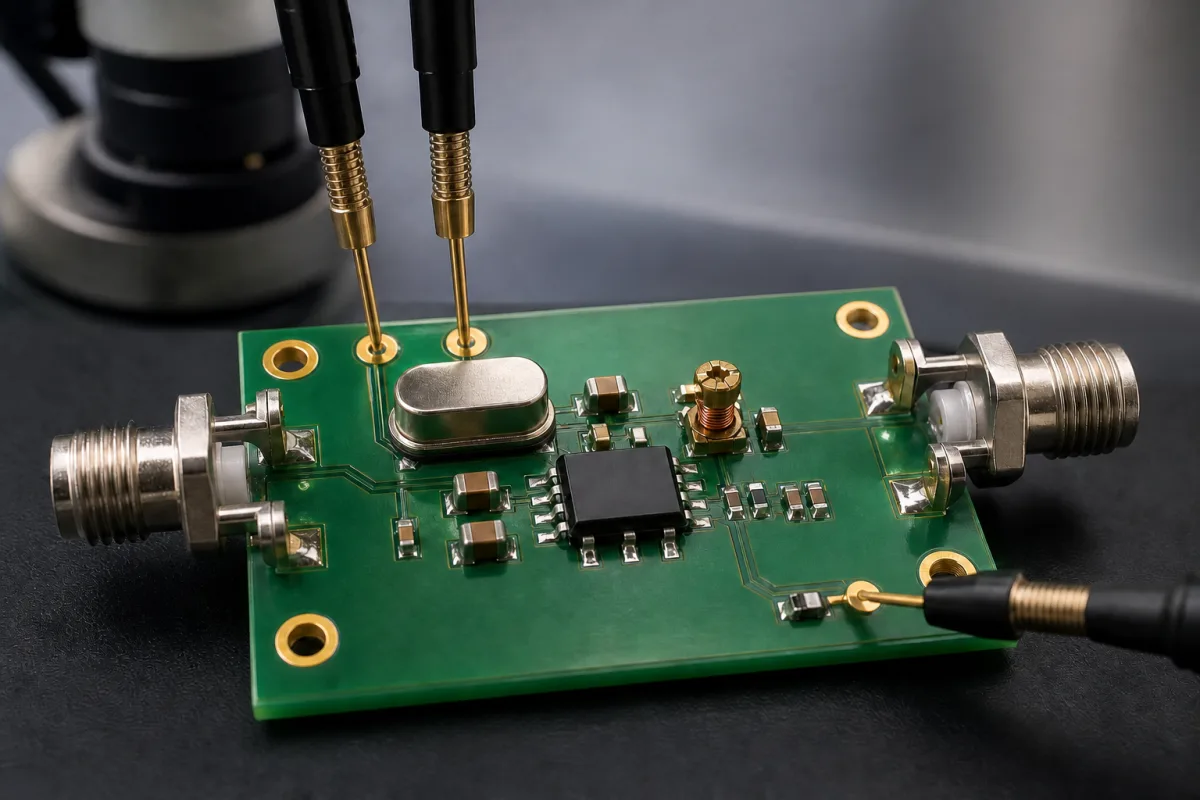
Representative product image. Confirm appearance and specifications with the manufacturer.

Product Specifications

Technical details and manufacturing context for Oscillator Circuit

Definition
An oscillator circuit is an electronic component used in computer, electronic, and optical product manufacturing. It generates a periodic, oscillating electrical signal at a specific frequency. This circuit is a critical part within high-frequency generators, producing stable, high-frequency oscillations through positive feedback mechanisms. It serves as the frequency-determining element for signal generation and transmission applications. The working principle involves active components such as transistors, operational amplifiers, or specialized integrated circuits, combined with frequency-determining elements like quartz crystals, LC tanks, or RC networks. These are arranged in a feedback loop configuration to sustain continuous oscillations at a precise frequency determined by the circuit's resonant characteristics. The materials typically used include semiconductor components (transistors or ICs), capacitors, inductors, resistors, and quartz crystals. The primary parameter is the oscillation frequency range and stability, measured in hertz (Hz). This parameter must be verified for the specific model and application. No specific standards are listed for this product. It is important to note that this directory entry is for reference only; actual product specifications, performance values, and compliance with any standards must be confirmed with the legal manufacturer or supplier. The oscillator circuit is a fundamental building block in many electronic devices, enabling precise timing and signal generation. Its design and performance directly impact the functionality of the end product. Therefore, selection should be based on the required frequency, stability, and environmental conditions. Maintenance signals may include frequency drift or failure to start oscillating. Boundaries of failure include component degradation or damage. Always consult the manufacturer for detailed specifications and application guidance.
Working Principle
The oscillator circuit uses active components like transistors or op-amps in a feedback loop with frequency-determining elements such as crystals, LC tanks, or RC networks. The feedback loop provides positive feedback that sustains oscillations. The frequency is set by the resonant characteristics of the frequency-determining elements. The active component amplifies the signal and compensates for losses in the loop, maintaining a steady oscillation. The circuit's design ensures that the loop gain and phase shift meet the Barkhausen criteria for sustained oscillation. The output is a periodic signal at the desired frequency, which can be used for timing, clock generation, or signal transmission.
Common Materials
Semiconductor components (transistors/ICs), Capacitors, Inductors, Resistors, Quartz crystals
Technical Parameters

What to specify in your RFQ

  • Oscillation frequency range and stability in Hz

These are the quantities to specify to the manufacturer when sizing or requesting a quote. The manufacturer's own documentation governs the exact figures and applicable standard.

Components / BOM
  • Active Device
    Provides amplification and sustains oscillations
    Material: Semiconductor (transistor/IC)
  • Resonant Element Part
    Determines oscillation frequency through LC/RC networks or crystal resonance
    Material: Quartz crystal/Inductor-Capacitor combination
  • Feedback Network Part
    Routes portion of output signal back to input to maintain oscillations
    Material: Resistor-Capacitor network
  • Bias Circuit Part
    Sets proper operating point for active components
    Material: Resistors and capacitors

Applied To / Applications

This component is essential for the following industrial systems and equipment:

Industrial Ecosystem & Supply Chain Structure

Complementary Systems
Downstream Applications
Specialized Tooling

Application Fit & Sizing Matrix

Operational Limits
voltage: 1.8V to 5.5V typical operating range
aging rate: ±1ppm/year to ±5ppm/year
temperature: -40°C to +85°C (industrial grade), -55°C to +125°C (military grade)
frequency stability: ±10ppm to ±100ppm depending on type
Media Compatibility
✓ Digital logic circuits ✓ Microcontroller clock sources ✓ Communication system timing
Unsuitable: High-vibration mechanical environments without proper mounting/isolation
Sizing Data Required
  • Required output frequency (Hz)
  • Load capacitance (pF)
  • Supply voltage (V)

Reliability & Engineering Risk Analysis

Failure Mode & Root Cause
Frequency Drift
Cause: Aging of crystal resonator or temperature coefficient issues affecting stability
Output Signal Degradation
Cause: Component fatigue in capacitors/resistors or power supply fluctuations causing waveform distortion
Maintenance Indicators
  • Audible hum or erratic frequency output indicating instability
  • Visible overheating or discoloration of components suggesting thermal stress
Engineering Tips
  • Implement regular calibration and thermal management to maintain frequency stability
  • Use high-quality, derated components and ensure clean, stable power supply to reduce stress

Indicative industry ranges for design and RFQ preparation. Confirm the exact figures and applicable standard with the manufacturer before specifying.

Compliance & Manufacturing Standards

Applicable Standards
IEC 60749-1: Semiconductor devices - Mechanical and climatic test methods CE marking: EMC Directive 2014/30/EU for electromagnetic compatibility

Quoted from the published standard.

Manufacturing Precision
  • Frequency stability: +/-0.005% over operating temperature range
  • Output voltage amplitude: +/-5% of nominal value
Quality Inspection
  • Frequency stability test across temperature range (-40°C to +85°C)
  • EMC compliance testing for radiated and conducted emissions

Manufacturers of Oscillator Circuit

Manufacturer profiles associated with Oscillator Circuit.

Sourcing Oscillator Circuit from China?
Tell us your specification and target quantity — we will match it against manufacturer records and come back with the factories that fit.
Request manufacturers We manufacture this

Manufacturer listings support early research and capability understanding. They are not certification, ranking, or transaction guarantees.

Technical documentation
Request current drawings, revision history, and a signed specification sheet.
Manufacturing capability
Verify equipment lists, process limits, capacity, and representative production evidence.
Inspection readiness
Confirm test methods, calibrated equipment, sampling plans, and traceable reports.
Supplier transparency
Check the legal entity, factory address, ownership, certifications, and direct contacts.

CNFX does not score or rank suppliers. Buyers must verify all claims and documents with the legal manufacturer before ordering.

Supply Chain Compatible Machinery & Devices

Industrial IoT Gateway

The Industrial IoT Gateway is a ruggedized edge computing device designed for industrial environments.

Explore Specs →
Modular Industrial Edge Computing Device

This modular industrial edge computing device is a ruggedized system designed for deployment in harsh industrial environments to perform real-time data processing, analytics, and control functions at the network edge.

Explore Specs →
Industrial Smart Camera Module

The Industrial Smart Camera Module is a compact, self-contained vision processing unit designed for integration into industrial machinery and production lines.

Explore Specs →
Surface Mount Resistor

Passive electronic component for current limiting and voltage division in circuits

Explore Specs →

Frequently Asked Questions

What is the primary function of an oscillator circuit?

The primary function is to generate a periodic, oscillating electrical signal at a specific frequency. It is used as a frequency-determining element in signal generation and transmission applications.

What materials are typically used in an oscillator circuit?

Typical materials include semiconductor components (transistors or ICs), capacitors, inductors, resistors, and quartz crystals. These are used to construct the active and frequency-determining parts of the circuit.

How is the oscillation frequency determined?

The frequency is determined by the resonant characteristics of the frequency-determining elements, such as quartz crystals, LC tanks, or RC networks, in combination with the feedback loop configuration.

What should be verified before selecting an oscillator circuit?

You should verify the oscillation frequency range and stability (in Hz) for your specific application. Also, confirm any applicable standards and performance specifications with the legal manufacturer or supplier.

Data Basis

Editorial classification, named public sources where available, and source-reviewed manufacturer records.

Preliminary Technical Classification
This page supports structured research, RFQ preparation, and supplier evaluation. It does not replace buyer-led supplier qualification, standards review, or technical approval.
Buyer enquiry

Request manufacturing insight for Oscillator Circuit

Ask for use case, specification boundaries, supplier type, and RFQ preparation information for this product.

Where it goes
Straight to the CNFX editorial desk, and to the manufacturer if this product is linked to a claimed profile. Nothing is broadcast to a supplier list.
Your details stay here
We do not sell or rent enquiry data, and we do not add you to a mailing list. Used only to answer this request.
No commission, no middleman
CNFX is a directory. We take no cut of any order and never negotiate on a supplier's behalf.
What we don't claim
A listing is not an endorsement. Qualify every supplier and verify every figure yourself before ordering.

Your business information is used only to process this request.

Thank you! Your message has been sent. We'll respond within 1–3 business days.
Sorry, we couldn't send your message. Please try again, or email us at contact@cnfx.com.

Need to Manufacture Oscillator Circuit?

Compare manufacturer profiles with relevant product and process capability.

Previous Product
XY Positioning Stage
Last Product
Get QuotesChat