Industry-Verified Manufacturing Data (2026)

Environmental Enclosure

Based on aggregated insights from multiple verified factory profiles within the CNFX directory, the standard Environmental Enclosure used in the Computer, Electronic and Optical Product Manufacturing sector typically supports operational capacities ranging from standard industrial configurations to heavy-duty production requirements.

Technical Definition & Core Assembly

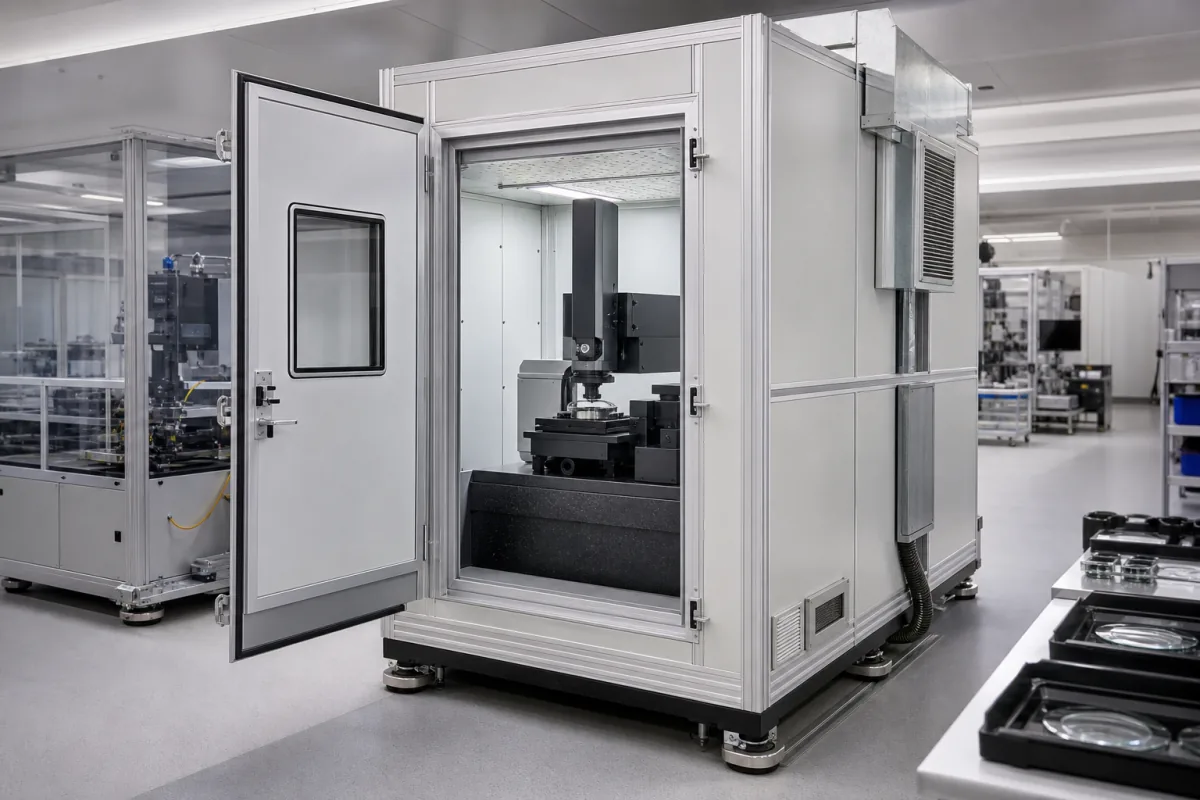
A canonical Environmental Enclosure is characterized by the integration of Viewing Window and Access Door. In industrial production environments, manufacturers listed on CNFX commonly emphasize Aluminum alloy construction to support stable, high-cycle operation across diverse manufacturing scenarios.

A protective housing that maintains stable environmental conditions for precision optical lens inspection and measurement equipment.
Product Specifications

Technical details and manufacturing context for Environmental Enclosure

Definition
The Environmental Enclosure is a critical component of the Precision Optical Lens Inspection and Measurement System that creates a controlled environment to shield sensitive optical components from external contaminants, temperature fluctuations, humidity variations, and air currents. It ensures measurement accuracy by maintaining consistent conditions around the inspection area.
Working Principle
The enclosure operates by creating a sealed or semi-sealed environment around the optical inspection zone. It may incorporate temperature control systems, humidity regulation, air filtration, and vibration isolation to maintain stable conditions. The enclosure prevents external environmental factors from interfering with the precision measurement of optical lenses.
Common Materials
Aluminum alloy, Acrylic/Polycarbonate panels, Stainless steel fittings
Technical Parameters
  • Internal dimensions to accommodate optical inspection equipment (mm) Customizable
Components / BOM
  • Viewing Window
    Provides optical access for inspection while maintaining environmental seal
    Material: Optical-grade acrylic or glass
  • Access Door
    Allows loading/unloading of lenses while minimizing environmental disturbance
    Material: Aluminum with sealing gasket
  • Temperature Control System
    Maintains stable internal temperature through heating/cooling elements
    Material: Stainless steel heating elements, copper cooling coils
  • Air Circulation System
    Ensures uniform environmental conditions throughout the enclosure
    Material: Aluminum fan housing, plastic impellers
Engineering Reasoning
20-25°C temperature, 40-60% relative humidity, ±0.5°C thermal gradient across enclosure
Temperature exceeds 30°C or falls below 15°C, humidity exceeds 70% or falls below 30%, thermal gradient exceeds 1.5°C/m across optical path
Design Rationale: Thermal expansion coefficient mismatch between enclosure materials (aluminum: 23.1×10⁻⁶/°C, acrylic: 70×10⁻⁶/°C) causing mechanical stress and optical misalignment; condensation at dew point (calculated via Magnus formula) causing lens surface contamination
Risk Mitigation (FMEA)
Trigger Compressor failure in thermoelectric cooling system due to lubricant breakdown at 65°C
Mode: Temperature rise at 0.8°C/minute exceeding 30°C threshold
Strategy: Dual redundant Peltier coolers with independent thermal sensors and 316L stainless steel heat exchangers
Trigger Desiccant saturation in humidity control cartridge reaching 85% moisture absorption capacity
Mode: Relative humidity increase to 72% causing condensation on lens surfaces at 22°C
Strategy: Regenerative dual-bed desiccant system with silica gel (pore size 2.4 nm) and automatic regeneration at 120°C every 48 hours

Industry Taxonomies & Aliases

Commonly used trade names and technical identifiers for Environmental Enclosure.

Industrial Ecosystem & Supply Chain DNA

Complementary Systems
Downstream Applications
Specialized Tooling

Application Fit & Sizing Matrix

Operational Limits
pressure: Atmospheric ±5 mbar (sealed environment)
other spec: Humidity: 40-60% RH (±3% stability), Vibration: <0.5 g RMS, Cleanliness: ISO Class 5 or better
temperature: 15°C to 30°C (±0.5°C stability)
Media Compatibility
✓ Cleanroom air (ISO Class 5-7) ✓ Nitrogen purge environments ✓ Dry compressed air (dew point < -40°C)
Unsuitable: Corrosive chemical atmospheres (e.g., acid vapors, solvent mists)
Sizing Data Required
  • Maximum equipment dimensions (L×W×H)
  • Required internal access points/ports
  • Thermal load from enclosed equipment (Watts)

Reliability & Engineering Risk Analysis

Failure Mode & Root Cause
Seal Degradation
Cause: UV exposure, temperature cycling, and chemical attack compromising gasket materials leading to environmental ingress.
Corrosion and Structural Weakening
Cause: Moisture ingress, condensation buildup, or exposure to corrosive atmospheres causing metal fatigue and fastener failure.
Maintenance Indicators
  • Visible condensation or moisture pooling inside the enclosure
  • Audible rattling or loose panel vibrations during operation
Engineering Tips
  • Implement regular seal integrity checks and replace gaskets proactively based on environmental exposure cycles
  • Apply corrosion-resistant coatings and ensure proper drainage/ventilation to prevent moisture accumulation

Compliance & Manufacturing Standards

Reference Standards
ISO 14644-1:2015 Cleanrooms and associated controlled environments IEC 60529:2013 Degrees of protection provided by enclosures (IP Code) ASTM E283-04 Standard Test Method for Determining Rate of Air Leakage Through Exterior Windows, Curtain Walls, and Doors Under Specified Pressure Differences Across the Specimen
Manufacturing Precision
  • Overall dimensions: +/- 1.5 mm
  • Door seal compression: +/- 0.5 mm
Quality Inspection
  • IP rating water ingress test (IEC 60529)
  • Air leakage test (ASTM E283)

Factories Producing Environmental Enclosure

Verified manufacturers with capability to produce this product in China

✓ 95% Supplier Capability Match Found

T Technical Director from Brazil Jan 06, 2026
★★★★★
"As a professional in the Computer, Electronic and Optical Product Manufacturing sector, I confirm this Environmental Enclosure meets all ISO standards."
Technical Specifications Verified
P Project Engineer from Canada Jan 03, 2026
★★★★☆
"Standard OEM quality for Computer, Electronic and Optical Product Manufacturing applications. The Environmental Enclosure arrived with full certification. (Delivery took slightly longer than expected, but technical support was excellent.)"
Technical Specifications Verified
S Sourcing Manager from United States Dec 31, 2025
★★★★★
"Great transparency on the Environmental Enclosure components. Essential for our Computer, Electronic and Optical Product Manufacturing supply chain."
Technical Specifications Verified
Verification Protocol

“Feedback is collected from verified sourcing managers during RFQ (Request for Quote) and factory evaluation processes on CNFX. These reports represent historical performance data and technical audit summaries from our B2B manufacturing network.”

7 sourcing managers are analyzing this specification now. Last inquiry for Environmental Enclosure from India (10m ago).

Supply Chain Compatible Machinery & Devices

Industrial IoT Gateway

Edge computing device connecting industrial equipment to cloud platforms.

Explore Specs →
Modular Industrial Edge Computing Device

Rugged computing platform for industrial data processing at the network edge

Explore Specs →
Industrial Smart Camera Module

Embedded vision system for industrial automation and quality inspection.

Explore Specs →
Industrial Wireless Power Transfer Module

Wireless power transfer module for industrial equipment applications

Explore Specs →

Frequently Asked Questions

What environmental conditions does this enclosure maintain for optical lens inspection?

The enclosure maintains stable temperature and controlled air circulation to prevent thermal expansion/contraction and particle contamination, ensuring accurate optical measurements in manufacturing environments.

What materials are used in the construction of this environmental enclosure?

Constructed with aluminum alloy frame, acrylic/polycarbonate viewing panels, and stainless steel fittings for durability, corrosion resistance, and clear visibility during inspection processes.

How does the air circulation system benefit precision optical measurement?

The integrated air circulation system maintains consistent air quality, prevents particle accumulation on lenses, and helps regulate temperature distribution for reliable measurement accuracy in electronic manufacturing applications.

Can I contact factories directly on CNFX?

CNFX is an open directory, not a transaction platform. Each factory profile provides direct contact information and production details to help you initiate direct inquiries with Chinese suppliers.

Get Quote for Environmental Enclosure

Request technical pricing, lead times, or customized specifications for Environmental Enclosure directly from verified manufacturing units.

Your business information is encrypted and only shared with verified Environmental Enclosure suppliers.

Thank you! Your message has been sent. We'll respond within 1–3 business days.

Need to Manufacture Environmental Enclosure?

Connect with verified factories specializing in this product category

Add Your Factory Contact Us
Previous Product
Entropy Source Module
Next Product
Environmental Housing