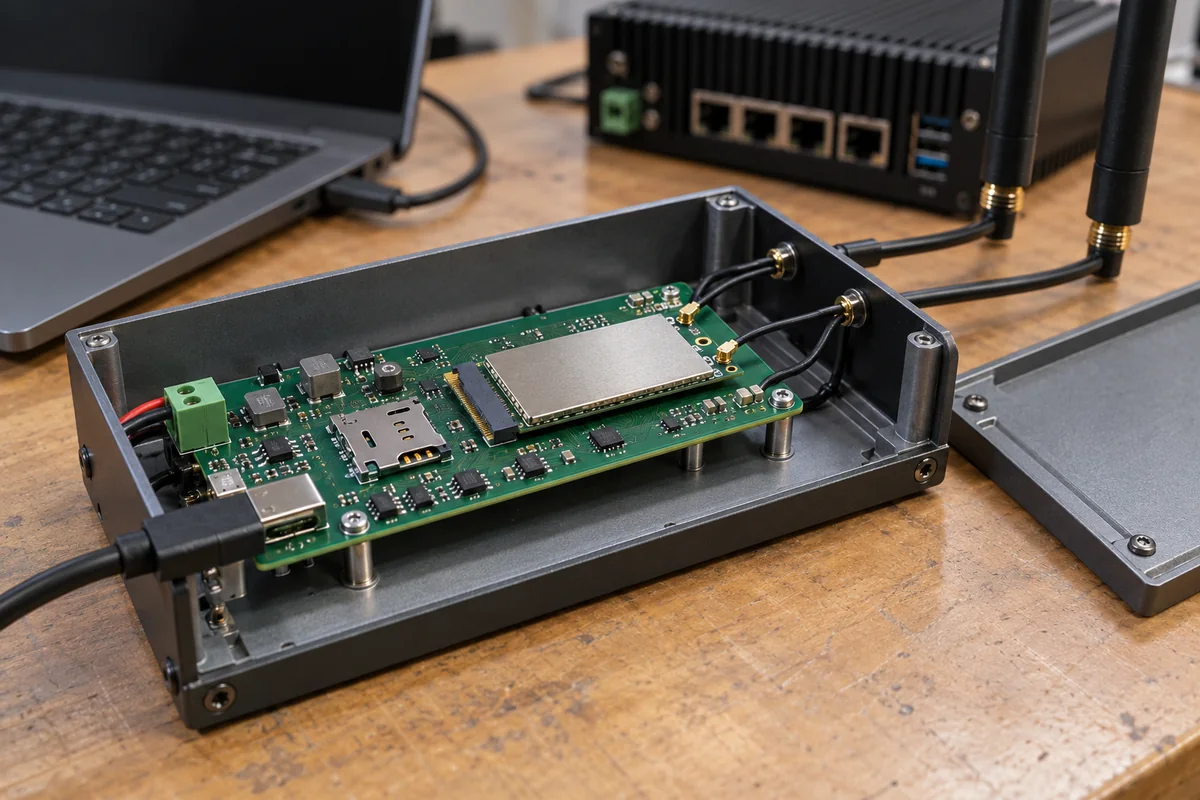
External interface module for an M.2 cellular modem: the adapter board that brings a 4G/5G Key B module out to USB, SIM slots and its own power
M.2 Key B carrier and adapter boards for 4G/5G modules · module length · USB 3.x host link · Nano SIM slots · auxiliary USB-C power and 3 A regulators · module supply window and idle current
Cellular modules for routers, gateways and laptops are sold in M.2 form: a 30 × 52 mm card with a Key B edge connector that carries USB, PCIe, SIM and control lines, and expects the host to supply the module rail, 3.135–4.4 V in the case of Quectel's RM520N. Equipment without an M.2 WWAN slot reaches such a module through an external interface module: an adapter or carrier board with the M.2 socket, SIM holders, a power stage and a USB connector to the host. What matters is that the socket matches the module length, that the supply holds up when the radio transmits, and that the SIM and control lines a project needs are actually brought out.
Adapter and carrier boards for M.2 Key B 4G/LTE and 5G cellular modules: the M.2 socket and its module sizes, USB host connection, SIM slots, power input and regulation, and control signals such as power, reset and SIM switching. The modules themselves and complete cellular modems or DTUs are covered on the Cellular modem page; PCIe and M.2 network and serial cards on the Communication interface board page; M.2 AI accelerator cards on the AI accelerator module page. Antennas and routers are outside this page.
CNFX editorial research · Sources checked October 19, 2026 · 3 sources
Key B socket, module length and what the board brings out
ALFA Network describes its AUAM2-3042 kit as an adapter that connects an M.2 Key B 5G/4G LTE/WWAN module to USB 3.0 Type-A, with a built-in Nano SIM slot, power and status LEDs and a transparent bracket that holds the module so its antenna connectors do not pop off under vibration. The kit includes the adapter board, bracket and securing screw; ALFA states that the module and antennas are not included and that buyers should confirm the module is a Key B 3042 type. [1]
Waveshare's RM520N-GL 5G HAT takes the same kind of module on an onboard M.2 B key slot and lists compatible 4G and 5G series (SIM7600X, EM06X, SIM82XX and RM5XX). It connects to a PC, Raspberry Pi or Jetson Nano over a USB 3.1 port that is USB 2.0 compatible, and brings out control pins through a level translator enabled by DIP switch for hosts such as Raspberry Pi or Arduino, with a power switch, reset button and status LEDs on board. [2]
The module side determines what the board has to carry: Quectel lists the RM520N series with two (U)SIM interfaces, one USB 2.0, one USB 3.0/3.1 and one PCIe 3.0 interface, and four Sub-6 antenna connectors plus an optional GNSS connector on the global variant, in a 30.0 × 52.0 × 2.3 mm M.2 format. [3]
Before ordering, state the module family and its M.2 length, whether one or two SIMs are needed, the host connection (USB 3.x or USB 2.0), and whether PCIe is used or only USB.
02
Supply window, idle current and auxiliary power for a 5G module
Quectel gives the RM520N-GL and RM520N-EU a supply range of 3.135 V to 4.4 V with 3.7 V (typ.), and lists the module at 195 µA powered down, 4.7 mA in sleep, 40 mA idle on USB 2.0 and 60 mA idle on USB 3.0, with operation from −30 to +75 °C and an extended range of −40 to +85 °C. [3]
The two publishers differ slightly on the RM520N-GL: Quectel's specification gives 40 mA idle on USB 2.0, Waveshare's table 41 mA; both give 60 mA on USB 3.0. Waveshare's table gives supply ranges of 3.3–4.4 V and 3.135–4.4 V for different modules in the family. Confirm against the module maker's current hardware design document. [3][2]
Idle current says little about transmit bursts, which is why Waveshare's board has a power stage rated up to 3 A and a USB-C connector, enabled by a switch, for a separate supply to the module so it can take more load. [2] ALFA describes its board only as having an optimised layout that keeps the voltage stable in low-signal areas, without a current figure. [1]
The ALFA kit has one Nano SIM slot. [1] Waveshare's HAT has two SIM card slots working as dual card, single standby, switched by AT command. [2] Quectel lists (U)SIM card detection as supported and eSIM as optional or in development, depending on the row. [3]
Quectel notes that the RM520N data rates in its table, such as 2.4 Gbps down and 900 Mbps up on 5G SA, are theoretical and depend on network conditions. [3] Editorial note: a host link limited to USB 2.0 by the adapter or the host port caps throughput below such figures; Waveshare's port is USB 3.1 and USB 2.0 compatible, so check which mode the host negotiates.
04
What an M.2 cellular adapter supplier needs to know
Paste it into your enquiry below or into an email to a maker, then replace every bracket.
Module: [maker; model; M.2 Key B; 3042 or 3052]
Host: [USB 3.x or USB 2.0; PC, SBC or embedded board]
SIM: [one or two Nano SIM; eSIM]
Power: [USB bus power or auxiliary input; current]
Control: [power, reset, SIM switch lines; logic level]
Mechanics: [bracket; enclosure; DIN rail or wall mounting]
Antennas: [count; connector type]
Explore company information and manufacturing capabilities, then discuss the scope of your project with a relevant supplier.
Share this page
Compiled and source-reviewed by the CNFX editorial team.
Each manufacturer above links to the page on that company's own website where the product is listed, with the date we checked it. How we source and review
· Page last updated 19 October 2026
Buyer questions
What module size fits an M.2 Key B adapter?
It depends on the board: ALFA's AUAM2-3042 takes Key B 3042 modules and asks buyers to confirm the size. [1]
Why do 5G adapter boards have an extra USB-C power input?
Waveshare's 5G HAT uses it for a separate module supply that allows more load, alongside an onboard stage rated up to 3 A. [2]
What supply voltage does an M.2 5G module need?
Quectel lists 3.135–4.4 V, 3.7 V (typ.), for the RM520N-GL. [3]
Sources and what still needs a direct check
Sources checked 2026-10-19. ALFA Network's AUAM2-3042 product page, the Waveshare RM520N-GL 5G HAT wiki, and Quectel's RM520N series 5G specification (V1.3).