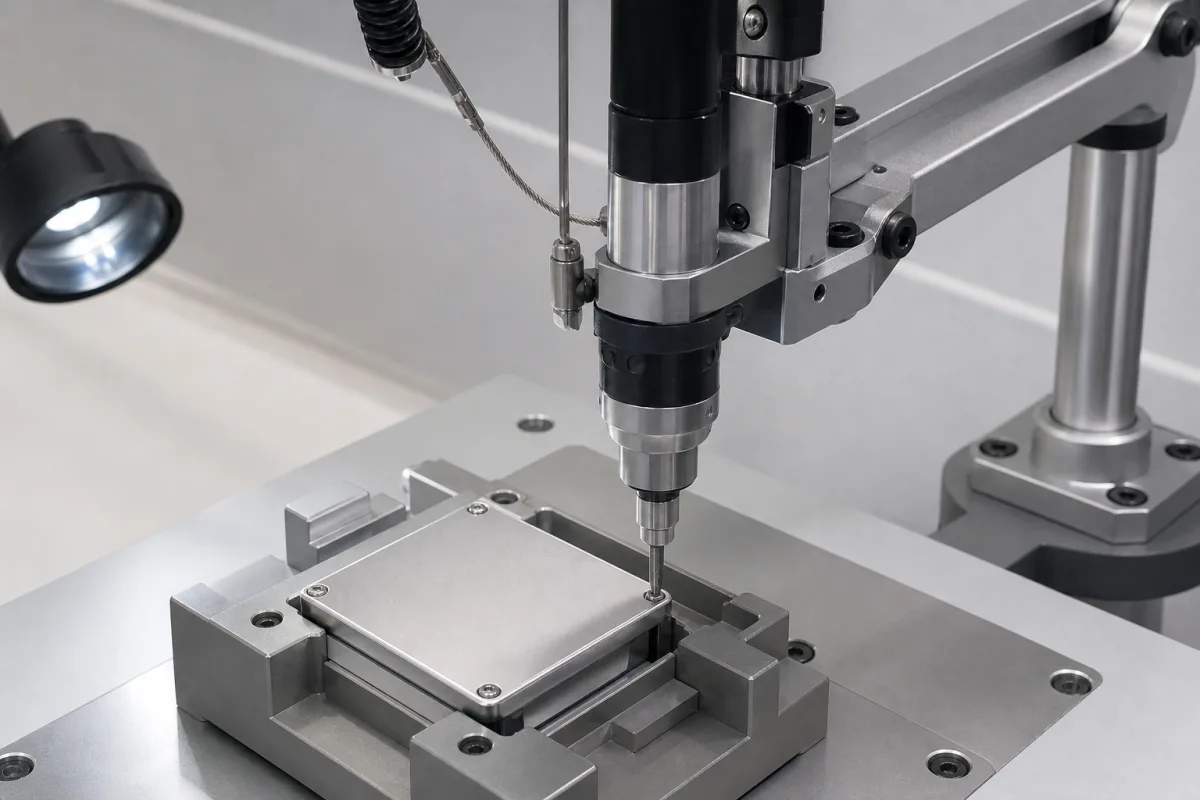
Low-torque electric screwdriver on a reaction arm for M2–M3 screws in RF shield lids and electronic housings
Bench fastening of M2 to M3 screws in electronics · current-controlled drivers from 0.02 N·m, held vertical on a reaction arm
Screws that hold a shield lid, a module cover or a small housing to a circuit board or chassis are M2 to M3 and need well under 2 N·m. On a bench they are driven by a low-torque electric screwdriver whose controller cuts motor power at the set torque, and the screwdriver hangs on an articulated reaction arm that keeps it vertical over the workpiece and takes the reaction off the operator's wrist. This page covers matching the driver's torque band to the screw and fitting the driver to the arm.
Corded, current-controlled or clutch electric screwdrivers below about 3 N·m, used with a torque reaction arm at an assembly bench for M2 to M3 screws in electronic assemblies such as shield lids, enclosures and module covers. Hand torque wrenches with their ISO 6789 types and classes are covered on the Torque wrench page; fixtured electric nutrunners for vehicle and powertrain joints are covered on the Fixtured electric nutrunner torque control system page.
CNFX editorial research · Sources checked October 12, 2026 · 3 sources
Put an M2 screw on a 0.05–0.5 N·m driver and an M3 on a 0.5–3 N·m driver
Kolver's low-torque catalogue splits small-screw drivers into three bands by rated torque. Its tables give the NATO50 at 0.05–0.5 N·m and 50–700 rpm, the MITO15 at 0.35–1.5 N·m and 450–850 rpm, and the PLUTO3 at 0.5–3 N·m and 370–1300 rpm, all with a 1/4 in hex bit drive; the NATO15 goes down to 0.02–0.27 N·m with a 4 mm half-moon bit. [1] The same catalogue warns that continuous use over 80% of the torque range is not recommended. [1]
The catalogue text and its tables do not agree on the ends of the low bands: the text gives MITO tools 0.2–1.5 N·m and NATO tools 0.01–0.5 N·m, while the model tables list MITO15 from 0.35 N·m and NATO from 0.02 or 0.05 N·m. [1] Ask the maker which figure applies to the tool being quoted.
For galvanized steel socket head screws in a steel thread at a friction coefficient of 0.12, a tightening torque table from Zimmer Group, taken from the Roloff/Matek Tabellenbuch, gives 0.35 N·m for M2, 0.73 N·m for M2.5 and 1.28 N·m for M3 in strength class 8.8, and 0.5, 1.02 and 1.8 N·m in class 10.9. [2] Screws into plastic bosses, PCB standoffs or thin sheet need the joint maker's own value; this table is for steel into steel.
Screw, class 8.8 (steel in steel)
Torque from the table
Driver band that covers it, below 80% of its maximum
Editorial calculation: PLUTO3 (0.5–3 N·m), 1.28 / 3 ≈ 43% of maximum; on MITO15 it would be ≈ 85% [1]
Editorial calculation reads Kolver's 80% caution as 80% of each model's maximum: 0.4 N·m for NATO50, 1.2 N·m for MITO15 and 2.4 N·m for PLUTO3.
02
Motor cut-off at the set torque and the ±5% scatter it leaves on an M2 screw
Kolver's EDU2AE control units convert 90–260 V AC mains to the tool's DC supply and cut power to the motor as soon as the preset torque is reached; multi-torque versions hold up to 8 settings for one driver. [1]
Kolver states that its software and switching transformer let MITO and PLUTO screwdrivers reach a +/- 5% precision all over the torque range, and gives a repeatability of +/-5% for PLUTO current-controlled tools. [1] It describes all NATO and MITO housings as ESD-safe. [1]
Editorial calculation: ±5% on an M2 setting of 0.35 N·m is ±0.0175 N·m, a band from about 0.33 to 0.37 N·m. Whether that scatter is acceptable depends on the screw maker's allowed torque window, which the request should state.
03
Reaction arm: 400–650 mm radius, 100 mm stroke, tool up to 52 mm diameter and 1.0 kg
Nitto Kohki's reaction arms for its delvo screwdrivers come as a swing type (DRA-SW-650), a slide type (DRA-SL-650) and a telescope type (DRA-TS-1000). The maker says the arms reduce the reaction force on the operator and that holding the driver vertical to the workpiece improves the quality of the work. [3]
The drawing for the swing arm carries the instruction not to run the screwdriver when the arm angle is smaller than 30°. [3] The arms are listed for all delvo models; Nitto Kohki does not list other makers' drivers. [3]
Editorial calculation, on dimensions only: Kolver lists the inline MITO15D at 33 mm diameter and 0.35 kg, the inline PLUTO3D at 40 mm and 0.55 kg, and the NATO50D at 33 mm and 0.25 kg [1], which all fall inside the 30–52 mm and 1.0 kg limits of the Nitto Kohki arms [3]. Clamp fit and reaction rating for a driver from another maker have to be confirmed with the arm supplier.
Paste it into your enquiry below or into an email to a maker, then replace every bracket.
Screws: [thread M2/M2.5/M3; head and drive type; screw material and class; what it threads into]
Torque: [target N·m; allowed window; joint maker's value]
Driver: [inline or pistol; current-controlled or clutch; ESD requirement; number of torque settings]
Arm: [radius needed over the fixture; vertical stroke; driver diameter and mass]
Bench: [mains voltage; space for the control unit; data output wanted]
Explore company information and manufacturing capabilities, then discuss the scope of your project with a relevant supplier.
Share this page
Compiled and source-reviewed by the CNFX editorial team.
Each manufacturer above links to the page on that company's own website where the product is listed, with the date we checked it. How we source and review
· Page last updated 13 October 2026
Buyer questions
Which driver covers an M2 screw at 0.35 N·m?
Editorial calculation: a 0.05–0.5 N·m driver such as Kolver's NATO50 puts 0.35 N·m at 70% of its maximum, under the 80% Kolver advises against for continuous use. [1][2]
How precise is a current-controlled screwdriver?
Kolver states a +/- 5% precision all over the torque range for its MITO and PLUTO screwdrivers. [1]
How heavy a screwdriver can a Nitto Kohki reaction arm carry?
The swing and slide arms take drivers of 30 to 52 mm diameter weighing up to 1.0 kg. [3]
Is there a minimum arm angle?
Yes. Nitto Kohki's drawing says not to run the screwdriver when the swing arm angle is smaller than 30°. [3]
Sources and what still needs a direct check
Sources checked 2026-10-12. Driver torque bands, control and precision come from Kolver's low-torque and PLUTO catalogue; screw torques from a Zimmer Group table based on Roloff/Matek; arm geometry from Nitto Kohki's reaction-arm leaflet. Values apply to the models named.