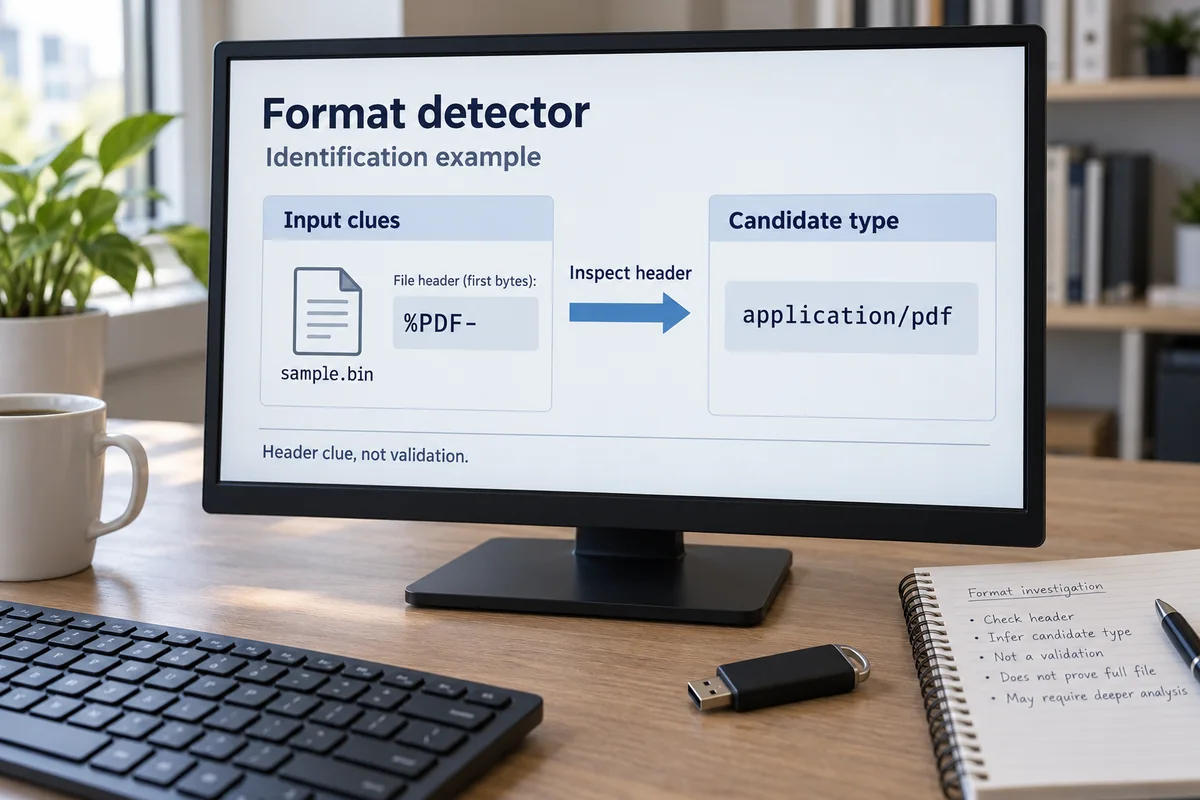
Recognizing file formats before selecting a parser
A detection result is useful only if the next processing stage knows what the identifier means and how it was obtained. Define the input evidence, required format detail and output vocabulary, then test the selected software and signature set against representative files.
Software components and tools that identify digital file formats from content signatures, names and container structure, illustrated by Apache Tika, DROID and the file project. This scope covers identification and its integration contract. Full document parsing, metadata-extraction platforms, network-protocol analyzers and industrial computer hardware are separate products.
CNFX editorial research · Sources checked October 19, 2026 · 3 sources
File bytes, name hints and container contents provide different evidence
Apache Tika’s 3.2.3 detection documentation describes magic-byte matching, filename hints and supplied content-type metadata. It says its Detector returns a MediaType representing its best estimate. A name or advertised type can refine a result, so record which hints the workflow supplies. [1]
The same documentation distinguishes recognizing a container, such as ZIP or OLE2, from identifying the format held inside. Its container-aware detection depends on the appropriate parser dependencies and TikaInputStream. Confirm the configured detection path for the file families you need; a header-only check and container inspection are different processing scopes. [1]
Build the acceptance set from the actual incoming corpus: renamed files, files with missing or misleading extensions, relevant container formats, empty files and incomplete inputs. Agree the required level of format/version detail before comparing detector results.
02
Choose an output vocabulary and preserve the identification status
The file project manual describes filesystem, magic and language tests, with the first successful test determining the default result. It also provides MIME-type/encoding output and an option to continue through matches. Fix those options when defining the integration contract. [3]
The file manual notes that failure to determine a type can be reported without changing the default process exit code. Capture the identification result and status explicitly; process completion alone is an insufficient routing decision. [3]
Keep file-format identity, text encoding and extracted document metadata as separate output fields. Agree what the next stage does when an identifier is absent, ambiguous or inconsistent with the supplied filename.
Accepted type vocabulary, hints and fallback routing.
Registry-linked format identification
DROID reports format/version information linked to PRONOM; its example output includes PUID and identification method. [2]
Required identifier/version detail and retained method/status fields.
Descriptive type or MIME/encoding
The file utility has descriptive and MIME/encoding output modes. [3]
Exact output mode, character-encoding handling and multiple-match policy.
03
Retain the signature set with each identification run
DROID’s project README describes internal signatures stored in XML files generated from PRONOM information. It supports signature updates and selection of installed signature files, including separate binary and container sets. Record the actual selected sets with the software version. [2]
Its documented interfaces include a Java desktop application and command-line use, with report output including CSV. Choose the integration and reporting scope needed by the repository rather than assuming that a file identifier also performs full document extraction. [2]
For a reproducible acceptance record, retain the input corpus identity, software and dependency versions, signature files, detector options and supplied hints. When rules change, compare classifications on that same corpus and review the changed results before altering downstream routing.
04
Measure identification quality on the deployment workload
Define expected results per file family, including unknown, conflicting and failed cases. Record correct identification, incorrect identification and unresolved results separately; also state whether success requires a broad type, a precise format or a specific version.
Specify CPU, memory, storage and runtime requirements for the software deployment. If an appliance is included, obtain its power, physical interfaces and environmental limits as a separate hardware specification. Software identification quality and latency require workload evidence; they are not analogue full-scale measurement tolerances.
Software responsibility
Acceptance information
Input-reading / processing layer
File or stream access, supplied name/type hints, size limits and container-inspection scope.
Signature and pattern-matching layer
Selected detectors, rule precedence, dependencies and handling of multiple or missing matches.
Format/signature registry
Rule-set provenance, versions, custom signatures and update responsibility.
Quality measurement
Labelled corpus, per-family result categories and the required identification detail.
Response time and throughput
File sizes and mix, container depth, concurrency, read limits, host configuration and measured latency/throughput.
Output and integration
Identifier vocabulary, method/status, encoding fields, report/API format and downstream routing.
05
Send a sample corpus and the required identification contract
Paste it into your enquiry below or into an email to a maker, then replace every bracket.
Explore company information and manufacturing capabilities, then discuss the scope of your project with a relevant supplier.
Share this page
Compiled and source-reviewed by the CNFX editorial team.
Test the detector's byte and filename evidence, signature version and unknown/mismatch outputs against the files and containers used by the integrating application. How we source and review
· Page last updated 19 October 2026
Buyer questions
Can header matching identify every format inside a container?
Tika’s cited documentation separates container recognition from container-aware identification and describes the additional dependencies and input handling required. [1]
Should DROID signature updates be recorded?
Its README supports updating and selecting signature files. Retain the selected binary/container sets with the software and run configuration. [2]
Does a successful file-command exit code prove a format was identified?
The manual says an undetermined type can be reported without changing the default exit code. Inspect the identification output and status. [3]
Sources and what still needs a direct check
Sources checked 2026-10-19. Tika’s cited page documents version 3.2.3 detection behaviour, not a recommendation of the newest release. DROID’s README and the file project manual describe their own interfaces and rule handling. These documents provide no measured performance for the reader’s corpus or deployment hardware.