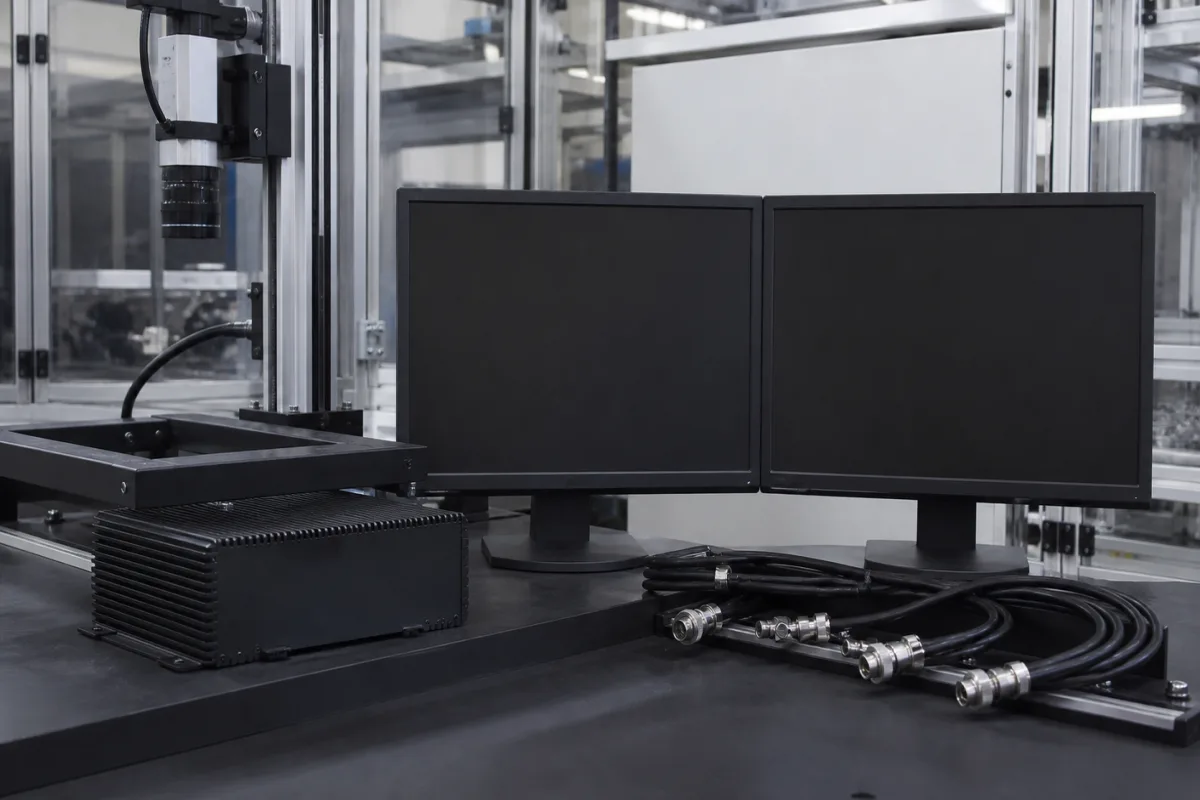
Image processing computer for PCB optical inspection: sizing CPU, GPUs and frame grabbers from pixel rate and defect-model speed
The computer that turns PCB inspection images into defect calls · 12 µm pixels at up to 60 cm²/s is about 42 Mpx/s from one orthogonal camera, against 115–157 tiles/s of model time per GPU and a 4U server with two GPUs and two frame grabbers
An automated optical inspection (AOI) machine for printed circuit boards is specified by resolution and inspection speed, but those two numbers fix a pixel rate that a computer has to absorb and analyse. Whether that computer is a single Core i7 PC or a rack server holding GPUs and frame grabbers follows from the pixels per second that arrive and the time the analysis spends on each. This page converts published AOI speed and resolution into a pixel and tile rate, sets it against measured defect-model speed, and looks at the slot layout of a server built for the job.
The image processing computers of PCB and electronics AOI systems, from the system PC inside a 3D AOI machine to rack servers carrying GPUs and frame grabbers, sized from resolution, inspection speed and the speed of the defect-detection software. Box PCs whose selling point is ruggedness are covered on the Industrial computer page; fanless vision boxes with built-in LED strobe drivers on the Image processing unit page; Jetson-based deep-learning boxes on the AI vision controller page; multi-camera vision controllers chosen by port count on the Vision processing unit page; the cards themselves on the Frame grabber and Interface board pages. Complete AOI machines are covered on the Automated optical inspection (AOI) system for PCB assembly page; cameras and optics are outside this page.
CNFX editorial research · Sources checked October 12, 2026 · 3 sources
12 µm pixels at up to 60 cm²/s: the image rate one orthogonal AOI camera hands the computer
Viscom's iS6052 3D AOI publishes the figures needed to work out its image load, and also what computer it runs on. [1]
Editorial calculation: a 50 mm field at 12 µm is about 4,170 pixels across, or 17.4 Mpx per field of view. At 60 cm²/s the machine covers 2.4 fields of 25 cm² per second, which is about 41.7 Mpx/s from the orthogonal camera alone. Angled cameras and 3D height data add to that, and the brochure does not give their resolution, so the total pixel rate cannot be worked out from it.
Editorial calculation: a full 508 mm × 508 mm board is 2,581 cm², about 43 s of inspection at 60 cm²/s; the computer must finish its analysis of each board inside that window, plus handling time, for the machine to hold its rated speed.
Give the AOI resolution, inspection speed, number and type of cameras, board size and line cycle time; ask the AOI or computer supplier what pixel rate the system computer is sized for.
02
115 to 157 frames per second on 640 × 640 PCB tiles: defect-model speed measured on one RTX 3090
Pei and co-authors (University of Science and Technology Beijing and partners) compared lightweight detectors on six PCB defect types (missing hole, mouse bite, open circuit, short circuit, spur, spurious copper), tiling 3,847 source images into 15,388 samples of 640 × 640 pixels. [2]
The test computer was a Dell Precision 7920 with an Intel Xeon Gold 6133 at 2.50 GHz and an NVIDIA GeForce RTX 3090 with 24 GB, running PyTorch 2.0. FPS was counted as images divided by the synchronized model-forward execution time, so image loading, pre-processing and post-processing are excluded. [2]
Editorial calculation: one 17.4 Mpx field of view holds about 42 non-overlapping 640 × 640 tiles, so 2.4 fields per second from the orthogonal camera is about 102 tiles per second. At the paper's 157.15 FPS (6.4 ms per tile), that alone would occupy about 65% of one RTX 3090's model time, before overlap between tiles, angled-camera images, pre- and post-processing are added. The comparison mixes a Viscom machine and a research model and is a sizing illustration, not a measurement of either.
Editorial note: the slowest and fastest detectors in the table differ by 36% in frame rate (115 against 157 FPS), so the model choice changes the GPU count as much as the camera does. Ask for end-to-end images per second measured on the proposed computer with the actual inspection software.
State whether the inspection uses rule-based algorithms, deep learning or both, the tile size and overlap, and the board cycle time, and ask for a measured end-to-end throughput, not model-only FPS.
03
Five x16 and two x8 slots for two GPUs, two frame grabbers and a 100GbE SmartNIC: an AOI server built on AMD EPYC
When the image load outgrows a single PC, the computer becomes a server. Advantech's 2023 case study describes the platform it supplied in Japan to an image processing and inspection company building AOI for glass substrates, thin film and silicon wafer surfaces. [3]
Advantech states the requirement behind the build: for film inspection, AOI has to capture, transfer and analyse high-resolution images continuously during roll-to-roll transport of sheets, films and metal foils, which raises system temperatures, so the platform had to be industrial grade and withstand long-duration operation at extreme temperatures. It gives product longevity of up to five years. [3]
Editorial calculation: two dual-slot GPUs and two frame grabbers take four of the seven PCIe links the board offers and at least six slot widths in the chassis, leaving three links for further capture, motion control or network cards. With two GPUs, the per-GPU figure in the previous section doubles to about 314 tiles per second of model time if the work splits evenly.
List every card the computer must hold (GPUs and their slot width, frame grabbers, motion or I/O cards, network cards), the PCIe lanes each needs, and the cabinet temperature, and ask for the slot map.
04
What to send for an AOI image processing computer
Paste it into your enquiry below or into an email to a maker, then replace every bracket.
AOI: [resolution; field of view; inspection speed; cameras]
Boards: [size; images per board; cycle time]
Software: [rule-based / deep learning; model; tile size]
Cards: [GPUs; frame grabbers; network; motion]
Form factor: [system PC / rack server]
Environment: [temperature; continuous duty]
Support: [product longevity; OS]
Explore company information and manufacturing capabilities, then discuss the scope of your project with a relevant supplier.
Share this page
Compiled and source-reviewed by the CNFX editorial team.
Each manufacturer above links to the page on that company's own website where the product is listed, with the date we checked it. How we source and review
· Page last updated 13 October 2026
Buyer questions
What computer runs inside a PCB AOI machine?
Viscom lists a Windows system computer with an Intel Core i7 for its iS6052 3D AOI, which inspects at 12 µm and up to 60 cm²/s. [1]
How many pixels per second does an AOI camera produce?
Editorial calculation from Viscom's figures: 12 µm resolution at 60 cm²/s is about 41.7 Mpx/s from the orthogonal camera, before angled and 3D images. [1]
How fast do PCB defect detection models run on a GPU?
On an RTX 3090, a 2026 Sensors study measured 115–157 frames per second for 640 × 640 PCB tiles, counting model-forward time only. [2]
What does a server-class AOI computer contain?
Advantech's AOI server used a 4U chassis, an AMD EPYC 7003 board with five PCIe x16 and two x8 links, two RTX GPUs, two frame grabbers and a dual 100GbE SmartNIC. [3]
Sources and what still needs a direct check
Sources checked 2026-10-12. AOI resolution, field of view, speed and system computer come from Viscom's iS6052 brochure; detector speeds, accuracy and the test computer from Pei et al. in Sensors (2026); the server configuration and its requirements from Advantech's 2023 AOI case study.