Industry-Verified Manufacturing Data (2026)

Input Circuitry

Based on aggregated insights from multiple verified factory profiles within the CNFX directory, the standard Input Circuitry used in the Computer, Electronic and Optical Product Manufacturing sector typically supports operational capacities ranging from standard industrial configurations to heavy-duty production requirements.

Technical Definition & Core Assembly

A canonical Input Circuitry is characterized by the integration of Input Connector and Protection Circuit. In industrial production environments, manufacturers listed on CNFX commonly emphasize Printed Circuit Board (PCB) construction to support stable, high-cycle operation across diverse manufacturing scenarios.

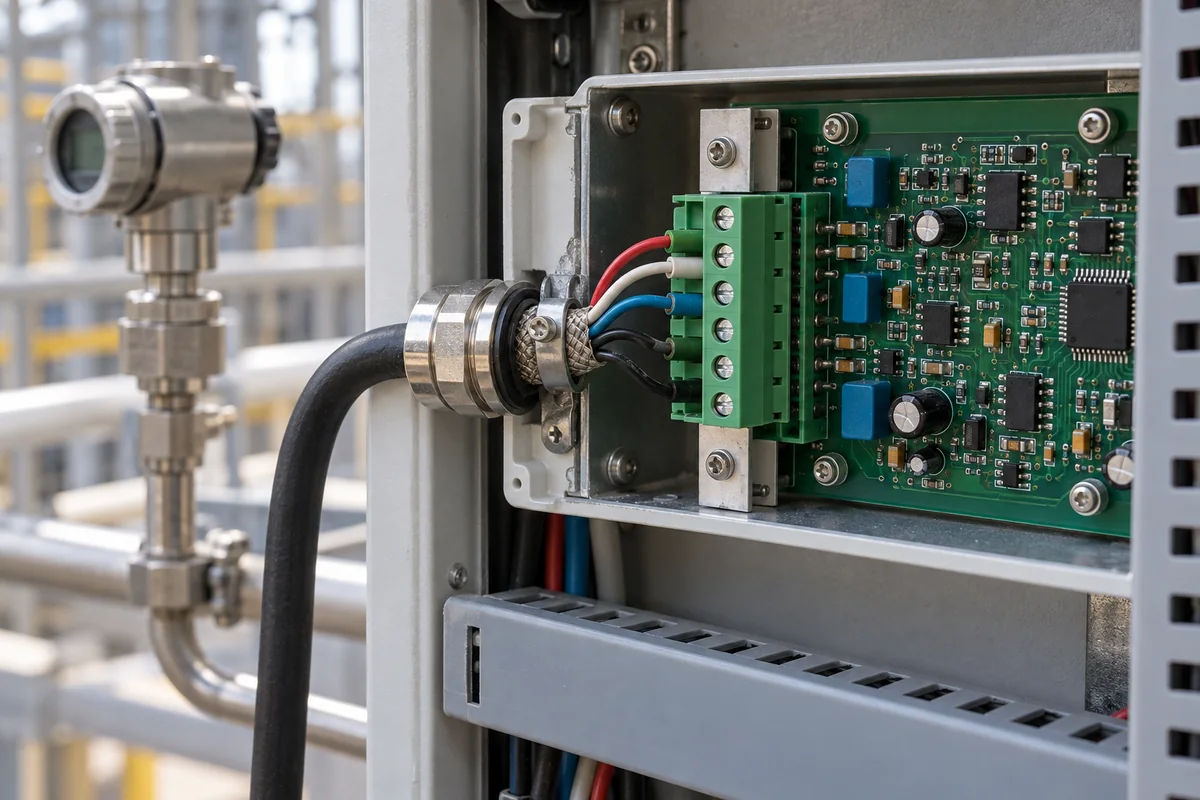
The electronic circuit within a signal conditioner that receives and initially processes input signals from sensors or other sources.
Product Specifications

Technical details and manufacturing context for Input Circuitry

Definition
Input circuitry is the front-end electronic subsystem of signal conditioners responsible for receiving raw electrical signals from various sensors, transducers, or measurement devices. It performs initial signal processing tasks such as impedance matching, filtering, amplification, isolation, and protection to prepare the signal for further conditioning, conversion, or transmission within the system.
Working Principle
Input circuitry operates by receiving electrical signals through input terminals, then applying various electronic functions including: impedance transformation to match source and load characteristics, filtering to remove unwanted noise and interference, amplification to boost weak signals to usable levels, isolation to prevent ground loops and protect downstream components, and protection against overvoltage, overcurrent, and electromagnetic interference. The processed signal is then passed to subsequent stages of the signal conditioner.
Common Materials
Printed Circuit Board (PCB), Semiconductor components (ICs, transistors, diodes), Passive components (resistors, capacitors, inductors), Connectors and terminals
Technical Parameters
  • Input voltage range specification (V) Per Request
Components / BOM
  • Input Connector
    Provides physical interface for connecting external signal sources
    Material: metal/plastic composite
  • Protection Circuit
    Safeguards against overvoltage, overcurrent, and electrostatic discharge
    Material: semiconductor components, resistors
  • Input Amplifier
    Amplifies weak input signals to usable levels
    Material: integrated circuits, transistors
  • Filter Network
    Removes unwanted noise and interference from the input signal
    Material: capacitors, inductors, resistors
Engineering Reasoning
0-10 VDC, -10 to +10 VDC differential, 4-20 mA
Input voltage exceeding ±15 VDC, input current exceeding 25 mA, common-mode voltage exceeding ±12 VDC
Design Rationale: Semiconductor junction breakdown at 15 V reverse bias, thermal runaway in input transistors at 25 mA, dielectric breakdown in isolation barriers at 12 V common-mode
Risk Mitigation (FMEA)
Trigger Electrostatic discharge (ESD) event exceeding 8 kV HBM
Mode: Gate oxide rupture in input MOSFETs causing permanent short circuit
Strategy: Integrated ESD protection diodes with 8 kV HBM rating and 1.5 Ω series resistance
Trigger Common-mode voltage transient exceeding 12 VDC for >100 μs
Mode: Breakdown of isolation barrier causing ground loop and signal corruption
Strategy: Optocoupler isolation with 1500 Vrms rating and 10 MΩ isolation resistance

Industry Taxonomies & Aliases

Commonly used trade names and technical identifiers for Input Circuitry.

Applied To / Applications

This component is essential for the following industrial systems and equipment:

Industrial Ecosystem & Supply Chain DNA

Complementary Systems
Downstream Applications
Specialized Tooling

Application Fit & Sizing Matrix

Operational Limits
pressure: Not applicable (internal circuit)
other spec: Input signal range: ±10V, ±20mA, 0-5V, 4-20mA
temperature: -40°C to +85°C
Media Compatibility
✓ Thermocouple signals (Type J/K/T) ✓ Strain gauge bridge outputs ✓ RTD (Resistance Temperature Detector) inputs
Unsuitable: High-voltage AC power lines (>100V AC)
Sizing Data Required
  • Input signal type (voltage/current/resistance)
  • Required input impedance (ohms)
  • Required isolation voltage (V)

Reliability & Engineering Risk Analysis

Failure Mode & Root Cause
Electrical Overstress
Cause: Voltage spikes, current surges, or electrostatic discharge exceeding component ratings, often from power supply instability, switching transients, or improper handling.
Thermal Fatigue
Cause: Repeated heating and cooling cycles causing solder joint cracks, delamination, or semiconductor degradation due to poor heat dissipation, high ambient temperatures, or cyclic power loading.
Maintenance Indicators
  • Intermittent operation or unexpected shutdowns, indicating loose connections, failing components, or thermal issues.
  • Audible buzzing, arcing sounds, or unusual odors (e.g., burning insulation), suggesting electrical faults, overheating, or component breakdown.
Engineering Tips
  • Implement thermal management: Ensure adequate ventilation, use heat sinks or fans for high-power components, and monitor operating temperatures to prevent thermal stress.
  • Apply protective measures: Use surge protectors, voltage regulators, and proper grounding to shield circuitry from electrical transients and environmental contaminants.

Compliance & Manufacturing Standards

Reference Standards
ISO 9001:2015 - Quality Management Systems IEC 61010-1:2010 - Safety requirements for electrical equipment for measurement, control, and laboratory use CE Marking - Conformité Européenne for electrical safety and EMC compliance
Manufacturing Precision
  • Component Placement: +/-0.1mm
  • Trace Width/Spacing: +/-10% of nominal dimension
Quality Inspection
  • In-Circuit Test (ICT) for electrical continuity and component verification
  • Automated Optical Inspection (AOI) for solder joint quality and component placement accuracy

Factories Producing Input Circuitry

Verified manufacturers with capability to produce this product in China

✓ 97% Supplier Capability Match Found

S Sourcing Manager from Canada Feb 21, 2026
★★★★★
"Found 38+ suppliers for Input Circuitry on CNFX, but this spec remains the most cost-effective."
Technical Specifications Verified
P Procurement Specialist from United States Feb 18, 2026
★★★★☆
"The technical documentation for this Input Circuitry is very thorough, especially regarding technical reliability. (Delivery took slightly longer than expected, but technical support was excellent.)"
Technical Specifications Verified
T Technical Director from United Arab Emirates Feb 15, 2026
★★★★★
"Reliable performance in harsh Computer, Electronic and Optical Product Manufacturing environments. No issues with the Input Circuitry so far."
Technical Specifications Verified
Verification Protocol

“Feedback is collected from verified sourcing managers during RFQ (Request for Quote) and factory evaluation processes on CNFX. These reports represent historical performance data and technical audit summaries from our B2B manufacturing network.”

16 sourcing managers are analyzing this specification now. Last inquiry for Input Circuitry from Mexico (46m ago).

Supply Chain Compatible Machinery & Devices

Industrial Smart Camera Module

Embedded vision system for industrial automation and quality inspection.

Explore Specs →
Industrial Wireless Power Transfer Module

Wireless power transfer module for industrial equipment applications

Explore Specs →
Industrial Smart Sensor Module

Modular industrial sensor with embedded processing and wireless connectivity

Explore Specs →
Surface Mount Resistor

Passive electronic component for current limiting and voltage division in circuits

Explore Specs →

Frequently Asked Questions

What is the primary function of input circuitry in signal conditioners?

The input circuitry receives raw signals from sensors or external sources and performs initial processing including protection against voltage spikes, signal amplification to usable levels, and filtering to remove noise before further conditioning.

What protection features are typically included in industrial input circuitry?

Industrial input circuits incorporate protection against overvoltage, reverse polarity, electromagnetic interference (EMI), and electrostatic discharge (ESD) using components like transient voltage suppressors, diodes, and isolation barriers.

How does the filter network in input circuitry improve signal quality?

The filter network removes unwanted frequencies and noise from input signals using passive components (resistors, capacitors, inductors) or active filtering circuits, ensuring clean, accurate signals for downstream processing and measurement.

Can I contact factories directly on CNFX?

CNFX is an open directory, not a transaction platform. Each factory profile provides direct contact information and production details to help you initiate direct inquiries with Chinese suppliers.

Get Quote for Input Circuitry

Request technical pricing, lead times, or customized specifications for Input Circuitry directly from verified manufacturing units.

Your business information is encrypted and only shared with verified Input Circuitry suppliers.

Thank you! Your message has been sent. We'll respond within 1–3 business days.

Need to Manufacture Input Circuitry?

Connect with verified factories specializing in this product category

Add Your Factory Contact Us
Previous Product
Input Circuit
Next Product
Input Conditioning Circuit