Industry-Verified Manufacturing Data (2026)

Signal Conditioners

Based on aggregated insights from multiple verified factory profiles within the CNFX directory, the standard Signal Conditioners used in the Machinery and Equipment Manufacturing sector typically supports operational capacities ranging from standard industrial configurations to heavy-duty production requirements.

Technical Definition & Core Assembly

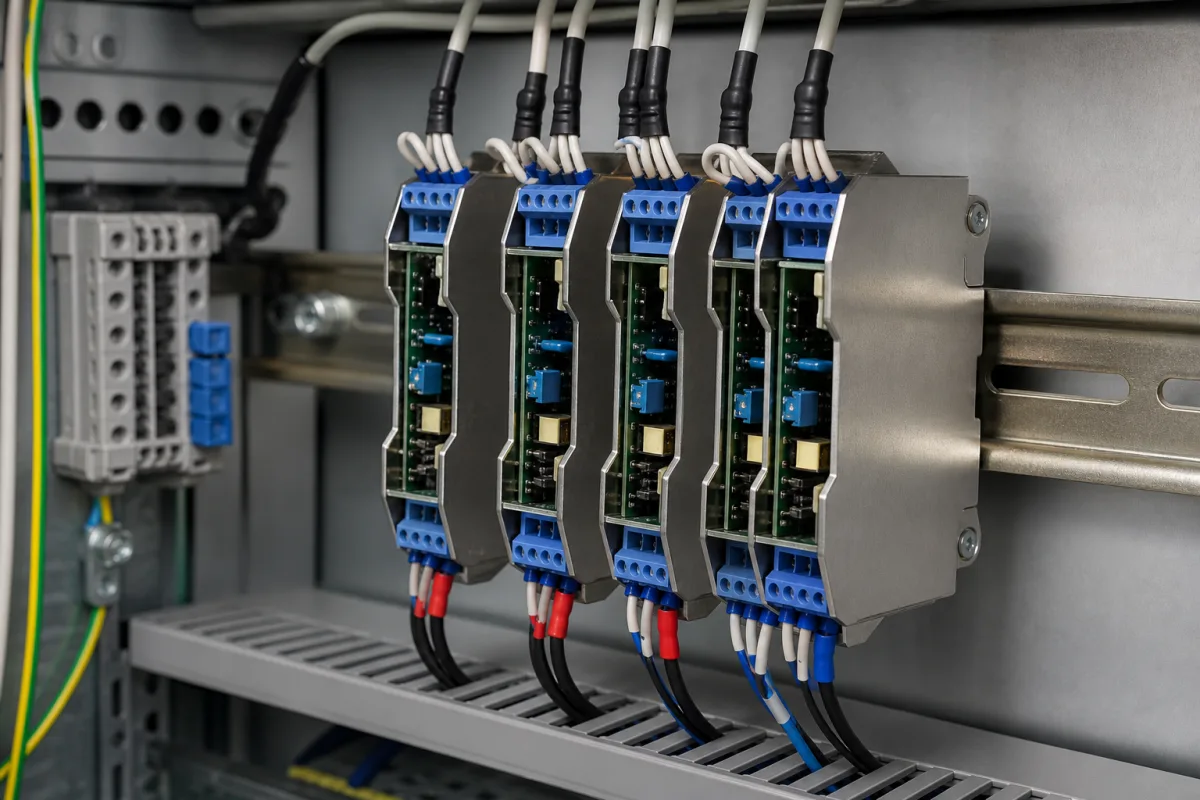
A canonical Signal Conditioners is characterized by the integration of Input Circuitry and Signal Processing Unit. In industrial production environments, manufacturers listed on CNFX commonly emphasize Printed Circuit Board (PCB) construction to support stable, high-cycle operation across diverse manufacturing scenarios.

Electronic devices that modify electrical signals to make them suitable for processing by control systems
Product Specifications

Technical details and manufacturing context for Signal Conditioners

Definition
Signal conditioners are critical components within Process Control Panels that receive raw signals from sensors (such as thermocouples, RTDs, pressure transducers) and convert, amplify, filter, isolate, or linearize these signals to standardized levels (typically 4-20mA or 0-10V) that can be accurately interpreted by PLCs, DCS, or other control equipment. They ensure signal integrity, reduce noise, provide electrical isolation, and enable reliable communication between field instruments and control systems.
Working Principle
Signal conditioners operate by receiving low-level, non-standard, or noisy input signals from sensors, then processing them through amplification circuits, filtering components, isolation barriers, and conversion modules. They typically include input conditioning (amplification/filtering), signal conversion (to standardized industrial signals), electrical isolation (to prevent ground loops and noise), and output conditioning. Advanced units may include linearization for non-linear sensors, cold junction compensation for thermocouples, and diagnostic capabilities.
Common Materials
Printed Circuit Board (PCB), Electronic components (ICs, resistors, capacitors), Plastic/polycarbonate housing, Copper connectors, Isolation transformers/optocouplers
Technical Parameters
  • DIN rail mounting dimensions (typically 22.5mm or 35mm width) (mm) Per Request
Components / BOM
  • Input Circuitry
    Receives and initially processes raw sensor signals, includes protection against overvoltage and reverse polarity
    Material: PCB with electronic components
  • Signal Processing Unit
    Amplifies, filters, linearizes, and converts signals to standardized formats
    Material: Integrated circuits, operational amplifiers
  • Isolation Barrier
    Provides electrical isolation between input, output, and power circuits to prevent ground loops and noise
    Material: Optocouplers, isolation transformers
  • Output Stage
    Delivers conditioned signal to control system at appropriate voltage/current levels
    Material: Transistors, output drivers, PCB traces
  • Terminal Blocks
    Connection points for input, output, and power wiring
    Material: Plastic housing with copper/silver-plated contacts
Engineering Reasoning
0-10 VDC input, 4-20 mA output, -40°C to 85°C ambient temperature
Input voltage exceeding ±15 VDC causes permanent damage to input protection diodes, output current exceeding 25 mA saturates output transistors
Design Rationale: Semiconductor junction breakdown at 0.7 V forward voltage/15 V reverse voltage for silicon diodes, thermal runaway in bipolar transistors at junction temperatures exceeding 150°C
Risk Mitigation (FMEA)
Trigger Common-mode voltage exceeding 30 VDC between input and ground reference
Mode: Input amplifier saturation causing signal distortion >5% of full scale
Strategy: Optical isolation with 2500 Vrms isolation rating and 100 MΩ isolation resistance
Trigger Ambient temperature cycling between -40°C and 85°C at 10°C/minute rate
Mode: Solder joint fatigue cracking after 5000 thermal cycles, increasing contact resistance to >100 mΩ
Strategy: Conformal coating with 0.5 mm thickness and CTE matching of 15 ppm/°C between PCB and components

Industry Taxonomies & Aliases

Commonly used trade names and technical identifiers for Signal Conditioners.

Applied To / Applications

This component is essential for the following industrial systems and equipment:

Industrial Ecosystem & Supply Chain DNA

Complementary Systems
Downstream Applications
Specialized Tooling

Application Fit & Sizing Matrix

Operational Limits
pressure: Not applicable (electronic device)
other spec: Input signal range: 0-10V, 4-20mA, thermocouple types; Output signal range: 0-10V, 4-20mA; Isolation voltage: 1500V RMS
temperature: -40°C to +85°C (operating range)
Media Compatibility
✓ Process control systems ✓ Industrial automation networks ✓ Laboratory measurement equipment
Unsuitable: High-voltage arc flash environments
Sizing Data Required
  • Input signal type and range
  • Required output signal type and range
  • Power supply voltage and isolation requirements

Reliability & Engineering Risk Analysis

Failure Mode & Root Cause
Signal Drift/Inaccuracy
Cause: Component aging (e.g., resistor/capacitor degradation), thermal stress from ambient temperature fluctuations, or contamination on circuit boards affecting impedance.
Complete Signal Loss/Output Failure
Cause: Power supply issues (voltage spikes, surges, or poor grounding), connector/cable faults (corrosion, loose terminals), or internal electronic component failure (e.g., blown ICs, damaged op-amps).
Maintenance Indicators
  • Erratic or unstable output readings on connected displays/controllers (e.g., fluctuating values when process is steady)
  • Audible buzzing/humming from the unit or visible signs of overheating (discoloration, burnt smell, hot casing)
Engineering Tips
  • Implement regular calibration checks and environmental controls (stable temperature/humidity) to minimize drift and thermal stress on sensitive components.
  • Use surge protection devices, ensure proper grounding/shielding, and inspect/clean electrical connections periodically to prevent power-related failures and corrosion.

Compliance & Manufacturing Standards

Reference Standards
IEC 61010-1: Safety requirements for electrical equipment for measurement, control, and laboratory use IEC 61326-1: Electromagnetic compatibility requirements for electrical equipment for measurement, control, and laboratory use ISO 9001: Quality management systems requirements
Manufacturing Precision
  • Input/Output linearity: +/-0.05% of full scale
  • Temperature stability: +/-0.01% per °C
Quality Inspection
  • Functional performance verification under simulated operating conditions
  • Environmental stress testing (temperature, humidity, vibration)

Factories Producing Signal Conditioners

Verified manufacturers with capability to produce this product in China

✓ 93% Supplier Capability Match Found

P Procurement Specialist from Germany Feb 12, 2026
★★★★★
"Testing the Signal Conditioners now; the technical reliability results are within 1% of the laboratory datasheet."
Technical Specifications Verified
T Technical Director from Brazil Feb 09, 2026
★★★★★
"Impressive build quality. Especially the technical reliability is very stable during long-term operation."
Technical Specifications Verified
P Project Engineer from Canada Feb 06, 2026
★★★★★
"As a professional in the Machinery and Equipment Manufacturing sector, I confirm this Signal Conditioners meets all ISO standards."
Technical Specifications Verified
Verification Protocol

“Feedback is collected from verified sourcing managers during RFQ (Request for Quote) and factory evaluation processes on CNFX. These reports represent historical performance data and technical audit summaries from our B2B manufacturing network.”

15 sourcing managers are analyzing this specification now. Last inquiry for Signal Conditioners from Turkey (1h ago).

Supply Chain Compatible Machinery & Devices

Automated Assembly Line System

Integrated production system for sequential component assembly operations

Explore Specs →
Automated Powder Coating System

Integrated industrial system for applying dry powder coatings to metal substrates.

Explore Specs →
Centrifugal Pump Impeller

Rotating component that transfers energy to fluid in centrifugal pumps.

Explore Specs →
High-Precision CNC Laser Cutting Machine

Computer-controlled industrial machine using focused laser beams to cut sheet metal with micron-level accuracy.

Explore Specs →

Frequently Asked Questions

What is the primary function of a signal conditioner in machinery manufacturing?

Signal conditioners modify electrical signals from sensors or instruments to make them suitable for processing by control systems, ensuring accurate data transmission and system reliability in industrial environments.

Why is isolation important in signal conditioners for industrial equipment?

Isolation barriers (using transformers or optocouplers) protect control systems from electrical noise, ground loops, and voltage spikes, preventing damage and ensuring signal integrity in harsh manufacturing environments.

What materials ensure durability in industrial signal conditioners?

Industrial signal conditioners use polycarbonate/plastic housings for impact resistance, copper connectors for reliable conductivity, and PCB-mounted components designed to withstand vibration, temperature variations, and contaminants common in machinery settings.

Can I contact factories directly on CNFX?

CNFX is an open directory, not a transaction platform. Each factory profile provides direct contact information and production details to help you initiate direct inquiries with Chinese suppliers.

Get Quote for Signal Conditioners

Request technical pricing, lead times, or customized specifications for Signal Conditioners directly from verified manufacturing units.

Your business information is encrypted and only shared with verified Signal Conditioners suppliers.

Thank you! Your message has been sent. We'll respond within 1–3 business days.

Need to Manufacture Signal Conditioners?

Connect with verified factories specializing in this product category

Add Your Factory Contact Us
Previous Product
Signal Conditioner/Amplifier
Next Product
Signal Converter