Industry-Verified Manufacturing Data (2026)

Filter Network

Based on aggregated insights from multiple verified factory profiles within the CNFX directory, the standard Filter Network used in the Computer, Electronic and Optical Product Manufacturing sector typically supports operational capacities ranging from standard industrial configurations to heavy-duty production requirements.

Technical Definition & Core Assembly

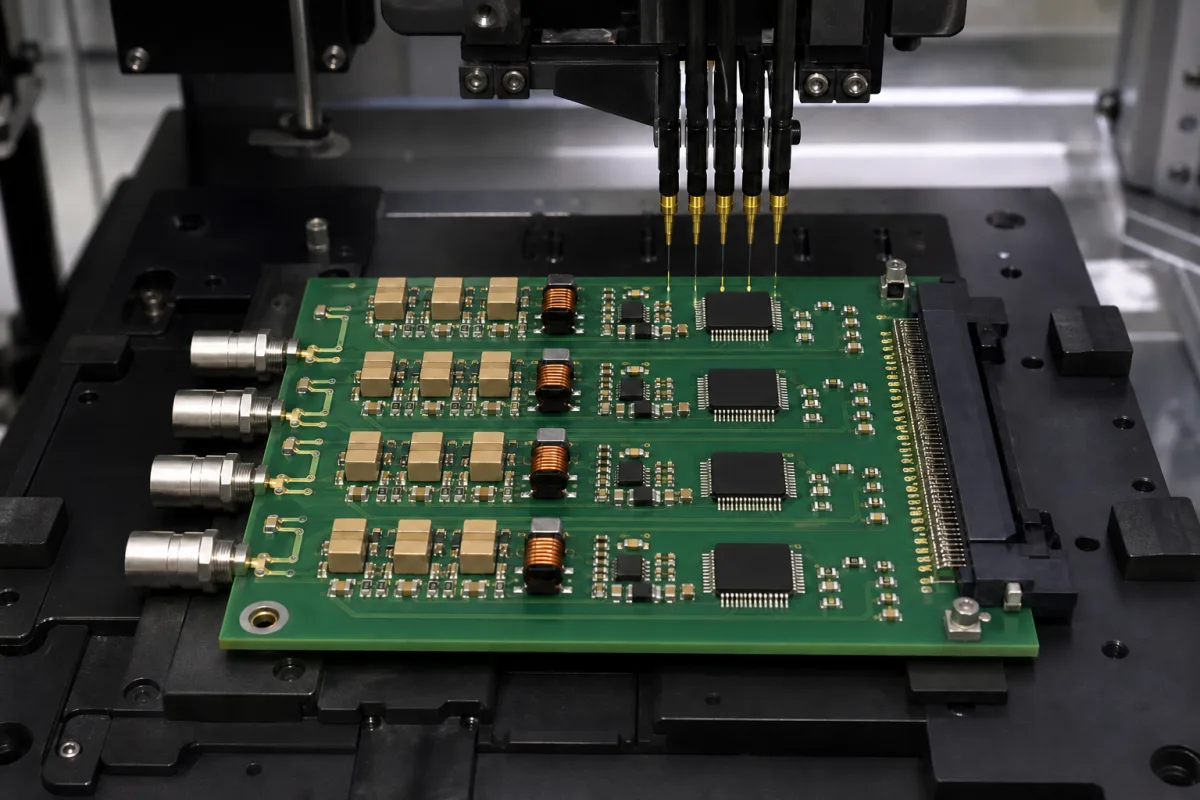
A canonical Filter Network is characterized by the integration of Capacitor and Inductor. In industrial production environments, manufacturers listed on CNFX commonly emphasize Ceramic capacitors construction to support stable, high-cycle operation across diverse manufacturing scenarios.

A circuit component within a signal conditioning system that selectively passes or blocks specific frequency ranges to remove noise and unwanted signals.
Product Specifications

Technical details and manufacturing context for Filter Network

Definition
A filter network is an essential part of a signal conditioning circuit that processes electrical signals by attenuating or eliminating certain frequency components while allowing others to pass through. It plays a critical role in improving signal quality by removing electromagnetic interference, harmonics, and other noise from the desired signal before further processing or measurement.
Working Principle
Filter networks operate based on the frequency-dependent impedance characteristics of their components (resistors, capacitors, and inductors). Different configurations (low-pass, high-pass, band-pass, band-stop) create specific frequency response curves that determine which signal frequencies are attenuated and which are transmitted with minimal loss.
Common Materials
Ceramic capacitors, Film capacitors, Ferrite cores, Copper wire, PCB substrate
Technical Parameters
  • Cutoff frequency or center frequency defining the filter's operational range (Hz) Customizable
Components / BOM
  • Capacitor
    Stores electrical energy and provides frequency-dependent impedance
    Material: ceramic/film dielectric with metal electrodes
  • Inductor
    Stores magnetic energy and provides frequency-dependent impedance
    Material: copper wire wound around ferrite/air core
  • Resistor
    Provides resistance to control filter characteristics and damping
    Material: carbon film/metal film
  • PCB Traces
    Interconnects filter components and provides signal paths
    Material: copper on FR-4 substrate
Engineering Reasoning
0.1 Hz - 100 MHz
Q-factor degradation below 0.7 or insertion loss exceeding 3 dB beyond cutoff frequency
Design Rationale: Dielectric breakdown in capacitor elements at voltages exceeding 50 VDC or thermal expansion mismatch between ceramic substrates and solder joints at temperatures above 125°C
Risk Mitigation (FMEA)
Trigger Electrostatic discharge exceeding 8 kV
Mode: Dielectric breakdown in filtering capacitors
Strategy: TVS diodes with clamping voltage of 5.8 V and response time of 1 ns
Trigger Thermal cycling between -40°C and 85°C at 10 cycles/hour
Mode: Solder joint fatigue leading to increased series resistance
Strategy: SnAgCu solder alloy with creep resistance and ceramic substrates with CTE of 7 ppm/°C

Industry Taxonomies & Aliases

Commonly used trade names and technical identifiers for Filter Network.

Applied To / Applications

This component is essential for the following industrial systems and equipment:

Industrial Ecosystem & Supply Chain DNA

Complementary Systems
Downstream Applications
Specialized Tooling

Application Fit & Sizing Matrix

Operational Limits
pressure: 0 to 100 psi
other spec: Frequency range: 1 Hz to 100 MHz, Impedance: 50 Ω or 75 Ω
temperature: -40°C to +85°C
Media Compatibility
✓ Clean air/gas streams ✓ Low-viscosity liquids ✓ Electronic signal lines
Unsuitable: High-particulate slurry environments
Sizing Data Required
  • Required frequency range (Hz)
  • Signal amplitude (V)
  • Impedance matching requirement (Ω)

Reliability & Engineering Risk Analysis

Failure Mode & Root Cause
Clogging/Blockage
Cause: Accumulation of particulate matter, scale, or debris in the filter media or housing due to inadequate pre-filtration, high contaminant loading, or improper media selection for the application.
Media Degradation/Breakthrough
Cause: Physical or chemical deterioration of the filter media (e.g., tearing, swelling, chemical attack) from excessive pressure differentials, incompatible fluids, thermal stress, or fatigue from cyclic loading, leading to loss of filtration efficiency and particle bypass.
Maintenance Indicators
  • Sustained high differential pressure (ΔP) across the filter exceeding manufacturer's specified limits, indicating severe clogging or flow restriction.
  • Visible particulate contamination downstream of the filter in clear sight glasses or sample points, signaling media failure or bypass.
Engineering Tips
  • Implement condition-based monitoring using real-time differential pressure transmitters with alarms set at 80-90% of the maximum allowable ΔP to trigger proactive element changes before failure.
  • Select and size filter media based on actual particle size distribution (PSD) analysis of the fluid, ensuring adequate dirt-holding capacity and compatibility with fluid chemistry and operating temperature ranges.

Compliance & Manufacturing Standards

Reference Standards
ISO 16889:2022 (Hydraulic fluid power - Filter elements - Multi-pass method for evaluating filtration performance) ANSI/ASME B40.100 (Pressure Gauges and Gauge Attachments - includes filter pressure ratings) DIN 24550 (Filter elements; dimensions, requirements, testing)
Manufacturing Precision
  • Particle retention rating: +/-10% of nominal micron rating
  • Pressure drop: +/-5% of specified value at rated flow
Quality Inspection
  • Multi-pass filtration efficiency test (ISO 16889)
  • Burst pressure test (hydrostatic pressure to failure)

Factories Producing Filter Network

Verified manufacturers with capability to produce this product in China

✓ 95% Supplier Capability Match Found

S Sourcing Manager from Brazil Feb 05, 2026
★★★★★
"Reliable performance in harsh Computer, Electronic and Optical Product Manufacturing environments. No issues with the Filter Network so far."
Technical Specifications Verified
P Procurement Specialist from Canada Feb 02, 2026
★★★★☆
"Testing the Filter Network now; the technical reliability results are within 1% of the laboratory datasheet. (Delivery took slightly longer than expected, but technical support was excellent.)"
Technical Specifications Verified
T Technical Director from United States Jan 30, 2026
★★★★★
"Impressive build quality. Especially the technical reliability is very stable during long-term operation."
Technical Specifications Verified
Verification Protocol

“Feedback is collected from verified sourcing managers during RFQ (Request for Quote) and factory evaluation processes on CNFX. These reports represent historical performance data and technical audit summaries from our B2B manufacturing network.”

17 sourcing managers are analyzing this specification now. Last inquiry for Filter Network from India (1h ago).

Supply Chain Compatible Machinery & Devices

Industrial IoT Gateway

Edge computing device connecting industrial equipment to cloud platforms.

Explore Specs →
Modular Industrial Edge Computing Device

Rugged computing platform for industrial data processing at the network edge

Explore Specs →
Industrial Smart Camera Module

Embedded vision system for industrial automation and quality inspection.

Explore Specs →
Industrial Wireless Power Transfer Module

Wireless power transfer module for industrial equipment applications

Explore Specs →

Frequently Asked Questions

What is the primary function of a Filter Network in electronic systems?

A Filter Network selectively passes or blocks specific frequency ranges within a signal conditioning system to remove electrical noise, interference, and unwanted signals, ensuring clean and reliable signal transmission.

What materials are commonly used in manufacturing Filter Networks?

Common materials include ceramic capacitors and film capacitors for capacitance, ferrite cores for inductance and EMI suppression, copper wire for conductive paths, and PCB substrate as the base material for circuit integration.

How does a Filter Network improve system performance in optical and electronic products?

By eliminating noise and unwanted frequency components, Filter Networks enhance signal integrity, reduce electromagnetic interference (EMI), improve data accuracy, and increase the overall reliability and performance of computer, electronic, and optical systems.

Can I contact factories directly on CNFX?

CNFX is an open directory, not a transaction platform. Each factory profile provides direct contact information and production details to help you initiate direct inquiries with Chinese suppliers.

Get Quote for Filter Network

Request technical pricing, lead times, or customized specifications for Filter Network directly from verified manufacturing units.

Your business information is encrypted and only shared with verified Filter Network suppliers.

Thank you! Your message has been sent. We'll respond within 1–3 business days.

Need to Manufacture Filter Network?

Connect with verified factories specializing in this product category

Add Your Factory Contact Us
Previous Product
Filter Module
Next Product
Final Adder