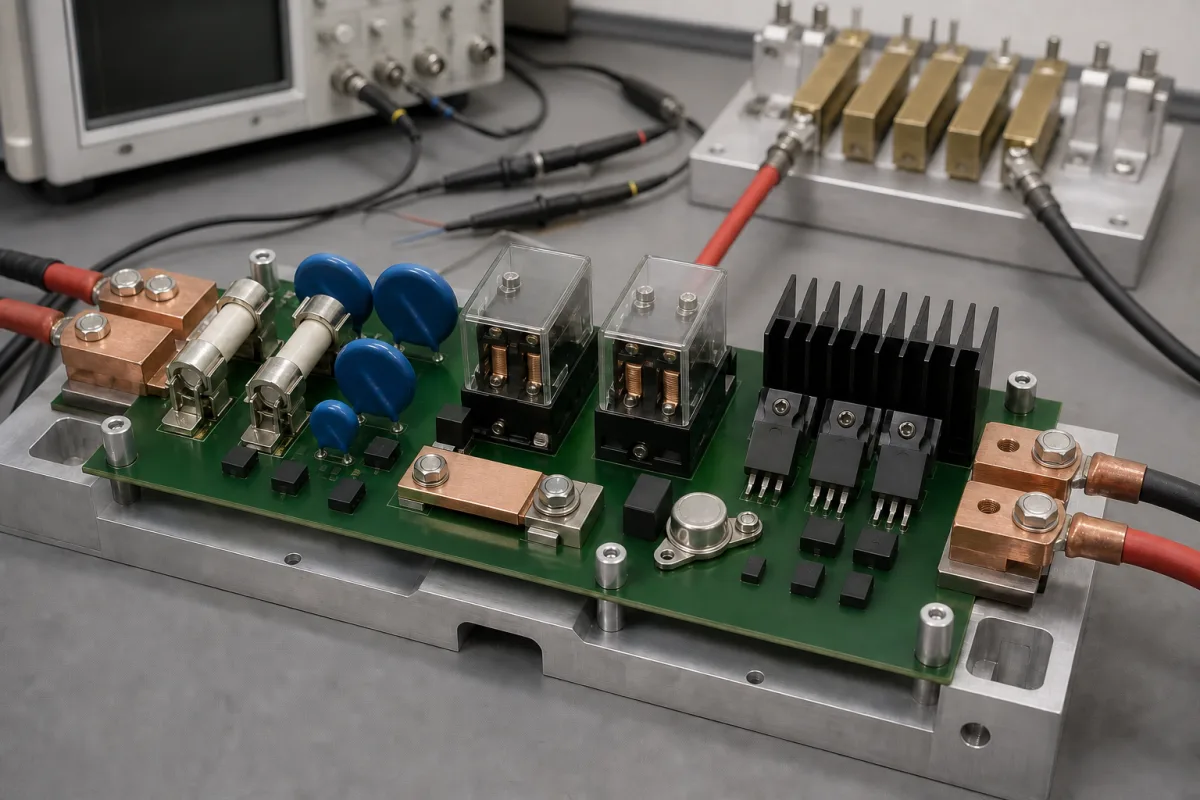
Board-level protection circuit (eFuse, TVS clamp and battery protection module)
Board-level protection · eFuse cut-off, TVS clamping and lithium battery protection modules: thresholds, response and fault behaviour
A board-level protection circuit is the part of a circuit board that detects an overvoltage, overcurrent, short circuit or overtemperature and then clamps the voltage or disconnects the load: a fuse or electronic switch, a clamp such as a TVS diode or varistor, current and voltage sensing, and, in a lithium pack, a protection IC driving charge and discharge MOSFETs. Ask three things first: which faults the circuit must handle, at what thresholds and how fast, and whether it should clamp, cut off, retry or latch off.
Protection circuits built onto a printed circuit board or supplied as a protection board: electronic fuses (eFuses) and MOSFET or relay cut-off stages for low-voltage DC inputs, TVS diode and varistor clamping on the board, and protection circuit modules (PCMs) for lithium-ion battery packs. Panel-mounted Type 1 and Type 2 surge protective devices for AC service entrances and distribution boards are covered on the Surge protection device page. Motor protection circuit breakers, miniature circuit breakers and fuses sold as stand-alone devices are outside this page.
CNFX editorial research · Sources checked October 12, 2026 · 5 sources
Set the cut-off thresholds and fault response for a DC input
Texas Instruments' TPS2660 is an example of an electronic fuse that replaces a separate fuse, reverse-polarity diode and overvoltage cut-off on a DC input. TI lists a 4.2 V to 60 V operating range with a 62 V absolute maximum, integrated reverse input polarity protection down to –60 V, back-to-back MOSFETs with 150 mΩ total on-resistance, and a current limit adjustable from 0.1 A to 2.23 A with ±5% accuracy at 1 A. [1]
The same device offers adjustable undervoltage lockout, overvoltage cut-off and output slew-rate control, a fixed 38 V overvoltage clamp on the TPS26602 variant, and a choice of fault response after a current-limit event: auto-retry, latch-off or circuit-breaker mode. TI states load protection during surge per IEC 61000-4-5 with minimum external components, a current monitor output with ±8.5% accuracy, quiescent current of 300 µA operating and 20 µA in shutdown, an operating temperature range of –40 °C to 125 °C, and UL 2367 recognition. [1]
Editorial calculation: on a 24 V input, the TPS26602's 38 V clamp is 38 ÷ 24 = 1.58 times the nominal voltage, and the 62 V absolute maximum leaves 62 − 38 = 24 V of margin above the clamp. [1] Ask the supplier which fault response the board is set to, because auto-retry and latch-off behave differently when a short persists.
Give the supplier the input voltage range and nominal value, the load current and inrush, the overvoltage and undervoltage cut-off points, the current limit and short-circuit response, whether reverse polarity must be blocked, the surge or transient test levels the input must pass, the fault response (retry or latch), the battery chemistry and cell count if it is a pack, the temperature range, and board size and connector limits.
02
Set the cell and pack limits on a lithium battery protection module
In a lithium-ion pack the protection circuit watches each cell. ABLIC's S-8261 single-cell protection IC shows the thresholds a module is built around: overcharge detection settable from 3.9 V to 4.5 V in 5 mV steps with ±25 mV accuracy at 25 °C and ±30 mV from –5 °C to 55 °C; overdischarge detection from 2.0 V to 3.0 V in 10 mV steps with ±50 mV accuracy; overcurrent 1 detection from 0.05 V to 0.3 V with ±15 mV accuracy; and a fixed 0.5 V overcurrent 2 level with ±100 mV accuracy. [3]
ABLIC states that the detection delays are generated internally with ±20% accuracy and that the IC has three-step overcurrent detection: overcurrent 1, overcurrent 2 and load short-circuiting. The VM and CO pins have a 28 V absolute maximum rating, current consumption is 3.5 µA typical and 7.0 µA maximum in operation, and the operating range is –40 °C to 85 °C. [3] The overcurrent levels are voltages, so the current at which a module trips depends on the sense resistance or MOSFET on-resistance it is measured across; ask the module maker for the trip currents, not only the IC setting.
At pack level, ATP Battery lists a 14-series protection board rated 200 A for charge and discharge with CAN bus, a fuel gauge, cell balancing and event logging. Its protections cover cell and pack overvoltage, cell and pack undervoltage, overcharge and overdischarge current, and high and low temperature in charging and discharging, and ATP states that the thresholds, recovery points and delays can be changed over the CAN bus. [4][5]
03
Compare clamping, cut-off and battery protection circuits
Three kinds of board-level protection appear in the sources reviewed. A clamp limits the voltage during a transient; a cut-off disconnects the load; a battery module does both detection and disconnection per cell.
Vishay's SMBJ series spans stand-off voltages of 5.0 V to 188 V with 600 W peak pulse power on a 10/1000 µs waveform and a junction range of –55 °C to 150 °C. [2] Editorial calculation: the SMBJ24A's maximum clamping voltage of 38.9 V is 1.62 times its 24 V stand-off voltage, and 600 W ÷ 38.9 V = 15.4 A, the peak pulse current in the same row. [2] Editorial note: a clamp rated at 38.9 V on a 24 V line still passes nearly 39 V to the load, so the components behind it, or an eFuse such as the TPS2660 with its 62 V absolute maximum, must tolerate that level. [1][2]
Circuit
Published example
Figures stated
TVS clamp
Vishay SMBJ24A, SMB package
Stand-off 24 V; breakdown 26.7–29.5 V; max clamping 38.9 V at 15.4 A; 600 W with 10/1000 µs waveform [2]
eFuse cut-off
TI TPS2660
4.2–60 V; 0.1–2.23 A limit; –60 V reverse; 150 mΩ [1]
Cell protection IC
ABLIC S-8261
Overcharge 3.9–4.5 V ±25 mV; overdischarge 2.0–3.0 V ±50 mV [3]
Pack protection board
ATP 14S PCM
14 series cells; 200 A charge and discharge; CAN-configurable limits [4]
04
Where comparator, sense resistor, MOSFET and TVS sit in the circuit
Part
Role
Fix in the order
Voltage comparator or protection IC
Compares cell or input voltage with set thresholds. [3]
Thresholds, accuracy, delays.
Current sense resistor
Converts load current to a voltage for overcurrent detection. [3]
Resistance, tolerance, power rating.
Switching element (MOSFET or relay)
Disconnects the load or charger; back-to-back MOSFETs block reverse current. [1]
Paste it into your enquiry below or into an email to a maker, then replace every bracket.
Input: [AC or DC; nominal and range; load and inrush current]
Overvoltage: [cut-off or clamp; threshold; surge test level]
Overcurrent: [trip current; short-circuit response; retry or latch]
Reverse polarity: [required or not]
Battery pack: [chemistry; cells in series; charge and discharge current; temperature limits; communication]
Board: [size; connectors; coating; temperature range]
1 company lists this product among what they make. Company figures are quoted from each
company's own website; every card states where the relationship came from.
ATP Battery
Manufacturing site to be confirmed for the order
Lists lithium battery protection circuit modules, including a 14S 200 A protection board with CAN bus, alongside lithium battery packs.
Explore company information and manufacturing capabilities, then discuss the scope of your project with a relevant supplier.
Share this page
Compiled and source-reviewed by the CNFX editorial team.
Each manufacturer above links to the page on that company's own website where the product is listed, with the date we checked it. How we source and review
· Page last updated 13 October 2026
Buyer questions
What is the difference between an eFuse and a TVS diode?
An eFuse such as TI's TPS2660 disconnects or limits the load at set voltage and current thresholds; a TVS diode such as Vishay's SMBJ24A clamps a transient, here to 38.9 V maximum at 15.4 A. [1][2]
What thresholds does a lithium battery protection circuit use?
ABLIC's S-8261 sets overcharge detection between 3.9 and 4.5 V per cell with ±25 mV accuracy and overdischarge detection between 2.0 and 3.0 V with ±50 mV accuracy. [3]
Can a battery protection board's limits be changed?
ATP Battery states that its 14S 200 A board's protection thresholds, recovery points and delays can be modified through the CAN bus. [4]
Sources and what still needs a direct check
Sources checked 2026-10-12. Texas Instruments, Vishay and ABLIC are semiconductor makers describing their own protection devices; ATP Battery describes its own battery protection boards.