Industry-Verified Manufacturing Data (2026)

Laser Diode

Based on aggregated insights from multiple verified factory profiles within the CNFX directory, the standard Laser Diode used in the Computer, Electronic and Optical Product Manufacturing sector typically supports operational capacities ranging from standard industrial configurations to heavy-duty production requirements.

Technical Definition & Core Assembly

A canonical Laser Diode is characterized by the integration of Semiconductor Chip and Heat Sink. In industrial production environments, manufacturers listed on CNFX commonly emphasize Gallium Arsenide (GaAs) construction to support stable, high-cycle operation across diverse manufacturing scenarios.

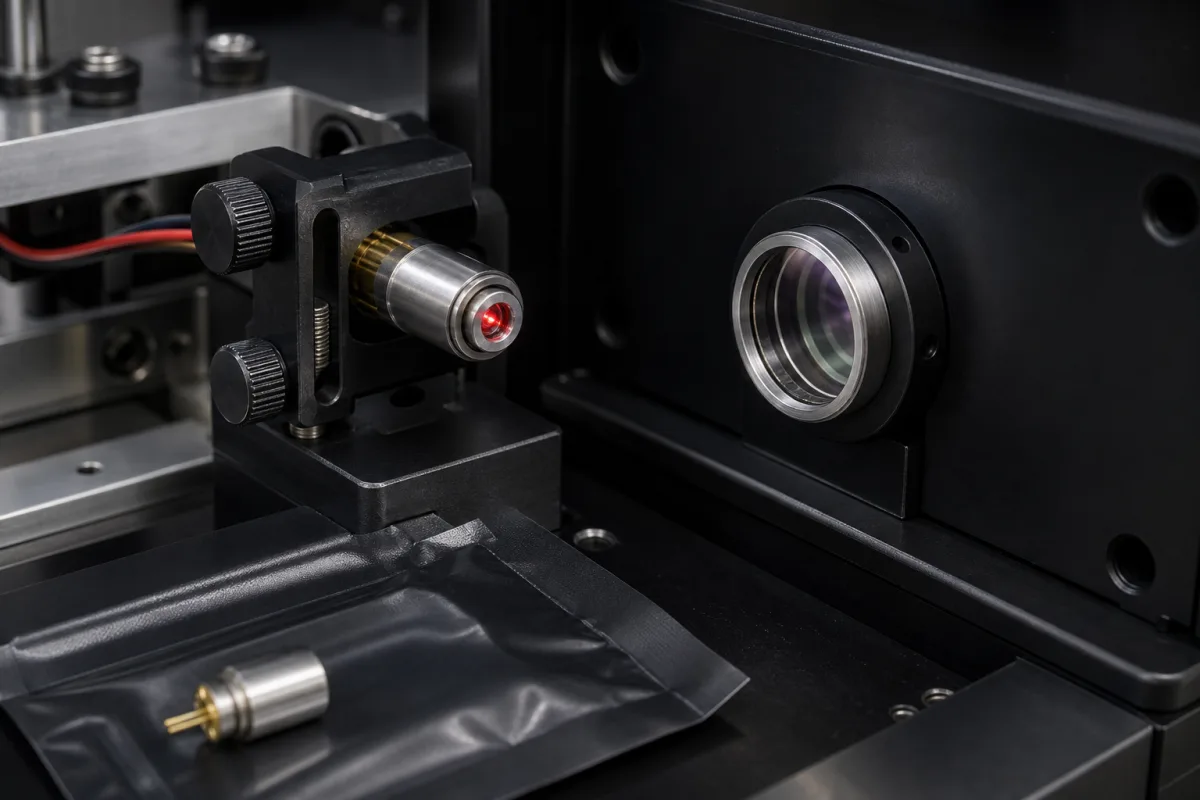
A semiconductor device that emits coherent light through stimulated emission, used as the light source in particulate matter sensors.
Product Specifications

Technical details and manufacturing context for Laser Diode

Definition
A laser diode is a key component in particulate matter sensors that generates a focused, coherent laser beam. Within the sensor system, it serves as the illumination source that interacts with airborne particles. When particles pass through the laser beam, they scatter light, which is then detected and analyzed to determine particle concentration, size distribution, and composition.
Working Principle
The laser diode operates on the principle of stimulated emission in a semiconductor p-n junction. When forward-biased with sufficient current, electrons and holes recombine in the active region, emitting photons. These photons are amplified through optical feedback within the resonant cavity, producing a coherent, monochromatic laser beam. In particulate matter sensors, this beam illuminates the sampling volume where particles scatter light according to Mie scattering theory.
Common Materials
Gallium Arsenide (GaAs), Indium Gallium Arsenide (InGaAs), Aluminum Gallium Arsenide (AlGaAs)
Technical Parameters
  • Wavelength of emitted laser light, typically in the visible or near-infrared range (e.g., 650nm, 780nm, 850nm) optimized for particle scattering efficiency (nm) Standard Spec
Components / BOM
  • Semiconductor Chip
    Active region where light emission occurs through electron-hole recombination
    Material: Gallium Arsenide (GaAs) or similar III-V compound semiconductor
  • Heat Sink
    Dissipates heat generated during operation to maintain stable performance and prevent thermal damage
    Material: Copper or Aluminum
  • Lens/Collimator
    Focuses and collimates the emitted laser beam for optimal illumination of the sampling volume
    Material: Glass or Optical Plastic
  • Package/Casing
    Protects the semiconductor chip from environmental factors and provides electrical connections
    Material: Ceramic or Metal
Engineering Reasoning
1.8-2.2 V forward voltage, 5-100 mA forward current, -40°C to +85°C ambient temperature
2.5 V forward voltage (permanent damage), 150 mA forward current (catastrophic failure), 125°C junction temperature (thermal runaway)
Design Rationale: Electromigration at high current densities (>10⁶ A/cm²) causing void formation in metal interconnects, catastrophic optical damage (COD) at power densities >10 MW/cm² due to facet heating exceeding 300°C, Auger recombination at high injection levels reducing quantum efficiency
Risk Mitigation (FMEA)
Trigger Electrostatic discharge (ESD) exceeding 500 V HBM
Mode: Catastrophic facet damage with immediate 100% optical power loss
Strategy: Integrated ESD protection diodes with 0.5 ns response time, hermetic TO-can packaging with 10¹² Ω-cm resistivity
Trigger Thermal impedance increase to 50 K/W due to solder voiding >15% area
Mode: Thermal runaway at 125°C junction temperature causing wavelength shift >5 nm
Strategy: AuSn eutectic solder with 25 μm thickness, diamond heat spreader with 2000 W/m·K conductivity, active temperature control with ±0.1°C stability

Industry Taxonomies & Aliases

Commonly used trade names and technical identifiers for Laser Diode.

Applied To / Applications

This component is essential for the following industrial systems and equipment:

Industrial Ecosystem & Supply Chain DNA

Complementary Systems
Downstream Applications
Specialized Tooling

Application Fit & Sizing Matrix

Operational Limits
pressure: Atmospheric to 1.5 bar (typical for sensor housings)
wavelength: 405nm to 1550nm (common ranges for PM sensors)
temperature: -40°C to +85°C (operating), -55°C to +100°C (storage)
current range: 10mA to 200mA (forward operating current)
optical power: 1mW to 100mW (typical for sensing applications)
Media Compatibility
✓ Clean air/gas streams ✓ Low-concentration particulate monitoring ✓ Controlled laboratory environments
Unsuitable: High-vibration industrial environments without proper isolation
Sizing Data Required
  • Required optical power output (mW)
  • Target wavelength for particle detection (nm)
  • Operating current/voltage specifications (mA/V)

Reliability & Engineering Risk Analysis

Failure Mode & Root Cause
Catastrophic Optical Damage (COD)
Cause: Excessive optical power density leading to localized overheating and melting of the semiconductor material, often due to current spikes, poor heat sinking, or contamination on the facet.
Gradual Output Power Degradation
Cause: Long-term defect propagation and dark line/spot formation within the active region, accelerated by high operating temperatures, current densities, and non-hermetic packaging allowing moisture ingress.
Maintenance Indicators
  • Significant, sudden drop in optical output power or efficiency during operation
  • Visible discoloration, darkening, or physical damage on the laser diode facet or window
Engineering Tips
  • Implement precise, stable current control with soft-start circuits and transient voltage suppression to prevent current spikes and thermal runaway.
  • Ensure optimal thermal management with properly sized, low-thermal-resistance heat sinks, maintain ambient temperature within specified limits, and use thermoelectric coolers (TECs) for high-power applications.

Compliance & Manufacturing Standards

Reference Standards
IEC 60825-1:2014 - Safety of laser products ISO 11146-1:2021 - Laser beam width, divergence angle and beam propagation factor ANSI Z136.1-2022 - Safe use of lasers
Manufacturing Precision
  • Wavelength: +/- 2 nm
  • Output power: +/- 5%
Quality Inspection
  • Spectral analysis for wavelength verification
  • Beam profile measurement for divergence and mode quality

Factories Producing Laser Diode

Verified manufacturers with capability to produce this product in China

✓ 98% Supplier Capability Match Found

S Sourcing Manager from Singapore Jan 20, 2026
★★★★★
"Great transparency on the Laser Diode components. Essential for our Computer, Electronic and Optical Product Manufacturing supply chain."
Technical Specifications Verified
P Procurement Specialist from Germany Jan 17, 2026
★★★★☆
"The Laser Diode we sourced perfectly fits our Computer, Electronic and Optical Product Manufacturing production line requirements. (Delivery took slightly longer than expected, but technical support was excellent.)"
Technical Specifications Verified
T Technical Director from Brazil Jan 14, 2026
★★★★★
"Found 10+ suppliers for Laser Diode on CNFX, but this spec remains the most cost-effective."
Technical Specifications Verified
Verification Protocol

“Feedback is collected from verified sourcing managers during RFQ (Request for Quote) and factory evaluation processes on CNFX. These reports represent historical performance data and technical audit summaries from our B2B manufacturing network.”

6 sourcing managers are analyzing this specification now. Last inquiry for Laser Diode from Poland (1h ago).

Supply Chain Compatible Machinery & Devices

Modular Industrial Edge Computing Device

Rugged computing platform for industrial data processing at the network edge

Explore Specs →
Industrial Smart Camera Module

Embedded vision system for industrial automation and quality inspection.

Explore Specs →
Industrial Wireless Power Transfer Module

Wireless power transfer module for industrial equipment applications

Explore Specs →
Industrial Smart Sensor Module

Modular industrial sensor with embedded processing and wireless connectivity

Explore Specs →

Frequently Asked Questions

What makes laser diodes suitable for particulate matter sensors?

Laser diodes provide coherent, focused light beams essential for detecting and measuring microscopic particles through light scattering techniques, offering high precision and reliability in environmental monitoring applications.

How do materials like GaAs and AlGaAs affect laser diode performance?

Gallium Arsenide (GaAs) and Aluminum Gallium Arsenide (AlGaAs) materials determine the wavelength, efficiency, and thermal stability of laser diodes, with specific compositions optimized for different sensor requirements and operating conditions.

What are the key considerations when integrating laser diodes into optical products?

Critical factors include thermal management with proper heat sinks, precise optical alignment using collimators/lenses, wavelength compatibility with sensor optics, and robust packaging to ensure long-term stability in industrial environments.

Can I contact factories directly on CNFX?

CNFX is an open directory, not a transaction platform. Each factory profile provides direct contact information and production details to help you initiate direct inquiries with Chinese suppliers.

Get Quote for Laser Diode

Request technical pricing, lead times, or customized specifications for Laser Diode directly from verified manufacturing units.

Your business information is encrypted and only shared with verified Laser Diode suppliers.

Thank you! Your message has been sent. We'll respond within 1–3 business days.

Need to Manufacture Laser Diode?

Connect with verified factories specializing in this product category

Add Your Factory Contact Us
Previous Product
Keypad Matrix
Next Product
Laser Diode Assembly